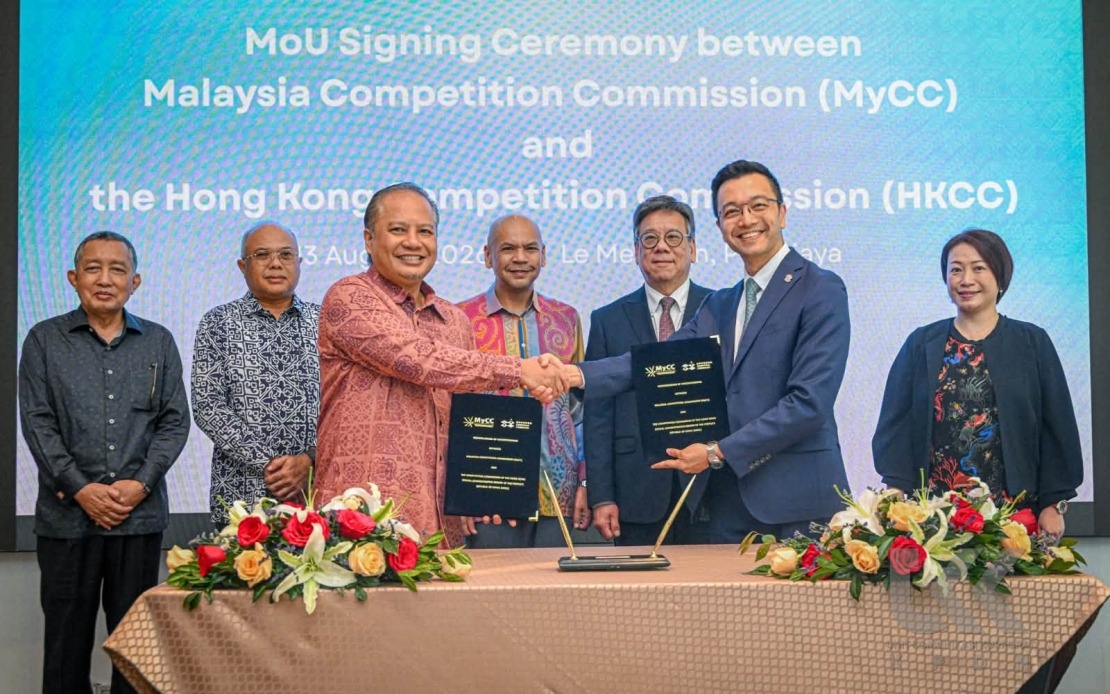
Malaysia's competition regulator has joined forces with its Hong Kong counterpart in a landmark agreement aimed at dismantling barriers to effective market enforcement across borders. The Malaysia Competition Commission (MyCC) and the Hong Kong Competition Commission (HKCC) formalised their partnership through a Memorandum of Understanding, recognising that modern competition threats increasingly transcend national boundaries and require coordinated regional responses.
Domestic Trade and Cost of Living Minister Datuk Armizan Mohd Ali framed the accord as part of Malaysia's broader strategy to position itself as a responsible market regulator within the Asian economic landscape. This agreement represents the fourth formal competition cooperation framework that MyCC has established, following earlier partnerships with regulatory bodies in Türkiye, South Korea, and the Philippines. The accumulation of these bilateral frameworks suggests a deliberate Malaysian policy direction toward deepening institutional ties with fellow competition authorities, particularly in the Asia-Pacific region where trade volumes and business interdependence continue to expand rapidly.
The strategic importance of the Malaysia-Hong Kong partnership lies in the two economies' substantial economic integration. Hong Kong serves as a major financial hub with significant influence over regional capital flows and corporate structures, while Malaysia hosts a diverse manufacturing and services sector heavily exposed to cross-border investment and supply chain arrangements. Competition violations originating from either jurisdiction can directly harm businesses and consumers in the other, creating enforcement gaps that sophisticated actors can exploit through regulatory arbitrage.
Minister Armizan emphasised that the contemporary global business environment has become sufficiently complex and interconnected that unilateral enforcement action produces limited results. When multinational corporations or cartel networks operate across multiple jurisdictions, competition authorities operating in isolation cannot access crucial evidence, establish coherent timelines, or pursue coordinated remedial actions. The MoU facilitates information sharing on legislative developments and enforcement strategies, enabling both commissions to anticipate risks and harmonise approaches where appropriate.
The agreement specifically commits both parties to exchange knowledge regarding significant amendments to competition legislation, allowing each regulator to learn from the other's experience navigating legal reforms. This intellectual capital transfer proves especially valuable for Malaysian policymakers monitoring how Hong Kong addresses emerging competition challenges in rapidly evolving sectors such as digital markets, where traditional enforcement frameworks often prove inadequate. Similarly, MyCC's experience with enforcement priorities in Southeast Asian contexts offers Hong Kong insights into managing competition issues in developing and middle-income markets.
Practical cooperation mechanisms embedded in the MoU include capacity-building initiatives designed to strengthen enforcement capabilities on both sides. Training programmes, joint workshops, and officer secondment arrangements will create opportunities for competition officials to develop specialised expertise in complex investigative techniques. These exchanges are particularly valuable for building competence in areas such as digital market surveillance, merger analysis across jurisdictions, and cartel detection methodologies that demand sophisticated analytical skills.
Cross-border competition issues represent an expanding category of enforcement challenges that neither authority can adequately address alone. Cartels operating across Asia, predatory pricing schemes coordinated between markets, and anticompetitive vertical arrangements involving supply chains spanning multiple countries all fall into this domain. By establishing bilateral protocols and demonstrating willingness to coordinate bilaterally or with other international counterparts, Malaysia and Hong Kong signal to business communities that regulatory arbitrage carries increasing risks.
The broader policy context reflects Malaysia's commitment to nurturing what Minister Armizan described as a dynamic and competitive market ecosystem. This language carries significance beyond rhetoric; it indicates governmental recognition that consumer welfare and economic growth depend fundamentally on functioning competitive markets where efficient businesses thrive and wasteful incumbents face pressure. When competition becomes distorted by cartels, monopolistic abuse, or anticompetitive mergers, the resulting deadweight losses ultimately reduce employment opportunities and income growth across the economy.
For Malaysian consumers, the practical implications include greater likelihood that imported goods from Hong Kong or involving Hong Kong-based corporations will face equivalent scrutiny to domestic suppliers, preventing anti-competitive pricing or supply discrimination. Small and medium enterprises operating across the Malaysia-Hong Kong trade corridor benefit from transparency improvements when both regulators coordinate investigation outcomes and share findings about suspicious business conduct patterns. The agreement thus represents a commitment that regulatory capture or selective enforcement will not provide competitive advantages to well-connected corporate actors.
The ministerial statement that MyCC will continue expanding such partnerships with regional and international authorities signals confidence in competition-based regulatory approaches as Malaysia engages with the wider world. This contrasts with alternative models that rely more heavily on state-owned enterprises or preferential licensing to guide industrial development. By strengthening competition institutions, Malaysia positions itself within the consensus among developed and emerging markets that competitive discipline, properly administered, outperforms discretionary state direction in delivering broad-based prosperity.
Hong Kong's participation in this arrangement reflects its own interest in maintaining stable cross-border business relationships and addressing the enforcement challenges posed by increasing economic integration with Southeast Asia. The territory's traditional role as a financial and trading hub depends partly on perceived regulatory predictability and fair treatment for market participants regardless of nationality. Formal cooperation with MyCC sends signals to multinational corporations that they cannot exploit regulatory differences between adjacent jurisdictions to circumvent competition rules.
Implementation success will depend on whether the MoU translates from symbolic commitment into tangible enforcement coordination. Early evidence will emerge through tracking whether MyCC and HKCC increase joint investigative activities, whether information sharing leads to concrete enforcement outcomes, and whether capacity-building activities produce measurable improvements in staff capabilities for handling complex cross-border cases. The agreement's durability will ultimately rest on demonstrating value to stakeholders including businesses seeking certainty and consumers benefiting from more vigorous competition.

