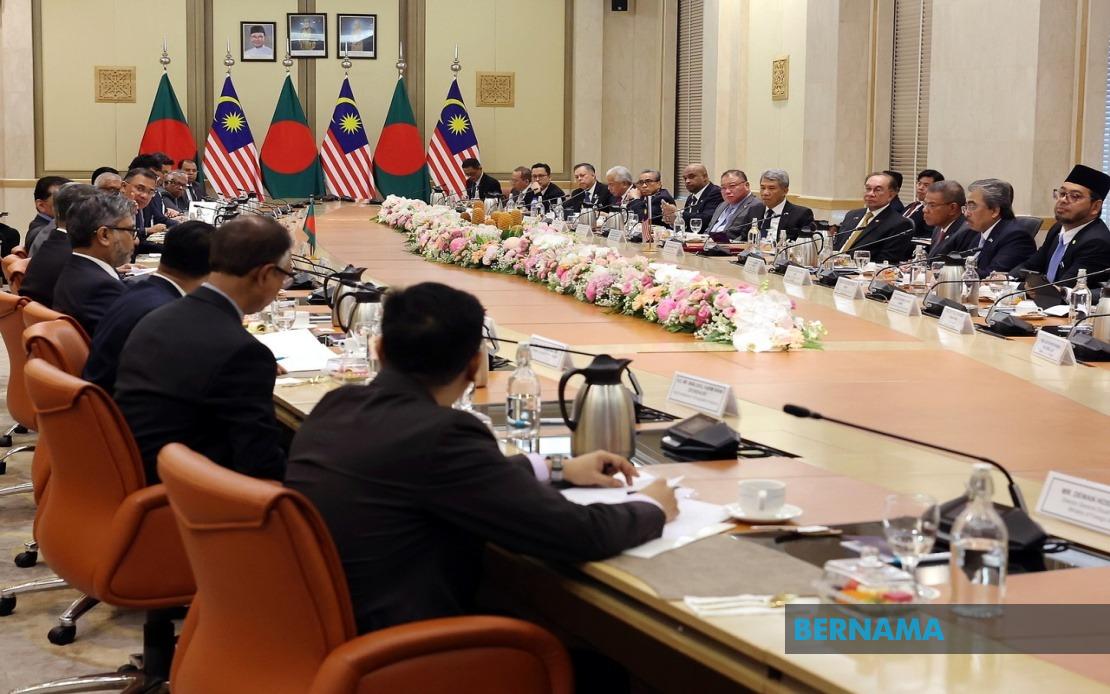
Prime Minister Datuk Seri Anwar Ibrahim has signalled that Malaysia and Bangladesh must urgently broaden their bilateral relationship into cutting-edge industries, moving beyond time-honoured agricultural trade towards a future-focused partnership spanning artificial intelligence, semiconductors, and renewable energy. Speaking at a joint press conference in Putrajaya on June 22, Anwar emphasised that while traditional investment channels remain vital, the two nations must now channel resources and expertise into emerging technologies that will define regional competitiveness over the coming decade.
The bilateral engagement took concrete form during a two-day official visit by Bangladesh Prime Minister Tarique Rahman, who joined Anwar in endorsing a framework for deeper cooperation across multiple sectors. The two leaders witnessed the formal exchange of three agreements designed to cement collaboration: a Memorandum of Understanding covering cultural ties, and two Exchanges of Notes addressing counter-terrorism research initiatives and bilateral investment promotion mechanisms. These accords serve as a foundational scaffold upon which both governments intend to construct a more ambitious technological partnership.
Anwar's articulation of the partnership's evolution reflects a broader Southeast Asian recognition that traditional sectors, whilst economically significant, can no longer serve as the sole engine of growth or regional influence. By explicitly naming artificial intelligence as a priority, Malaysia signals its intention to position itself as a serious player in the global AI race—a domain where Southeast Asian nations currently lag behind developed economies and China. Bangladesh, with its growing population and improving digital infrastructure, represents both a potential market for Malaysian technology exports and a collaborator in developing solutions tailored to South and Southeast Asian contexts.
The semiconductor sector looms particularly large in this repositioning. Malaysia already hosts significant semiconductor manufacturing facilities and has longstanding expertise in this domain, but regional cooperation could unlock supply-chain efficiencies and facilitate knowledge transfer to Bangladesh's emerging industrial base. By anchoring semiconductor development as a bilateral priority, both nations implicitly acknowledge that over-reliance on Western and Chinese semiconductor suppliers poses strategic vulnerabilities—a lesson reinforced by recent global supply-chain disruptions. A Malaysia-Bangladesh semiconductor partnership could eventually contribute to broader regional self-sufficiency and technological sovereignty.
Energy cooperation carries equally weighty implications. Bangladesh faces mounting electricity demand as industrialisation accelerates, whilst Malaysia possesses both renewable energy expertise and liquefied natural gas infrastructure. Collaborative projects in solar, wind, and hydrogen technologies could position the two nations as pioneers in Southeast Asian clean energy transitions, whilst simultaneously addressing climate commitments outlined in regional frameworks. Such partnerships also offer commercial opportunities for Malaysian companies seeking to expand their renewable energy portfolios across the Indian subcontinent.
The emphasis on advanced manufacturing alongside these emerging sectors indicates a sophisticated understanding that AI, semiconductors, and energy technologies require an industrial base capable of producing not merely raw components but integrated, sophisticated products. Malaysia's existing manufacturing ecosystem, combined with Bangladesh's labour advantages and growing technical capacity, creates conditions favourable for establishing competitive manufacturing hubs that could serve regional and global markets. This aligns with evolving strategies across Southeast Asia to capture higher-value-added segments of global supply chains.
Cultural cooperation, whilst appearing secondary to commercial and technological initiatives, carries strategic weight in Southeast Asian geopolitics. Enhanced cultural ties build people-to-people connections that support trade and investment flows, whilst also providing a foundation for diplomatic collaboration on regional security matters. The counter-terrorism research component of the bilateral agreements reflects shared concerns about extremism and transnational security threats—issues that remain salient across South and Southeast Asia despite varying manifestations in each context.
The investment promotion and facilitation framework suggests both governments recognise that legal clarity and institutional support mechanisms significantly influence capital flows. By formalising processes for bilateral investment, Malaysia and Bangladesh create conditions that encourage private sector participation in the priority sectors identified. Malaysian companies seeking regional expansion may view Bangladesh as an increasingly attractive destination, whilst Bangladeshi enterprises gain clearer pathways to Malaysian markets and partnerships.
For Malaysian policymakers, the Bangladesh engagement reflects a deliberate strategy of deepening ties with South Asian economies whilst maintaining traditional partnerships with Asean neighbours. Bangladesh's position as a bridge between South and Southeast Asia, combined with its significant population and economic growth trajectory, makes it strategically valuable. Similarly, Bangladesh gains access to Malaysian expertise in areas where the country aspires to develop capabilities—particularly in technology sectors where Malaysia has established competitive advantages.
The bilateral framework also carries implications for regional technology governance. As AI and semiconductors become increasingly subject to geopolitical competition between major powers, Southeast Asian nations that develop their own technical capabilities and maintain diversified partnerships can better navigate emerging constraints. A Malaysia-Bangladesh partnership in these domains, should it yield tangible collaborations, could provide a model for other intra-regional partnerships that build technological resilience.
Looking forward, the success of these cooperation agreements will depend on translating high-level political commitments into concrete institutional mechanisms, funding channels, and personnel exchanges. Both governments must identify specific projects that promise commercial viability whilst advancing shared technological objectives. Research institutions, semiconductor manufacturers, and renewable energy firms in both countries will prove crucial in operationalising the framework established through the bilateral agreements.
The timing of this partnership expansion also reflects evolving global dynamics. As Western nations and China compete intensively across technology sectors, countries like Malaysia and Bangladesh occupy a middle ground where strategic autonomy and non-aligned technology partnerships become increasingly valuable. By collaborating rather than choosing exclusive alignment with external powers, both nations preserve flexibility whilst building complementary capabilities that serve their respective development aspirations and regional influence objectives.