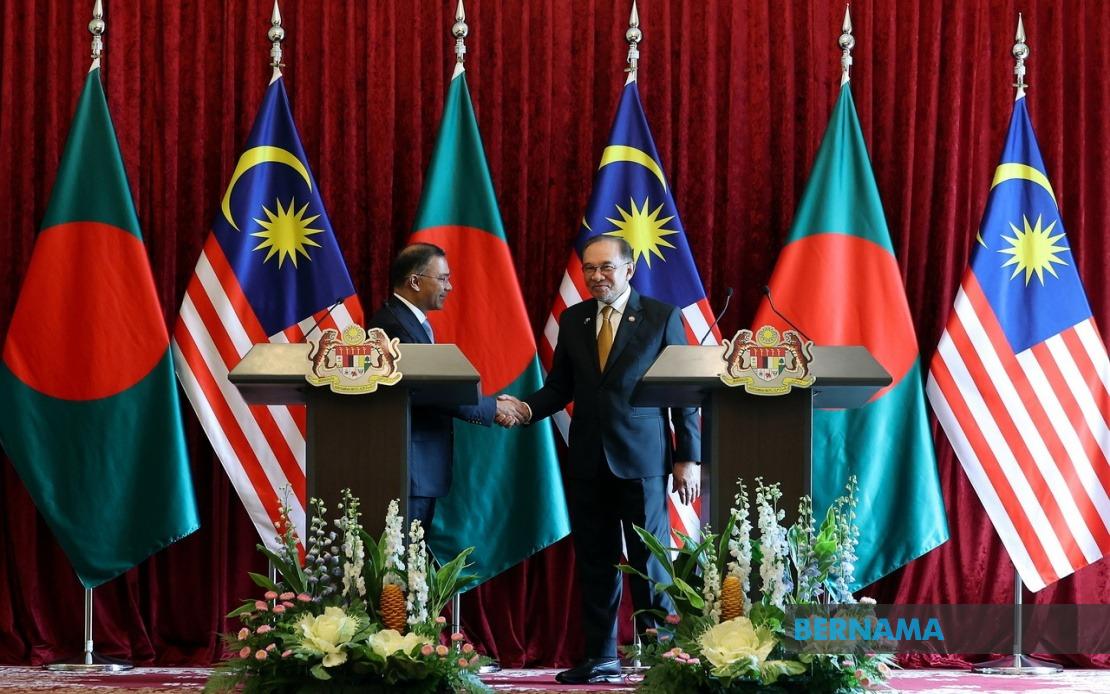
Malaysia and Bangladesh have resolved to move beyond symbolic ties and activate comprehensive defence cooperation frameworks during an official visit to Putrajaya by Bangladesh Prime Minister Tarique Rahman. Prime Minister Datuk Seri Anwar Ibrahim and his Bangladeshi counterpart jointly committed to operationalising the Memorandum of Understanding on Defence Cooperation, a document that has long remained largely latent despite decades of diplomatic engagement between the two nations. This shift toward genuine implementation signals a recognition by both governments that regional security challenges and shared strategic interests demand more than ceremonial military exchanges.
The foundation for this partnership already exists in tangible form. Malaysian and Bangladeshi defence establishments have maintained consistent contact through high-level military delegations, structured personnel training initiatives, and regular goodwill naval port calls that demonstrate established channels of communication. However, the joint statement emphasises that these existing mechanisms, while valuable, require formalisation and expansion through the activation of institutional frameworks that have remained dormant. The commitment to operationalise the MoU represents an acknowledgment that ad-hoc cooperation, though useful, cannot adequately address the sophistication of modern security threats or facilitate the systematic knowledge transfer that both nations increasingly require.
The leaders identified military science and technical expertise as primary collaboration pillars, a recognition that developing nations face distinct capacity gaps in defence modernisation. By anchoring partnerships in these domains rather than merely in hardware purchases or military sales, Malaysia and Bangladesh position themselves to build indigenous capabilities and reduce long-term dependency on external suppliers. The inclusion of defence industry partnerships within the cooperation framework opens possibilities for joint manufacturing ventures, technology adaptation, and export-oriented defence production that could benefit both economies while strengthening bilateral security ties.
Central to the expanded framework is the planned convening of the bilateral Joint Committee on Defence Cooperation, which will serve as the institutional mechanism for charting a structured defence roadmap. This committee-based approach contrasts with previous ad-hoc arrangements and introduces systematic planning horizons spanning multiple years. Such formal structures enable both nations to align defence priorities, identify capability gaps, and allocate resources strategically rather than responding to immediate crises or diplomatic gestures. The roadmap approach also allows for regular review cycles and course correction, essential features for long-term strategic cooperation in an unpredictable geopolitical environment.
Educational collaboration has emerged as a cornerstone of the partnership expansion. Both leaders stressed the importance of mutual seat allocations at each other's National Defence Colleges and Command and Staff Colleges, institutions that shape strategic thinking and develop future military and civilian leadership. These educational exchanges carry significance beyond simple personnel training; they build interpersonal networks among military and defence policy officials who will shape bilateral relations for decades. Officers who study together develop shared conceptual frameworks and professional relationships that ease coordination during crises and facilitate informal communication channels when formal diplomatic pathways become constrained.
United Nations peacekeeping operations represent another critical collaboration domain, reflecting both nations' commitment to multilateral security frameworks and their desire to enhance operational effectiveness. The commitment to joint tactical exercises, pre-deployment training collaboration, and expertise exchange acknowledges that peacekeeping environments demand interoperability and shared understanding of operational procedures. For Malaysia, with its established history of peacekeeping contributions across Africa and the Middle East, the opportunity to conduct joint pre-deployment training with Bangladesh forces optimises the effectiveness of both nations' contributions to UN mandates. Bangladesh, as the world's largest troop contributor to UN peacekeeping operations, brings operational experience and institutional knowledge that Malaysian forces can draw upon.
Counterterrorism and violent extremism prevention constitute an increasingly urgent mutual concern, particularly given both nations' experience with maritime security challenges and transnational militant networks operating across South and Southeast Asia. The commitment to intelligence sharing and information exchange moves beyond theoretical cooperation into operational domains where real-time communication and trust become critical. Both nations face terrorism financing networks, recruitment pipelines, and ideological propagation mechanisms that traverse the Indian Ocean and maritime corridors connecting them. Capacity-building initiatives and training programmes addressing these asymmetric threats require genuine operational partnership rather than symbolic gestures.
The educational cooperation extends beyond defence to encompass broader academic partnerships, with particular emphasis on technical and vocational education training. The recognition of approximately 11,000 Bangladeshi students currently studying in Malaysia underscores the significant human capital flows between the two nations. These students represent not merely academic exchanges but potential vectors for long-term bilateral relationships, as many will return to Bangladesh to occupy professional and leadership positions. The agreement to expand mutually recognised qualifications and joint degree programmes acknowledges that human capital mobility, when managed through structured frameworks, generates sustained economic and cultural benefits for both societies.
Labour market alignment and skills development feature prominently in the educational framework, reflecting a pragmatic understanding that academic cooperation must ultimately serve economic competitiveness. By aligning training programmes with priority sectors identified by both governments, Malaysia and Bangladesh increase the likelihood that educational investments yield employment pathways and productive integration into both economies. Graduate mobility arrangements recognise the reality that talent flows across borders; structured frameworks facilitate this movement while enabling both nations to benefit from skills development investments.
Tourism cooperation has been positioned within the context of Malaysia's 'Visit Malaysia 2026' and 'Malaysia Year of Medical Tourism 2026' campaigns, connecting bilateral relations to domestic economic objectives. The extension of warm welcomes to Bangladeshi travellers and commitments to enhanced tourism promotion serve multiple functions: they generate foreign currency, increase cultural understanding, and strengthen people-to-people connections that transcend official diplomacy. Medical tourism particularly resonates given Malaysia's established reputation as a regional healthcare hub; Bangladeshi patients and medical professionals benefit from exposure to Malaysian facilities and expertise, creating enduring connections that extend beyond tourism into professional networks.
The timing of this cooperation expansion reflects broader geopolitical dynamics reshaping South and Southeast Asian strategic priorities. Both nations face evolving security challenges from maritime threats, transnational crime networks, and climate-induced displacement patterns that demand regional cooperation frameworks. By activating dormant cooperation mechanisms and introducing systematic institutional structures, Malaysia and Bangladesh position themselves to address these challenges collectively rather than in isolation. The expansion also signals to other regional powers that South Asian and Southeast Asian nations are building their own cooperative architectures rather than depending solely on great power frameworks for security provision.
For Malaysia specifically, deepening defence partnerships with Bangladesh enhances strategic depth in the Indian Ocean region and diversifies security relationships beyond traditional partners. Bangladesh's strategic location controlling the northern Bay of Bengal approaches, combined with its growing defence capabilities and UN peacekeeping experience, offers Malaysia valuable partnership opportunities. Conversely, Bangladesh benefits from access to Malaysian defence technological capabilities, maritime security expertise developed through decades of regional engagement, and opportunities to learn from Malaysian experiences in managing diverse populations and complex maritime boundaries. The mutual benefits structure suggests the partnership has genuine substance rather than existing primarily for diplomatic convenience.