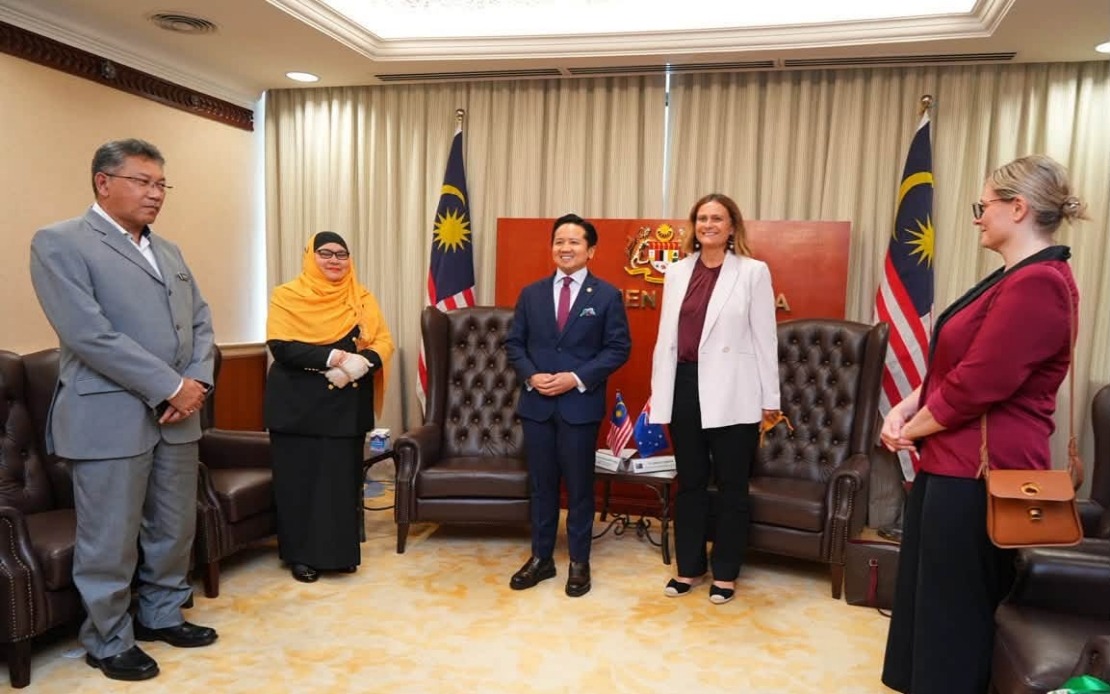
Malaysia and Australia have signalled their intention to forge stronger ties in the rare earth elements and critical minerals sectors, with particular emphasis on building indigenous capacity for neodymium magnet production. The commitment emerged from discussions between Natural Resources and Environmental Sustainability Minister Datuk Seri Arthur Joseph Kurup and Australian High Commissioner to Malaysia Danielle Heinecke at Parliament in Putrajaya, reflecting both nations' recognition that collaborating on this strategic industry could unlock significant economic and technological benefits for the region.
The proposed partnership represents a natural alignment of complementary strengths. Australia brings established technical expertise and proven capabilities in critical minerals extraction and processing, areas where the country has positioned itself as a global leader through decades of mining operations and research investment. Malaysia, meanwhile, possesses the manufacturing infrastructure, downstream processing experience, and strategic geographic location to develop a competitive value chain spanning midstream to downstream activities. This combination has the potential to create a resilient supply network for rare earth materials in Southeast Asia, reducing regional dependence on Far Eastern suppliers and diversifying global sourcing.
Central to the cooperation framework is Malaysia's commitment to realising its National Mineral Policy 3, an ambitious roadmap designed to transform the nation's mineral sector through value-addition and sustainable development practices. Rather than limiting itself to raw material extraction, Malaysia seeks to establish comprehensive processing and manufacturing capabilities that capture greater economic value domestically. The development of neodymium magnet manufacturing exemplifies this strategy, as magnets derived from rare earth elements are critical components in electric vehicle motors, renewable energy systems, and advanced manufacturing—all sectors experiencing explosive global demand.
The two countries will prioritise exchanging technical knowledge on managing rare earth processing residues, particularly the complex challenge of neutralisation underflow residue, or NUF. This waste stream represents both an environmental liability and a potential resource if properly managed and treated. By sharing best practices in residue handling, both nations can develop cleaner, more efficient production pathways that align with contemporary environmental standards and corporate sustainability commitments. Such collaboration could position Malaysia as a model for responsible rare earth processing in a region where environmental concerns over mining operations remain a sensitive policy consideration.
Beyond minerals alone, the bilateral agenda extends into complementary areas that reflect contemporary global concerns. Both governments acknowledged the importance of hazardous waste management protocols, a particularly relevant focus given Malaysia's experience with industrial development and Australia's strict environmental regulations. Marine ecosystem conservation also featured prominently, reflecting shared responsibility for Indo-Pacific waters and recognition that extractive industries must operate within ecological boundaries. These discussions signal that the Malaysia-Australia partnership on critical minerals is being framed not as an industrial-first agenda but as one consciously embedding environmental stewardship from inception.
Climate financing and Malaysia's involvement in the upcoming United Nations Climate Change Conference, COP31, emerged as cross-cutting themes. This framing is instructive: by anchoring critical minerals cooperation within climate and sustainability narratives, both governments are positioning rare earth development not as a carbon-intensive extraction play but as enabling infrastructure for global decarbonisation. Neodymium magnets power wind turbines and electric motors; rare earth processing using renewable energy becomes part of the climate solution narrative rather than remaining a marginal environmental concern.
The cooperation framework operates under the Malaysia-Australia Comprehensive Strategic Partnership, a mechanism established in 2021 that provides institutional scaffolding for deepening engagement across multiple sectors simultaneously. This broader partnership context matters strategically, as it signals that rare earth and critical minerals cooperation is not an isolated commercial arrangement but rather one component of a wider relationship renewal. For Malaysia, formalising ties with Australia on strategic materials also subtly diversifies its international technology and investment partnerships, providing an alternative axis to existing relationships in the critical minerals space.
For Southeast Asia more broadly, this bilateral initiative carries regional implications. Should Malaysia successfully develop domestic neodymium magnet manufacturing capacity in partnership with Australian expertise, the achievement could catalyse similar initiatives throughout the region. Countries like Thailand, Indonesia, and Vietnam would face increased pressure to develop their own value-added mineral processing capabilities rather than remaining passive suppliers of raw materials. A more integrated Southeast Asian critical minerals ecosystem could emerge, with different nations specialising in different segments of the value chain, ultimately strengthening the region's bargaining position in global supply networks.
The timing of this initiative aligns with global supply chain anxieties following years of semiconductor shortages and geopolitical tensions affecting critical material flows. Western nations, Japan, and South Korea have all intensified efforts to diversify rare earth sourcing away from concentrated dependencies. Malaysia's geographic proximity to major manufacturing hubs in East and Southeast Asia, combined with its existing industrial infrastructure and technical workforce, positions it as a strategically valuable location for downstream rare earth processing and magnet manufacturing. For Australia, anchoring material flows through a trusted regional partner also provides supply security benefits.
From an investment perspective, the initiative may signal Malaysia's openness to capital inflows in the critical minerals value chain, an important consideration given the sector's capital intensity. Australian companies and institutional investors may view this statement of intent as a green light for exploratory investments in Malaysian rare earth processing facilities and magnet manufacturing plants. The explicit mention of both nations' commitment to sustainable resource management could also attract ESG-conscious investors seeking exposure to responsibly produced critical minerals—a growing market segment as institutional investors incorporate climate and social governance criteria into allocation decisions.
The discussions also implicitly acknowledge that manufacturing competitiveness increasingly depends on securing reliable supplies of strategic inputs. Rather than competing for the same limited pools of rare earth materials, Malaysia and Australia are exploring how they can construct an integrated supply relationship that benefits both economies. This cooperation model—distinct from traditional resource extraction partnerships where one nation extracts and another processes elsewhere—reflects evolving thinking about how resource-rich developing and developed nations can collaborate to create durable competitive advantages in globalised manufacturing sectors.

