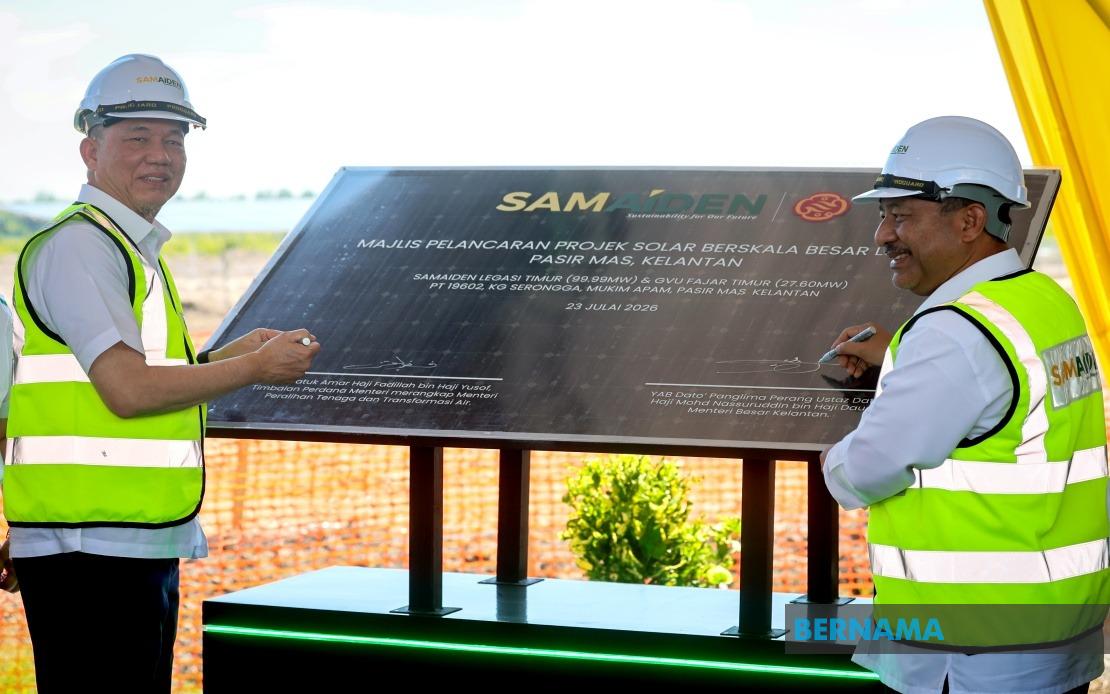
Malaysia's renewable energy sector is gaining momentum, with installed capacity reaching nearly 32 per cent as of June, signalling that the nation remains positioned to achieve its 2030 target of 35 per cent. Deputy Prime Minister Datuk Seri Fadillah Yusof, who also serves as Minister of Energy Transition and Water Transformation, disclosed the figure during the launch of the Large-Scale Solar Project (LSS5) in Pasir Mas, Kelantan, underscoring the government's commitment to systematic progress in reshaping the country's energy landscape.
The trajectory reflects consistent advancement under Malaysia's National Energy Transition Roadmap, a comprehensive policy framework designed to steer the nation towards a lower-carbon energy future. The government had already surpassed an earlier milestone by December 2025, achieving 31 per cent renewable energy installed capacity. With subsequent targets set at 35 per cent by 2030 and an ambitious 70 per cent by 2050, the roadmap establishes a clear progression that balances near-term feasibility with long-term climate commitments. This structured approach distinguishes Malaysia's energy transition as a deliberate, phased strategy rather than a reactive adjustment to global pressures.
Fadillah articulated that energy transition represents far more than an environmental preference; it constitutes a fundamental strategic requirement for Malaysia's future. The Deputy Prime Minister framed the shift as essential for safeguarding the nation's energy security, bolstering economic resilience in an increasingly competitive global market, and attracting high-calibre foreign investment. Simultaneously, Malaysia seeks to honour its international climate commitments, positioning itself as a responsible player in global environmental governance. This multi-dimensional rationale demonstrates how energy policy intersects with broader national development agendas, particularly relevant for Southeast Asian nations navigating similar pressures.
Central to the government's approach is a commitment to balance, ensuring that Malaysia's energy transition does not compromise affordability or reliability. Officials stress that renewable expansion must coexist with mechanisms guaranteeing cost-effective electricity for households and industries, while maintaining grid stability. This triangulated objective—addressing energy security, affordability, and sustainability simultaneously—reflects practical acknowledgement that purely idealistic targets prove politically unsustainable in developing economies where price sensitivity remains high. For Malaysian consumers and businesses, this signals that tariff increases accompanying renewable deployment should remain measured, though long-term pricing dynamics remain uncertain.
The LSS5 project in Kelantan exemplifies private-sector engagement in this transition. The initiative, located in Kampung Serongga, demonstrates investor confidence in Malaysia's renewable energy policies and regulatory environment. Such large-scale projects require substantial upfront capital and multi-year operational commitments, making them sensitive indicators of business confidence. The fact that developers are willing to invest in Malaysian solar infrastructure suggests that policy certainty and financial frameworks have achieved sufficient maturity to attract competitive bidding. For the broader region, Malaysia's success in leveraging private investment for renewable projects offers an instructive model, particularly for neighbouring countries pursuing similar energy goals.
Kelantan's emergence as a renewable energy destination carries particular significance for a state historically reliant on agricultural and light industrial sectors. The Menteri Besar, Datuk Mohd Nassuruddin Daud, characterised LSS5 as a benchmark project that could catalyse further sustainable investments in the state. Kelantan possesses considerable advantages for solar deployment: vast tracts of suitable land, receptive state government backing, and increasingly active private-sector participation. If properly leveraged, these assets could diversify Kelantan's economic base, reducing vulnerability to commodity price fluctuations and creating employment in high-skill installation, maintenance, and grid-management roles. The state's positioning of renewable energy as a development tool reflects a broader regional recognition that green energy and economic growth are complementary rather than competing objectives.
Beyond large-scale utility projects, the government is promoting distributed solar adoption through initiatives like the Solar ATAP Programme, which encourages rooftop installations across residential, commercial, and institutional properties. This two-pronged strategy—combining utility-scale projects with distributed generation—distributes renewable energy benefits more equitably and builds local ownership of the energy transition. Mosques, temples, and other community spaces becoming solar generators transforms these institutions into contributors to national energy security while demonstrating tangible commitment to sustainability at the grassroots level. For property owners, such programmes reduce long-term electricity costs, though initial investment barriers and technical literacy remain limiting factors in uptake rates.
The employment and economic dimensions of Malaysia's renewable energy expansion merit close attention. Large-scale solar projects generate temporary construction jobs and permanent roles in operations and maintenance. Moreover, growth in renewable energy stimulates supporting industries: equipment manufacturing, installation services, grid modernisation, and energy storage technologies. These sectors offer higher-value employment than traditional resource extraction, aligning with Malaysia's long-standing aspiration to move up the economic value chain. Regional competition for renewable energy jobs is intensifying, however, as neighbouring countries pursue similar strategies. Malaysia's ability to retain talent and foster innovation in clean energy will depend on sustained investment in skills development and research infrastructure.
The achievement of 32 per cent renewable capacity, while substantial, still leaves Malaysia considerably reliant on conventional power sources. The remaining 68 per cent—predominantly natural gas and coal—continues to define the nation's energy mix. Transitioning this large share within eight years requires sustained investment, technological advancement, and operational flexibility. Grid integration challenges become increasingly acute as renewable penetration rises; variable generation from solar and wind resources demands either energy storage solutions, demand-management systems, or backup generation capacity. Malaysia's infrastructure development trajectory will determine whether renewable targets prove achievable without recourse to prohibitively expensive backup mechanisms.
International climate commitments underpin Malaysia's renewable targets, but domestic economic calculus ultimately determines implementation success. The government's framing of energy transition as compatible with cost affordability signals recognition that Malaysians require tangible assurance that environmental progress will not translate into household hardship. This political constraint shapes policy design: subsidies may persist for disadvantaged consumers, industrial tariffs must remain competitive to prevent manufacturing migration, and rate-of-return expectations for renewable investors must be realistic. Balancing these competing demands while achieving 35 per cent renewable capacity by 2030 demands sophisticated policy architecture and flexibility in implementation timelines if unforeseen obstacles emerge.
Looking ahead, Malaysia's renewable energy trajectory carries implications beyond domestic borders. As a regional economic powerhouse and ASEAN member, Malaysia's success or failure in energy transition influences regional investors' confidence in Southeast Asian climate commitments. Conversely, neighbouring nations' progress in renewable deployment may create competitive pressures that accelerate Malaysia's transition. The region's collective movement towards cleaner energy could eventually reshape regional electricity trade and industrial competitiveness, with early movers potentially capturing advantages in attracting green-focused foreign direct investment. For Malaysian policymakers, this suggests that energy transition must be understood not merely as environmental compliance but as a competitive positioning exercise with substantial economic stakes.

