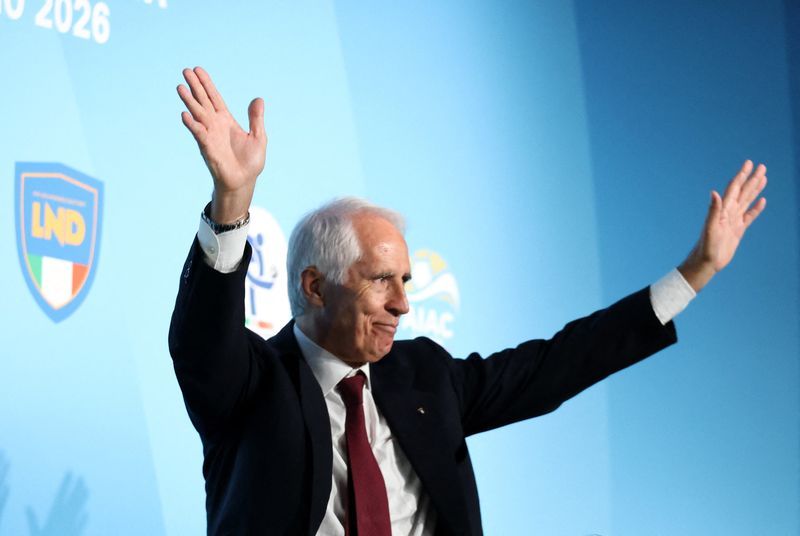
Giovanni Malago has assumed control of Italian football at perhaps its lowest point in four decades, winning election as president of the Italian Football Federation on Monday with a commanding 68.58 per cent vote at the federation assembly in Rome. The 67-year-old businessman and former futsal player faces the considerable task of steering the four-time World Cup champions out of their deepest malaise following April's devastating playoff loss to Bosnia & Herzegovina that extended Italy's World Cup qualification drought to three consecutive tournaments.
Malago arrives at the federation after successfully overseeing Milan's hosting of the Winter Olympics this February, an assignment that garnered widespread recognition for its organizational competence. His election represents a significant shift in direction for Italian football governance, as he replaces Gabriele Gravina, who resigned in the aftermath of the World Cup qualification disaster that prompted fierce backlash from supporters and politicians alike. The timing of Gravina's departure reflected the magnitude of the national humiliation—a team with Italy's pedigree and resources failing to secure a place at sport's grandest tournament for the third time running.
The broader context of Italy's football collapse extends far beyond the failed World Cup qualification. The country's elite clubs have also exited European competitions, leaving the entire Italian football ecosystem in unprecedented distress. This dual collapse at both international and continental club level suggests systemic failures rather than isolated disappointments, pointing to deep structural problems within the federation's competitive ecosystem and player development infrastructure. For Italian football observers and fans accustomed to the nation's traditional standing among Europe's elite, the sight of no Italian representatives in major continental tournaments represented a particularly bitter pill.
In his first public statements following the election victory, Malago acknowledged the weight of expectation while attempting to project confidence. He articulated a vision extending beyond mere administration, positioning the federation as a source of inspiration for Italian football. His rhetoric emphasized the need to transform historical achievement into motivation rather than allowing it to become an anchor dragging the sport backward. This philosophical approach suggests Malago intends to break with the past rather than attempt a nostalgic restoration, a necessary posture given that traditional models have manifestly failed to produce results in recent years.
The incoming federation leader must immediately address several critical challenges that will define his tenure. His most pressing appointment involves selecting a new men's national team coach following Gennaro Gattuso's resignation after the playoff defeat. This role carries enormous symbolic weight in Italian football culture, as the national team coach serves as the public face of the federation's overall direction. Beyond this headline-grabbing hire, Malago must undertake a comprehensive overhaul of youth development systems—a weakness repeatedly identified by football figures including legendary striker Roberto Baggio, who has warned that Italy's talent cultivation mechanisms have become inadequate for the modern game.
The federation will also need to coordinate preparations for the 2032 European Championship, which Italy will co-host alongside Turkey. This tournament presents both opportunity and urgency; it provides a relatively near-term target for rebuilding credibility while also offering the home advantage that could prove crucial for a team in transitional phase. Successfully organizing and competing in a continental championship on home soil could represent a meaningful first step toward restoring Italian football's international standing. For Southeast Asian observers, this context illustrates how even football powerhouses face genuine vulnerability when structural weaknesses accumulate unchecked.
Malago's appointment also carries significance beyond Italy's borders, particularly for European football's broader competitive balance. Italy's struggles represent an opening for other nations to consolidate continental dominance, while the federation's recovery efforts will be closely monitored by other traditional powers evaluating their own organizational models. The federation must balance continuity with innovation, maintaining Italian football's tactical traditions and technical emphasis while adopting modern development methodologies that have emerged from successful programs globally.
Former federation president Gravina, who led the organization since 2018, offered a somewhat rueful assessment as he departed. His admission that he should have stepped down earlier underscores the difficulty of recognizing when leadership transitions become necessary in sports governance. Gravina's tenure had witnessed both triumph—Italy's victory at Euro 2020—and catastrophe, a polarization that ultimately proved unsustainable. His successor inherits not merely the debris of failed qualification campaigns but also the need to establish credibility quickly in an environment where patience has worn dangerously thin.
The federation's internal unity represents another critical consideration for Malago. His election victory, while decisive, occurred within an organization that had been fractured by repeated sporting disasters. The new president's call for cooperation and collective action suggests awareness that rebuilding credibility requires consensus-building alongside substantive reform. Italian football's hierarchical structures and regional club rivalries have historically complicated federation-level coordination, creating governance challenges that extend beyond conventional sports administration.
For Malaysian and Southeast Asian readers observing these developments, Italy's predicament offers instructive lessons regarding the vulnerability of established sports powers. Despite generations of football heritage and infrastructure advantages, Italy's failure to adapt modern competitive requirements with adequate speed created a qualitative gap that recent results have painfully exposed. The federation's recovery will depend not on revisiting past glories but on whether Malago can successfully implement contemporary best practices while preserving the technical and tactical advantages that historically distinguished Italian football.