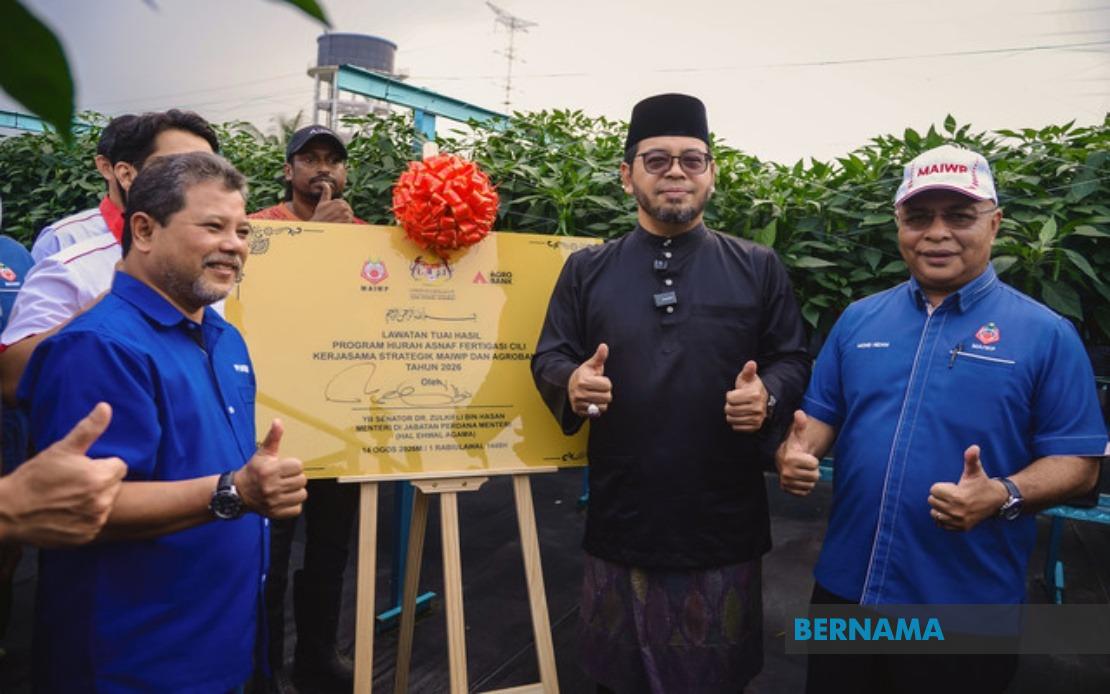
Malaysia's Islamic Development and Welfare Foundation (MAIWP) is scaling up its high-tech chilli farming initiative for asnaf participants, building on the remarkable success of its initial cultivation phase. The expansion to five acres demonstrates growing confidence in the fertigation-based model, which uses precision irrigation to deliver nutrients directly to plant roots—a technique that maximises yields while conserving water and reducing labour demands.
The first harvest from the pilot phase yielded an impressive 16.7 tonnes of chillies, generating returns that exceeded RM207,000 for participating asnaf farmers. This productivity level underscores how modern agricultural technology can transform subsistence farming into a viable income stream for disadvantaged groups. Minister in the Prime Minister's Department (Religious Affairs) Dr Zulkifli Hasan emphasised that the programme's outstanding results validated the strategic decision to equip asnaf communities with both technical knowledge and capital-intensive infrastructure typically reserved for commercial operations.
What distinguishes this initiative is its dual focus on production and value creation. Beyond simply cultivating raw chillies, MAIWP has designed the programme to empower participants to venture into downstream activities—producing chilli pastes, dried chilli products, and specialised sauces intended for retail and commercial markets. This value-addition approach significantly multiplies profit margins and creates employment opportunities within the community itself, transforming farming from a primary sector activity into an agribusiness enterprise.
The human impact of the scheme is evident in the experiences of individual participants. Alinda Rosely, a 49-year-old single mother, described how the programme fundamentally altered her economic trajectory. She credited the practical knowledge in fertigation techniques with enabling her to rebuild her financial independence after years of economic vulnerability. During a particularly favourable market period last year, she earned RM40,000 within six months—an income level that would be unattainable through conventional informal employment or subsistence farming, illustrating how skills-based interventions can achieve transformative outcomes.
The timing of this expansion reflects broader strategic objectives within Malaysia's Islamic financing and welfare ecosystem. MAIWP's mission centres on cultivating economically self-reliant and internationally competitive asnaf communities, recognising that sustainable poverty alleviation requires income generation rather than perpetual assistance. The chilli fertigation model aligns with this philosophy by combining immediate income opportunities with skills transfer and technological capability-building that benefits participants across multiple projects and career transitions.
The scale of MAIWP's broader welfare operations contextualises this agricultural initiative within a much larger institutional framework. As of August 12, 2026, the organisation had distributed RM699.57 million in zakat funds through 38 distinct welfare assistance schemes, serving as the primary institutional mechanism for channelling Islamic charitable obligations toward disadvantaged populations. The chilli project represents a comparatively labour-intensive but potentially highly rewarding subset of MAIWP's overall portfolio, demonstrating how targeted sectoral interventions can achieve outsized returns on invested capital.
Fertigation technology adoption in Malaysia has historically been limited to large-scale commercial horticultural producers, with high capital costs and technical expertise requirements creating barriers for small-scale and marginalised farmers. By deploying this technology among asnaf communities through MAIWP, the programme effectively democratises access to productivity-enhancing tools while simultaneously addressing skills deficits that have historically constrained agricultural competitiveness among disadvantaged groups. This technology transfer represents a significant institutional innovation in how zakat resources are deployed.
The five-acre expansion will necessitate recruiting and training additional cohorts of asnaf farmers, scaling the institutional capacity for technical support, input procurement, and harvest marketing. This growth phase presents opportunities to refine operational protocols and identify bottlenecks in the supply chain, potentially yielding insights valuable for future agricultural initiatives targeting the asnaf segment. The experience accumulated during pilot and expansion phases can inform policy discussions around agricultural development and Islamic financing mechanisms more broadly.
Market conditions for chilli production in Southeast Asia remain favourable given sustained regional demand for fresh and processed chilli products across food manufacturing, hospitality, and retail sectors. Malaysian consumers' preference for locally-produced chillies, combined with export opportunities to Singapore, Brunei, and increasingly to regional ASEAN partners, provides reasonably stable demand for quality produce. This favourable market environment suggests that expansion beyond five acres may be feasible if current productivity levels and market prices remain stable.
The programme's expansion also carries implications for rural development policy and asnaf community engagement more broadly. By demonstrating that technological modernisation and structured market integration can generate substantial income for economically disadvantaged groups, MAIWP is building a replicable model that could influence how other Islamic development institutions approach poverty alleviation. The success metrics achieved thus far—particularly the high per-hectare yields and participant income levels—suggest that sectoral agricultural intensification may represent an underutilised pathway within Malaysia's broader social safety net architecture.

