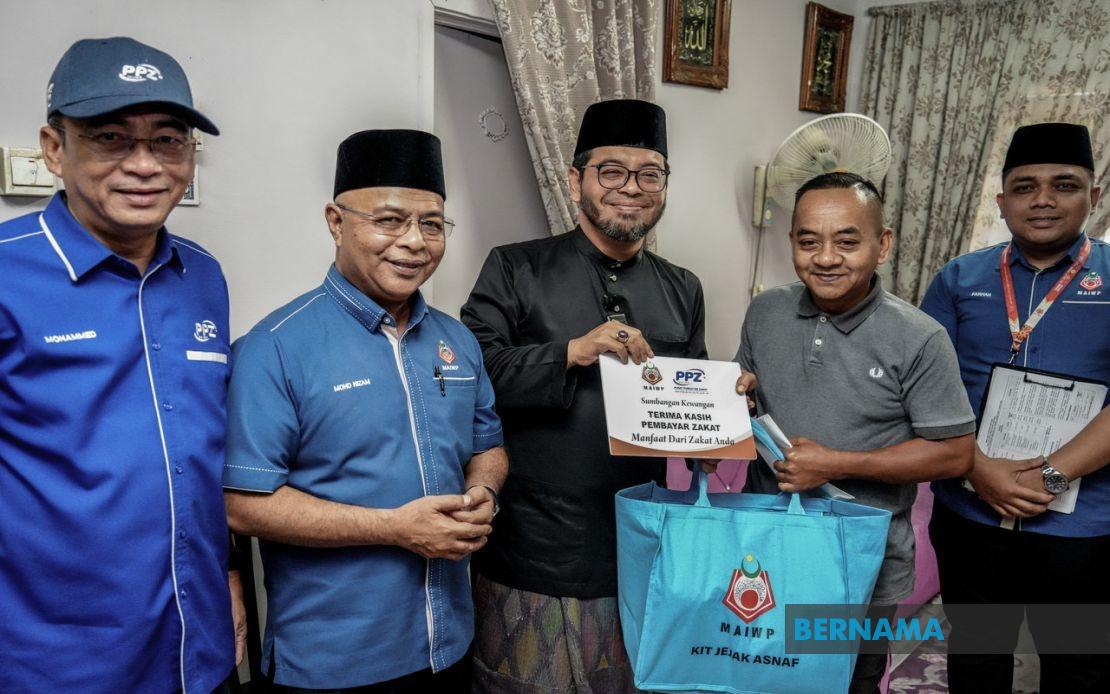
The Federal Territories Islamic Religious Council (MAIWP) has initiated a comprehensive support initiative targeting households in acute financial distress, with a recent field visit by government officials highlighting the organisation's commitment to direct engagement with beneficiaries. A widow currently caring for five children aged between six and fifteen has become the focal point of this assistance drive following her husband's death in early August, receiving coordinated support covering monthly living costs, residential rent, and educational expenses for all her dependents. This case exemplifies how Malaysia's Islamic welfare apparatus is adapting its delivery mechanisms to address the compound vulnerabilities facing single-income households that have experienced sudden economic shocks.
Datak Dr Zulkifli Hasan, the Minister in the Prime Minister's Department overseeing Religious Affairs, emphasised during a press briefing that direct community engagement represents a cornerstone principle in MAIWP's operational strategy. By conducting field assessments rather than relying solely on administrative applications, the council gains genuine insight into family circumstances, hardship patterns, and the specific nature of financial obligations that recipients struggle to manage. This ground-level verification approach reduces the risk of misallocated resources while building institutional knowledge about emerging poverty dynamics within the Federal Territories. The minister's advocacy for this methodology reflects broader recognition within Malaysia's welfare ecosystem that paper-based assessments often fail to capture the lived reality of vulnerable populations navigating intersecting challenges simultaneously.
Beyond the widow's case, MAIWP's outreach encompasses a diverse range of household structures requiring targeted intervention. A family comprising a married couple and eight school-age children received attention during the same visit, with the father employed as a driver for Kuala Lumpur City Hall while his wife manages full-time domestic responsibilities. This family's situation illustrates how formal employment alone frequently proves insufficient to meet the threshold expenses of larger households, particularly when educational, health, and basic nutrition costs accumulate. The household currently receives monthly medical assistance encompassing childcare essentials and diabetes management supplies, while MAIWP has also facilitated wheelchair provision and ongoing educational support, demonstrating how assistance packages must be customised to address specific health vulnerabilities rather than applying uniform templates across all recipients.
The council's interventions extend to single mothers navigating protracted vulnerability following family dissolution. One beneficiary family identified during the visitation comprises a divorced mother raising three school-age children since 2018, receiving regular cost-of-living allowances, basic necessities provisions, and targeted educational support. This demographic represents a persistent challenge within Malaysia's social safety architecture, as divorced women often experience compounded economic disadvantage through reduced access to formal credit, potential employment discrimination, and the psychological burdens accompanying family breakdown. MAIWP's sustained engagement with this cohort acknowledges that poverty following marital dissolution frequently extends well beyond the immediate post-separation period, requiring institutional commitment spanning years rather than months to enable genuine household stabilisation.
The breadth of assistance categories reveals sophisticated understanding of how poverty manifests across diverse circumstances rather than manifesting primarily through income deficiency alone. General Schooling Aid programmes recognise that educational access represents a critical determinant of intergenerational mobility, yet families living paycheck-to-paycheck frequently delay or forego school fee payments, uniforms, and learning materials when immediate subsistence needs dominate household budgets. Similarly, medical assistance targeting diapers and diabetic supplies addresses a particular poverty intersection where chronic health conditions consume disproportionate household resources while remaining inadequately covered by public health provision, creating secondary poverty traps that deepen already-constrained circumstances.
The temporal dimension of MAIWP's assistance distribution provides context for understanding the scale of welfare demand within the Federal Territories. As of August 12, 2026, the organisation had distributed RM699.57 million cumulatively, representing substantial capital flow into vulnerable households across Kuala Lumpur, Labuan, and Putrajaya. This figure contextualises individual case interventions within a systematic, large-scale operation rather than episodic charitable responses, suggesting MAIWP functions as a substantive welfare institution managing recurrent demand patterns rather than exceptional hardship circumstances. The magnitude of accumulated distributions indicates that vulnerable household prevalence within the Federal Territories constitutes an ongoing structural challenge requiring permanent institutional capacity rather than temporary programme deployment.
For Malaysian policymakers and development practitioners, MAIWP's operational approach offers instructive precedent regarding welfare delivery effectiveness. The emphasis on field verification, customised assistance packages calibrated to specific household compositions and challenges, and sustained engagement across multiple assistance categories reflects sophisticated targeting considerably more nuanced than blanket poverty line thresholds employed in some comparative contexts. Rather than designating all households below specific income levels as uniformly eligible, MAIWP's methodology acknowledges that vulnerability emerges through specific combinations of circumstances—death of primary earner, chronic illness, childcare responsibilities limiting employment, household size relative to income—requiring differentiated responses.
Regional policymakers across Southeast Asia observe Malaysian welfare models with particular interest, as the MAIWP framework represents one of several competing approaches to integrating religious institutional capacity with formal welfare provision. Unlike secular welfare bureaucracies or purely faith-based charity operations, MAIWP occupies an intermediate position leveraging Islamic organisational networks and values while maintaining government coordination and resource allocation. This hybrid positioning potentially enables both the trust and community embeddedness that faith institutions cultivate and the systematic resource management that formal government structures provide, though tensions between these competing logics occasionally generate accountability challenges requiring careful institutional design.
The widow receiving assistance following her husband's death represents a particularly consequential intervention point, as households experiencing sudden loss of primary earners face maximum vulnerability during the immediate aftermath period. Without rapid external support, such families rapidly exhaust savings, accumulate arrears across housing and education costs, and potentially fragment through fostering or family separation strategies. By providing comprehensive support covering basic expenses and schooling simultaneously rather than requiring families to prioritise sequentially, MAIWP's intervention prevents cascading secondary deprivations that frequently accompany initial economic shocks. The willingness to propose assistance encompassing monthly living costs alongside rent and schooling demonstrates understanding that income sufficiency requires meeting multiple categories of obligation concurrently rather than addressing expenses sequentially.
Looking forward, the visibility that ministerial field visits provide to MAIWP operations potentially influences policy evolution and resource allocation within Malaysia's broader Islamic welfare architecture. When senior officials personally witness household circumstances that assistance programmes address, institutional priorities reflect this experiential knowledge rather than purely administrative datasets. This politicisation of welfare delivery, while sometimes generating undesirable dynamics, can also generate sustained government commitment to adequate resourcing and programme expansion when senior decision-makers develop personal understanding of beneficiary circumstances that statistics alone might not convey. The choice to conduct and publicise these field visits suggests MAIWP leadership recognises both the vulnerability of target households and the necessity of maintaining government attention to welfare provision as a priority policy domain within the religious affairs portfolio.

