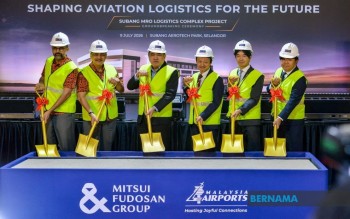
Malaysia Airports Holdings Bhd (MAHB) and Mitsui Fudosan Group, a major Japanese real estate and logistics conglomerate, have jointly launched an RM80 million initiative to construct a specialized air cargo logistics complex at Subang Airport in Selangor. The partnership structures MAHB as a minority stakeholder with 30 per cent ownership, while Mitsui Fudosan retains operational control through its 70 per cent holding. The groundbreaking ceremony held at the site on Thursday marks a significant step in Malaysia's ongoing efforts to strengthen its air logistics infrastructure and attract international investment to its aviation sector.
Transport Minister Anthony Loke Siew Fook described the collaboration as a strategic move that demonstrates MAHB's evolution from a purely airport operator into a broader asset management platform. The minister emphasized that the partnership exemplifies a deliberate approach to unlocking value from the airport authority's considerable land holdings by integrating them with specialized expertise from international partners. Rather than attempting to develop and manage complex logistics facilities independently, MAHB identified a partner whose track record and capabilities could substantially reduce execution risks and ensure operational excellence from the outset.
Mitsui Fudosan brings formidable credentials to the venture, having established and operated multiple logistics facilities at major Asian aviation hubs, particularly at Tokyo's Haneda Airport. The Japanese firm's deep experience in the sector includes not only construction and facility design but also the operational management systems essential for high-throughput cargo handling. According to Loke, this expertise will prove invaluable in helping MAHB navigate the technical and operational complexities inherent in establishing a world-class air cargo facility capable of competing with regional counterparts.
The project itself is being undertaken by MFMA Industrial Sdn Bhd, a newly established joint venture company that brings together Mitsui Fudosan (Asia) Malaysia Sdn Bhd and Malaysia Airports (Subang) Sdn Bhd as equal operational partners. This corporate structure allows both entities to contribute their respective strengths—Mitsui Fudosan's operational and technical expertise alongside MAHB's airport authority status and local market knowledge. The facility will be located within Subang Aerotech Park, an industrial zone already home to various aviation and aerospace enterprises, providing immediate synergies with existing operations.
The timing of this investment reflects broader industry trends within Southeast Asia, where air cargo demand has surged in recent years driven by e-commerce growth, manufacturing diversification, and increased regional supply chain integration. Subang Airport, despite being Malaysia's second-largest commercial aviation hub after Kuala Lumpur International Airport, has historically lagged in specialized cargo infrastructure compared to competing regional facilities. This development addresses that capacity gap and positions Subang as a more attractive destination for air freight operators seeking alternatives to congested major hubs.
The complex will specialize in maintenance, repair, and overhaul (MRO) logistics services, a segment of considerable value within the aviation sector. MRO operations require sophisticated facilities for handling aircraft components, spare parts storage, and specialized equipment, generating higher margins than standard cargo handling. By focusing on this niche market segment, the facility aims to attract high-value aerospace businesses and cement Subang's position within Malaysia's growing aviation ecosystem.
For Malaysia's aviation sector, the initiative signals growing confidence among international logistics operators in the country's long-term development trajectory. Mitsui Fudosan's willingness to commit significant capital and operational resources suggests the firm views Malaysia as a stable, attractive market for logistics expansion. This confidence has multiplier effects, as successful demonstration of profitability in specialized aviation logistics could attract additional Japanese and international operators to establish similar facilities elsewhere in Malaysia.
The partnership model employed here offers instructive lessons for other Malaysian development authorities seeking to commercialize public assets. By retaining a meaningful equity stake while delegating operational responsibility to specialists, MAHB achieves financial upside while avoiding the operational execution risks associated with unfamiliar business domains. This approach contrasts with purely privatization models, allowing the public sector to benefit from professional management while maintaining strategic influence over asset development.
Within the broader context of Malaysia's post-pandemic economic recovery, such infrastructure investments carry outsized importance. Air cargo logistics directly supports manufacturing and export-oriented industries, which remain crucial to Malaysia's economy. Enhanced capacity and capabilities in cargo handling reduce operational friction for exporters and attract companies considering Malaysia as part of their regional supply chain networks. This is particularly relevant given ongoing supply chain realignments across Southeast Asia as companies diversify away from singular-source production models.
The venture also reflects MAHB's transformation under recent leadership, moving away from the airport operator's traditional focus on passenger terminal management toward broader commercial real estate and logistics development. This diversification strategy provides MAHB with revenue streams less vulnerable to passenger traffic volatility—a consideration particularly relevant given the aviation sector's demonstrated susceptibility to external shocks, as evidenced by the coronavirus pandemic's impact on global aviation.
Regional competition among Southeast Asian airports for cargo and logistics market share remains intense. Singapore Changi, Bangkok's Suvarnabhumi, and Jakarta's Soekarno-Hatta all operate sophisticated cargo facilities. Malaysia's ability to leverage international partnerships to rapidly develop competitive infrastructure becomes increasingly important for maintaining regional competitiveness. The Subang project represents one element of a broader strategy to position Malaysian airports as essential nodes within Asia-Pacific supply chains rather than marginal players serving primarily domestic and regional passenger markets.

