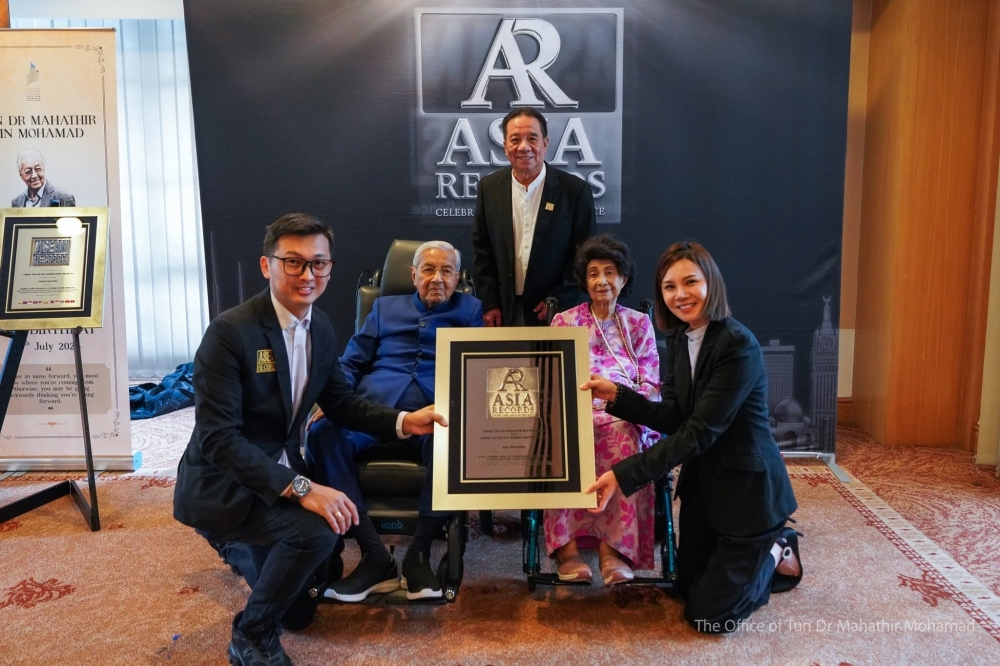
Tun Dr Mahathir Mohamad and his wife Tun Dr Siti Hasmah Mohd Ali have become the recipients of three Guinness World Records after both individuals reached the age of 100, marking a significant milestone in Malaysian history and establishing new benchmarks for longevity and public service on the global stage.
The distinction comes as recognition of their remarkable journey together, with the couple's combined achievements spanning decades of public engagement and contributions to Malaysian society. This recognition places them among an exclusive cohort of couples who have achieved centenarian status while maintaining prominence and continued relevance in public affairs. The Guinness World Records acknowledgment reflects not merely their individual longevity but the broader significance of their sustained partnership and activities throughout their extended lives.
Formal documentation of their records underscores Malaysia's growing representation in global longevity achievement rankings. As populations worldwide experience extended lifespans, the recognition of individuals who reach 100 years carries deeper implications for understanding factors contributing to healthy ageing, resilience, and sustained mental engagement throughout extended lifespans. The couple's records acquisition demonstrates that reaching centenarian status no longer constitutes a statistical anomaly but rather an increasingly attainable milestone for those benefiting from modern healthcare infrastructure and lifestyle choices.
Tun Dr Mahathir's longevity holds particular significance given his demanding tenure as Prime Minister across two separate periods, encompassing 22 years of intensive governance between 1981 and 2003, and a subsequent return to office in 2018. His ability to maintain intellectual vigour and public engagement well beyond typical retirement ages has made him a notable figure in global gerontological studies. Medical professionals have expressed interest in understanding the physiological and psychological factors enabling his sustained cognitive function and active participation in national affairs throughout his centennial year and beyond.
Tun Dr Siti Hasmah has likewise distinguished herself through sustained philanthropic work and public engagement, maintaining presence in healthcare advocacy and social causes throughout her extended life. Her medical background and continued involvement in community development initiatives demonstrate that centenarian status need not result in diminished social contribution. Her recognition alongside her husband emphasizes the mutual support systems that may contribute to extended healthspan, where individuals maintain not just longevity but functional capacity and purposeful engagement.
The significance of this recognition extends beyond personal achievement into the realm of national health statistics and demographic planning. Malaysia's healthcare system has supported the extended lives of these prominent citizens, and their centenarian status serves as implicit endorsement of the country's medical capabilities. Their longevity reflects broader improvements in Malaysian healthcare infrastructure, nutrition, and living standards over the past seven decades, demonstrating tangible outcomes of development policies implemented during various administrations.
For Malaysian readers navigating questions about ageing populations and long-term care policy, the Mahathir-Siti Hasmah recognition carries practical implications. Southeast Asian nations increasingly face demographic transitions toward older populations, and high-profile examples of active centenarians influence public attitudes toward ageing and retirement planning. The couple's continued visibility and engagement challenge stereotypes about inevitable decline associated with advanced age, potentially influencing how younger Malaysians perceive their own prospects for healthy ageing.
The three records acquired suggest multifaceted achievement rather than single-category distinction, indicating Guinness recognition across different metrics of centenarian accomplishment. This multi-category recognition distinguishes the couple from individuals recognized for isolated achievements, suggesting their records encompass dimensions ranging from longevity itself to sustained public engagement or familial continuity. The specific categories remain significant for understanding what aspects of their lives achieved measurable distinction on international scales.
Globally, the recognition positions Malaysia alongside other nations producing centenarian figures of international prominence. Countries with significant representation in Guinness longevity records benefit from enhanced global positioning regarding healthcare excellence and quality-of-life standards. The records acquisition therefore carries diplomatic and soft-power implications, signalling Malaysia's success in supporting extended, active lives for its citizens and contributing to regional narratives about Southeast Asian development outcomes.
For the broader Malaysian public, the recognition provides occasion to reflect on intergenerational relationships and the value placed on elder wisdom in Malaysian society. The continued engagement of centenarian figures in national discourse, either through direct participation or through media attention to their perspectives, reinforces cultural frameworks that honor accumulated experience and long-term perspectives on national development. Their records acquisition thus functions symbolically as acknowledgment that Malaysia values the voices and continued contributions of its eldest citizens.
The achievement also highlights disparities in healthspan accessibility within Malaysia and across the region. While Mahathir and Siti Hasmah have achieved centenarian status with apparent sustained quality of life, many Malaysians lack access to preventative healthcare and resources supporting healthy ageing. Their recognition thus unavoidably raises questions about equity in longevity outcomes and the concentration of healthcare resources that enable extended, active lives for some segments of the population.

