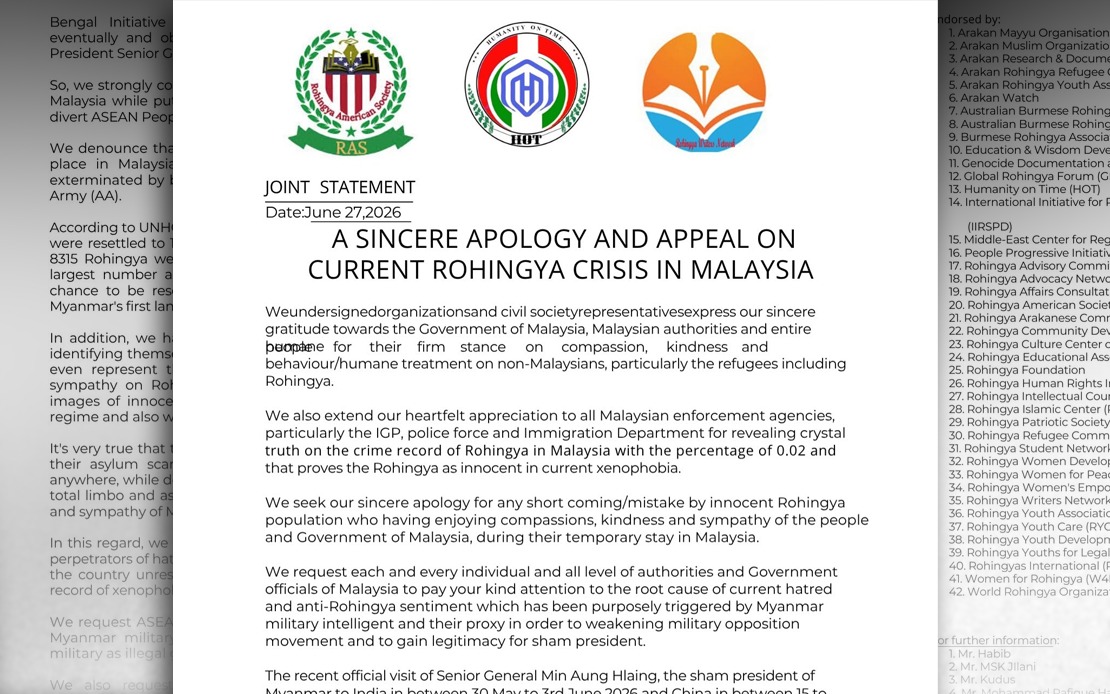
Malaysia's premier humanitarian organisation, the Malaysian Humanitarian Aid and Relief (MAHAR), has publicly acknowledged an apology extended by 40 Rohingya-focused non-governmental organisations, framing the gesture as evidence of organisational accountability. The response, delivered through a formal statement, suggests the two sectors are attempting to move past tensions that have periodically surfaced within Malaysia's refugee support landscape, though the broader implications of the apology and MAHAR's conditions remain complex.
Beyond simply accepting the apology, MAHAR has articulated an expansive vision for what refugee support should encompass in the Malaysian context. The organisation contends that genuine humanitarian intervention extends well beyond the traditional delivery of essential services such as food distribution and shelter provision. Instead, MAHAR argues that NGOs working with Rohingya populations must assume responsibility for equipping displaced persons with knowledge of their civil obligations while residing in Malaysia—a framework that positions education on legal and social norms as integral to humanitarian practice rather than a supplementary concern.
Central to MAHAR's argument is the proposition that refugee integration requires active cultivation of respect for Malaysian legal systems, cultural practices, and societal conventions. This emphasis reflects a growing recognition in humanitarian circles that successful coexistence between refugee communities and host populations depends not merely on meeting survival needs but on fostering mutual understanding. The organisation contends that Rohingya NGOs should leverage their community connections and cultural insight to promote this integration agenda, functioning as bridges between refugee populations and established Malaysian society.
Simultaneously, MAHAR has issued a pointed reminder that the Rohingya crisis itself demands sustained international engagement. The organisation argues that substantive humanitarian work necessarily includes intensive advocacy campaigns targeting the persecution mechanisms that continue to operate against Rohingya populations in Myanmar. This dual approach—addressing immediate needs in Malaysia while simultaneously pressuring for root-cause solutions—reflects a philosophy that views refugee crises as structural problems requiring multifaceted responses rather than temporary humanitarian challenges managed through charitable provision alone.
Jismi Johari, MAHAR's president, has injected an additional consideration into the debate: the safety concerns of both refugee populations and local Malaysian communities. This framing acknowledges that humanitarian work occurs within contested social spaces where competing security narratives and risk perceptions shape public attitudes. Johari's intervention suggests that dismissing or minimising legitimate local safety concerns would be counterproductive to the broader humanitarian mission, as it would deepen the credibility gap between aid organisations and Malaysian citizens whose support remains essential to sustainable refugee protection.
Johari further addressed the delicate question of community representation and individual accountability. While acknowledging that Malaysian citizens have raised genuine safety incidents involving individuals from refugee communities, he cautioned against extrapolating these isolated cases into wholesale condemnations of entire populations. This position reflects a sophisticated understanding that humanitarian crises often become weaponised in public discourse, with specific incidents used to justify sweeping generalisations that ultimately harm vulnerable populations while undermining social cohesion.
The MAHAR president's emphasis on the universality of deviance across all communities functions as both a practical observation and a philosophical statement. By noting that misconduct exists in every society rather than being peculiar to refugee populations, Johari attempts to reframe safety discussions away from essentialist narratives toward a more balanced recognition that social order challenges are endemic to human communities regardless of legal status. This argumentative move seeks to depoliticise security concerns while maintaining their legitimacy.
Addressing the path forward, Johari identified empathy, reciprocal respect, and inclusive engagement from all stakeholders as necessary ingredients for resolving community tensions. This prescription acknowledges that humanitarian effectiveness cannot be achieved through unilateral action by aid organisations alone but instead requires buy-in from local communities, government bodies, and refugee populations themselves. The emphasis on constructive engagement suggests MAHAR views its role as partially facilitative—creating spaces and frameworks within which diverse interests can negotiate coexistence.
MAHAR's reaffirmation of its institutional commitment to humanitarian action grounded in justice, safety, and human dignity represents an attempt to establish legitimacy across multiple constituencies. By explicitly binding humanitarian principles to both refugee protection and community safety, the organisation positions itself as genuinely balanced rather than advocacy-oriented in a way that might alienate Malaysian publics. This rhetorical strategy reflects the challenging position of humanitarian organisations operating in contexts where refugee and host community interests are sometimes perceived as antagonistic.
The broader context surrounding MAHAR's statement involves Malaysia's ongoing role as a major refugee-hosting country despite lacking formal asylum legislation. With over 180,000 registered Rohingya in Malaysia, the tensions between humanitarian protection imperatives and social integration challenges have become increasingly salient in public and political discourse. MAHAR's intervention suggests the humanitarian sector is responding to mounting pressure to demonstrate that refugee support benefits Malaysian society broadly rather than existing as a parallel system for non-citizens.
The NGO apology that prompted MAHAR's statement remains partially opaque in public accounts, but its acknowledgment suggests growing awareness among Rohingya organisations that their operational legitimacy depends on stronger engagement with Malaysian civic values and legal frameworks. This dynamic reflects a maturation in Malaysia's humanitarian ecosystem, where earlier phases of crisis response are giving way to more sophisticated models of refugee integration and social cohesion.
Looking ahead, MAHAR's conditions for endorsing refugee NGO work—combining community-focused integration efforts with sustained international advocacy—may establish new benchmarks for how humanitarian organisations position themselves in Southeast Asia's refugee landscape. Whether these standards become widely adopted or remain specific to MAHAR's framework will likely shape how refugee support evolves across the region in coming years.

