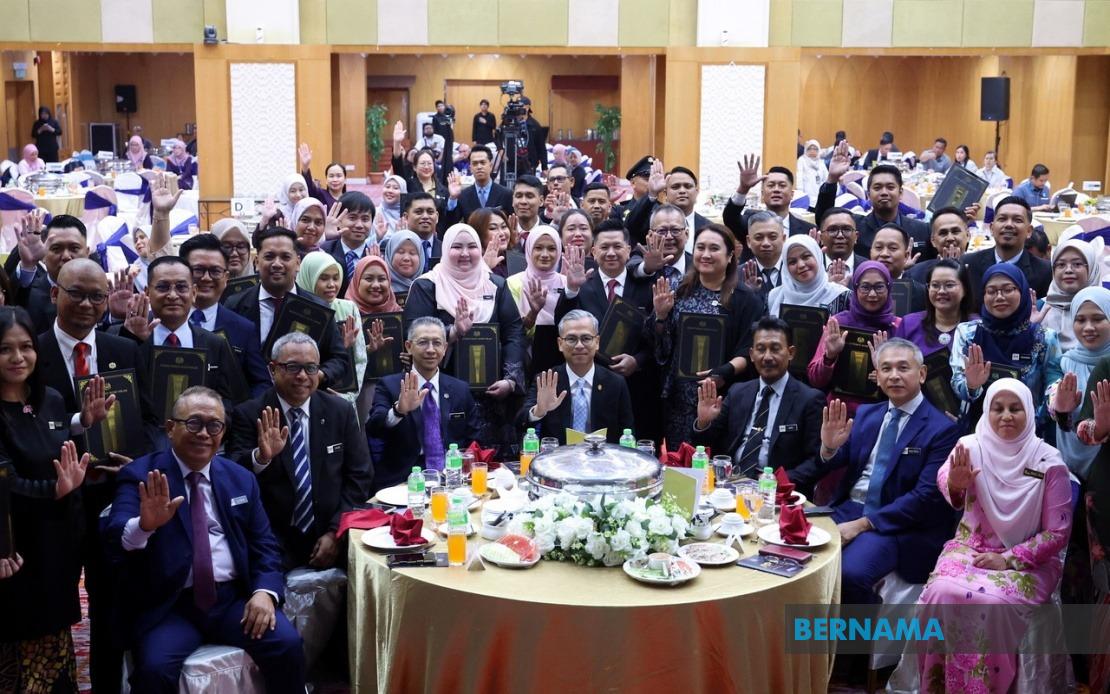
Communications Minister Datuk Seri Fahmi Fadzil has reinforced the MADANI Government's pledge to prioritise what he terms the "people's economy"—ensuring that improvements in national economic indicators directly translate into better living standards for ordinary Malaysians. Speaking at the Communications Ministry's Sabah and Labuan Zone Excellent Service Awards ceremony in Kota Kinabalu on August 10, Fahmi underscored that while headline figures such as gross domestic product growth, investment inflows, and trade expansion matter, their ultimate value lies in improving the material circumstances of everyday people.
The minister's remarks reflect a broader strategic pivot within Malaysia's government towards measuring economic success not merely through aggregate statistics but through their penetration into household budgets and purchasing power. This framing addresses a persistent disconnect in developing economies where macroeconomic indicators can appear robust while citizens struggle with affordability and access to essential services. For Malaysian policymakers navigating post-pandemic economic recovery, the distinction Fahmi drew signals a recalibration of priorities towards inclusive growth and direct welfare improvements.
Fahmi provided concrete examples of how the government intends to operationalise this philosophy, pointing specifically to the implementation of fuel subsidy retargeting under the BUDI MADANI programme. This initiative represents one of the government's most contentious recent policy decisions, involving the rationalisation of diesel subsidies—a move intended to improve fiscal sustainability while protecting the most vulnerable segments of the population. The minister's emphasis on subsidy reform as exemplifying people-centred economics suggests the government views targeted assistance as central to its poverty alleviation strategy, even as such programmes invite political scrutiny.
A particular focus emerged in Fahmi's remarks regarding the geographic dimension of economic policy. He highlighted how Sabah and Sarawak present distinctive implementation challenges due to vast distances between population centres and the higher costs associated with service delivery across dispersed communities. This acknowledgment is significant for East Malaysian readers, as it demonstrates federal recognition that standardised policies designed for peninsular conditions may require substantive adaptation to account for terrain, infrastructure constraints, and logistical costs unique to Borneo. Prime Minister Datuk Seri Anwar Ibrahim and the Cabinet, Fahmi stressed, were actively considering these regional variations when designing subsidy mechanisms and welfare programmes.
The minister articulated a vision wherein excellence in national economic management cascades outward to benefit individuals in concrete, observable ways. Rather than citizens experiencing economic growth abstractly through GDP statistics, he argued that they should feel improvements reflected directly in their purchasing power, job security, and ability to afford basic necessities. This messaging appears calibrated to address public scepticism regarding whether headline growth rates translate into improved conditions for lower and middle-income households—a concern that has animated political discourse across Southeast Asia in recent years.
Fahmi also emphasised the responsibility of government ministries and agencies to communicate policies transparently and comprehensively to the public. This point extends beyond mere public relations; it reflects recognition that policy efficacy partly depends on citizen understanding and buy-in. Misinterpretation of government programmes—particularly complex initiatives such as targeted subsidy systems—can undermine their effectiveness and generate unnecessary political friction. The minister's call for clearer communication across the government apparatus suggests ongoing challenges in translating policy intentions into public understanding, particularly in contexts where multiple tiers of government and diverse linguistic communities require coordinated messaging.
The ceremony where Fahmi made these remarks itself merits attention as a venue for policy articulation. The Communications Ministry's Excellent Service Awards programme, honouring government staff for customer service excellence, provides a platform for reinforcing messaging about the government's service orientation and commitment to responsive administration. By using such occasions to restate policy priorities, the government integrates personnel management and public communication—signalling to civil servants that people-centred delivery underpins organisational culture.
For Malaysian businesses and investors monitoring government direction, Fahmi's emphasis on the people's economy carries implications for future policy frameworks. It suggests that the MADANI administration will continue calibrating economic policies towards direct welfare improvements, potentially including further rounds of subsidy reform, wage support programmes, or social assistance expansions. This orientation may also shape regulatory environments, as policymakers prioritise affordability and accessibility alongside efficiency and growth metrics.
The broader context of the MADANI Government's economic philosophy—articulated around inclusivity and tangible welfare improvements—distinguishes its approach from purely productivity or investment-focused frameworks that characterised some earlier administrations. This represents a notable philosophical shift that resonates with global trends towards stakeholder capitalism and social market economics, even as Malaysia's specific implementation mechanisms remain distinctly rooted in its political economy and regional circumstances.
Looking forward, the extent to which the MADANI Government can deliver on promises to convert macroeconomic improvements into distributed welfare gains will substantially influence its political fortunes and popular legitimacy. Sabah and Sarawak, where geographic challenges compound urban-rural disparities, will serve as critical test cases for whether policies designed with these regional contexts in mind can meaningfully improve living standards. The minister's explicit acknowledgment of these challenges suggests the government recognises the stakes involved in translating economic growth into lived improvement across Malaysia's diverse regions.

