The Malaysian government's coalition administration has doubled down on its pledge to deliver broad-based prosperity to every corner of the country, with Johor serving as a focal point for demonstrating the tangible impact of federal investment. Pakatan Harapan's secretary-general, Datuk Seri Saifuddin Nasution Ismail, underscored this commitment while addressing the state, emphasizing that sustainable growth must extend beyond the peninsula's wealthier urban zones to encompass diverse communities and regions. His remarks reflect a deliberate strategy to position development not as a zero-sum competition between states, but as a collaborative national effort steered by Prime Minister Datuk Seri Anwar Ibrahim's administration.
Under the MADANI framework—an acronym reflecting the government's stated principles—infrastructure investment, connectivity improvements, healthcare expansion, and disaster resilience have emerged as core pillars of the development agenda. The Home Minister articulated this multifaceted approach during his statement, noting that the government views quality of life through the lens of practical outcomes: employment generation, enhanced mobility, medical accessibility, and improved living standards. This perspective signals a shift from measuring progress purely through financial outlays to evaluating impact through citizen welfare metrics, an approach that resonates particularly with developing nations in Southeast Asia grappling with balancing growth with equity.
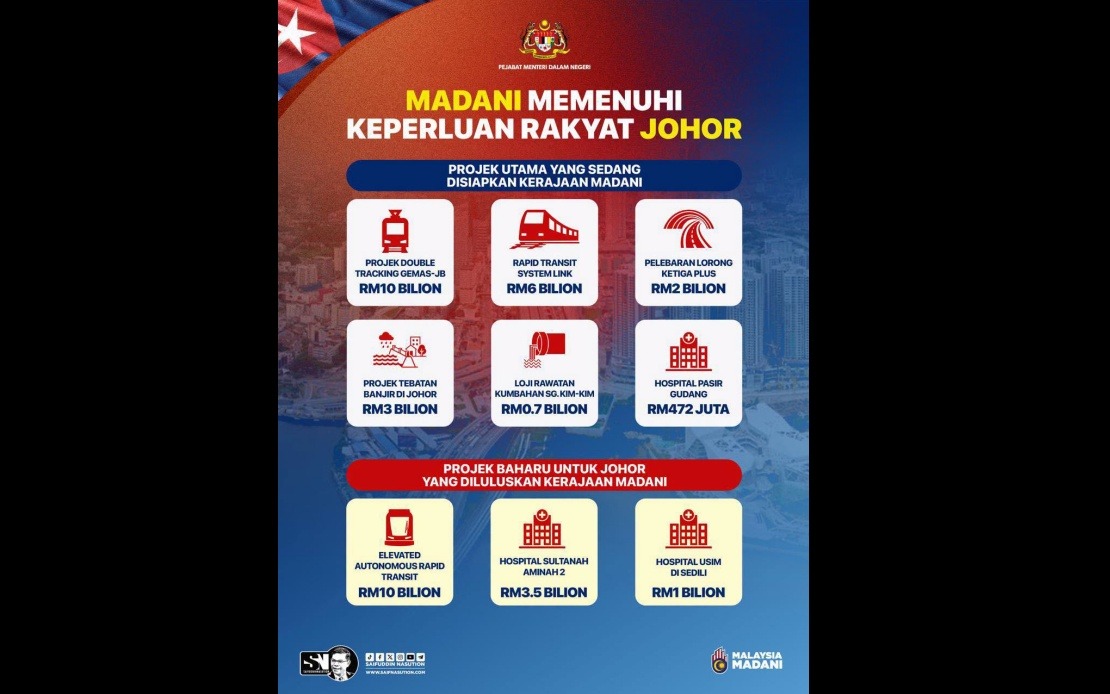
Johor's position as a leading industrial and commercial hub in Malaysia makes its development trajectory significant for the broader national economy. The state serves not only as a regional economic engine but also as a bellwether for federal policy effectiveness. Several landmark projects are already advancing across the state, including the Gemas-Johor Bahru Electrified Double Tracking Project, which aims to modernize rail infrastructure and reduce reliance on road transport. The Rapid Transit System Link, designed to enhance connectivity between Johor and neighboring Singapore, represents a critical component of cross-border economic integration, facilitating trade and labour mobility across the Causeway.
Transportation infrastructure constitutes a primary focus of the government's investment strategy in Johor. Beyond rail initiatives, the widening of the PLUS Highway's third lane addresses congestion challenges and supports the smooth movement of goods and people throughout the state. The Elevated Autonomous Rapid Transit system and the Rapid Transit System Link both represent next-generation transport solutions aimed at modernizing Johor's urban mobility ecosystem. For Malaysian policymakers and regional analysts, these projects reflect broader Southeast Asian trends toward automated transit systems and integrated transport networks as solutions to rapid urbanization and congestion.
Flood mitigation emerged prominently in the government's development narrative, addressing a perennial challenge that has plagued Johor and other Malaysian states with increasing severity. Dedicated flood management projects, alongside the Sungai Kim Kim Sewage Treatment Plant, demonstrate recognition that sustainable development must incorporate environmental resilience and water management as foundational components. This prioritization gains added relevance given the recurring monsoon flooding that disrupts economic activity and displaces communities across the region annually.
Healthcare expansion represents another substantial element of the development programme, with three significant hospital initiatives underway or approved. The Pasir Gudang Hospital, alongside Sultanah Aminah Hospital 2 and the USIM Hospital in Sedili, collectively expand medical capacity across different districts within Johor. For a state with growing population pressures and economic activity, adequate healthcare infrastructure is essential for sustaining workforce productivity and public health outcomes. The strategic geographic distribution of these facilities suggests deliberate planning to serve both urban and semi-rural populations equitably.
Saifuddin Nasution's articulation of development metrics reflects a governance philosophy increasingly common among Malaysia's political leadership—one that emphasizes tangible citizen benefits over abstract aggregate figures. This framing carries particular weight in Malaysian politics, where public dissatisfaction with inequality and perceived regional favoritism has historically influenced electoral outcomes. By explicitly linking infrastructure spending to job creation, service accessibility, and quality of life improvements, the government frames its development narrative in terms directly relevant to voter experience and household welfare.
The sequential announcement of approved large-scale projects—the Elevated Autonomous Rapid Transit, Sultanah Aminah Hospital 2, and USIM Hospital in Sedili—signals ongoing commitment and suggests a pipeline of initiatives designed to maintain development momentum beyond the current fiscal year. This continuity messaging carries strategic importance in an electoral environment where incumbents must demonstrate not merely present performance but future trajectory. For investors and international observers, the visible project pipeline offers reassurance regarding long-term policy stability and capital availability for infrastructure spending.
For Southeast Asian policymakers monitoring Malaysia's development strategies, the MADANI Government's approach reflects several noteworthy priorities: diversified sectoral investment spanning transport, health, and disaster management; explicit emphasis on cross-border economic integration; recognition of technological modernization through autonomous transit systems; and commitment to geographic equity through dispersed project locations. These themes align with broader ASEAN development frameworks emphasizing connectivity, digitalization, and inclusive growth.
The implementation success of these initiatives will substantially influence public perception of the MADANI Government's effectiveness and potentially shape electoral dynamics in coming years. Johor, as a politically competitive state with significant economic weight, represents a critical testing ground for federal development promises. Delayed project completion, cost overruns, or failure to deliver promised employment and service benefits could undermine government credibility, whereas timely, high-quality delivery reinforces the administration's development legitimacy.
Regional analysts will watch how Malaysia's development trajectory unfolds against competing priorities in education, healthcare equity, and debt management. The government's willingness to commit substantial capital to infrastructure and state-level projects suggests confidence in long-term revenue streams and fiscal sustainability, though Malaysia's debt-to-GDP ratio remains a constraint on unlimited spending expansion. Balancing transformative infrastructure investment with fiscal prudence represents an ongoing challenge for the administration, particularly as it navigates post-pandemic economic recovery and regional competition for investment inflows.

