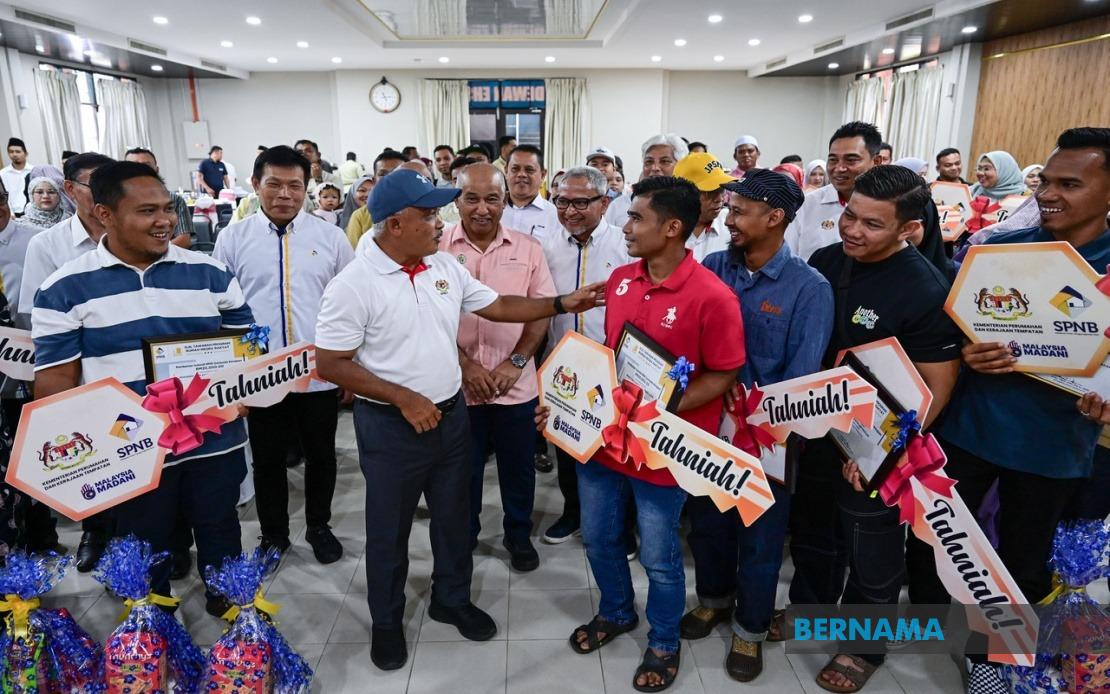
Fifty families across the Kuala Terengganu and Kuala Nerus parliamentary constituencies have received housing support through the Rumah Mesra Rakyat (RMR) programme, marking another milestone in the MADANI Government's push to expand affordable homeownership among lower-income Malaysians. The assistance package, distributed during a ceremony at Dewan Ehsan in Felda Wilayah Timur, comprises thirty completed dwellings ready for immediate occupation and twenty offer letters authorising the construction of new residential units. The presentation underscores the government's determination to translate housing policy into tangible community benefits.
Housing and Local Government Ministry secretary-general Datuk Dr M. Noor Azman Taib presided over the distribution during his working visit to the constituency, emphasising that the RMR initiative extends far beyond conventional shelter provision. According to Dr M. Noor Azman, the programme represents a comprehensive approach to improving living standards for those who possess land but lack access to safe, dignified housing. The initiative functions as a mechanism for socioeconomic uplift, recognising that home ownership anchors family stability, community cohesion, and long-term financial security for vulnerable populations.
Implemented by Syarikat Perumahan Negara Berhad (SPNB) under the Housing and Local Government Ministry, the RMR programme reflects the broader MADANI administration's commitment to inclusive development. Dr M. Noor Azman highlighted that the government intends to intensify programme rollout to ensure greater numbers of Malaysians can transition into property ownership. This commitment transcends immediate housing gaps, functioning instead as foundational infrastructure for generational well-being and community resilience across the country.
Budget 2026 allocates resources for constructing 6,545 RMR units nationwide, signalling sustained governmental investment in housing accessibility. Cumulative implementation figures reveal substantial progress: of the units deployed to date, 3,900 have entered the pipeline, with 2,478 completed and transferred to beneficiaries while another 1,422 remain under construction. This momentum indicates accelerating delivery capacity, though the scale of remaining need across Malaysia's lower-income segments suggests continued expansion remains essential.
Terengganu has emerged as a significant focus area for the RMR initiative, with 680 units currently in development stages and a corresponding budgetary allocation of RM46.67 million dedicated to the state's implementation. By May of this year, 246 units had reached completion and transferred to eligible households, whilst construction proceeded on an additional 154 units. These figures demonstrate that Terengganu's housing deficit is receiving proportional attention within national programming, though completion timelines suggest multi-year delivery cycles remain necessary.
Within Kuala Terengganu parliamentary constituency specifically, 34 RMR units have been activated, with eighteen completed structures already occupied and sixteen advancing through construction phases. The corresponding figures for Kuala Nerus reveal thirty-two units engaged, comprising twenty-five finished dwellings and seven under active development. The distribution pattern reflects demographic demand and implementation capacity across both constituencies, with completion rates suggesting varying project timelines depending on site-specific conditions and construction complexities.
Since its inception in 2002, the RMR programme has cumulatively benefited more than 80,000 families nationwide by providing housing meeting safety, comfort, and quality standards. This historical trajectory indicates the initiative's established track record and proven capacity for systemic impact across diverse geographical and demographic contexts. For Malaysian policymakers evaluating housing intervention effectiveness, the RMR programme's two-decade operational history provides substantial evidence of sustainable delivery mechanisms and recipient satisfaction.
For residents across Terengganu, the RMR programme addresses a persistent structural challenge: the gap between land ownership and housing accessibility. Many rural and semi-urban Malaysians possess ancestral or acquired land but lack capital or institutional access to construct dwellings meeting modern standards. The programme bridges this divide by providing construction financing and quality assurance, transforming latent assets into functional family homes whilst simultaneously stimulating local construction sectors and employment.
The initiative carries particular significance for Southeast Asian housing policy observers, as Malaysia's RMR model demonstrates how targeted government intervention can serve lower-income populations without necessitating direct housing construction by the state. By leveraging SPNB's expertise and existing landholdings, the approach combines efficiency with scalability, potentially offering replicable frameworks for regional governments wrestling with similar housing accessibility challenges across Indonesia, Thailand, and the Philippines.
Looking forward, sustaining momentum across Budget 2026's expanded targets will require coordination between federal ministry apparatus, state government bodies, and implementing agencies. The Terengganu experience suggests that regional deployment remains feasible provided budgetary commitments remain stable and construction supply chains maintain functionality. For beneficiary families, the completed homes represent more than shelter—they constitute entry points into formal property markets, collateral for economic advancement, and anchors for intergenerational stability within their communities.

