Malaysia's MADANI government has reaffirmed its dedication to the Ziarah Kasih initiative, underscoring the administration's strategy of maintaining direct engagement with economically disadvantaged households across the nation. The programme, which translates roughly as "Visit of Compassion," exemplifies the government's people-centric policy framework and reflects the broader Malaysia MADANI vision of positioning citizen welfare at the centre of governance decisions. Through structured outreach and targeted material assistance, the initiative seeks to bridge gaps in social protection for those facing acute vulnerability, particularly elderly and infirm Malaysians who lack adequate family or state support systems.
According to Abdullah Izhar Mohamed Yusof, political secretary to the Communications Minister, the government identifies beneficiaries through collaborative efforts between the Department of Information and Komuniti MADANI, ensuring that assistance reaches those with the greatest need. This targeting mechanism represents an evolution in how the government allocates limited welfare resources, moving beyond broad-based subsidies toward concentrated support for specific vulnerable populations. The approach acknowledges that blanket assistance programmes often fail to address the acute crises faced by individuals confronting simultaneous physical, economic, and social hardships. By concentrating resources on identified cases, the government aims to maximise the tangible impact of each allocation.
The Ziarah Kasih programme operates as a systematic intervention within Malaysia's expanding social safety net. Rather than functioning as a one-off charitable gesture, officials have indicated that assistance will be delivered on a regular, recurring basis, signalling institutional commitment rather than episodic generosity. This regularised approach provides recipients with greater predictability and allows families to plan household finances with greater confidence. For many vulnerable Malaysians, the knowledge that assistance will arrive periodically transforms the psychological and practical dimensions of managing hardship, converting uncertainty into manageable reality.
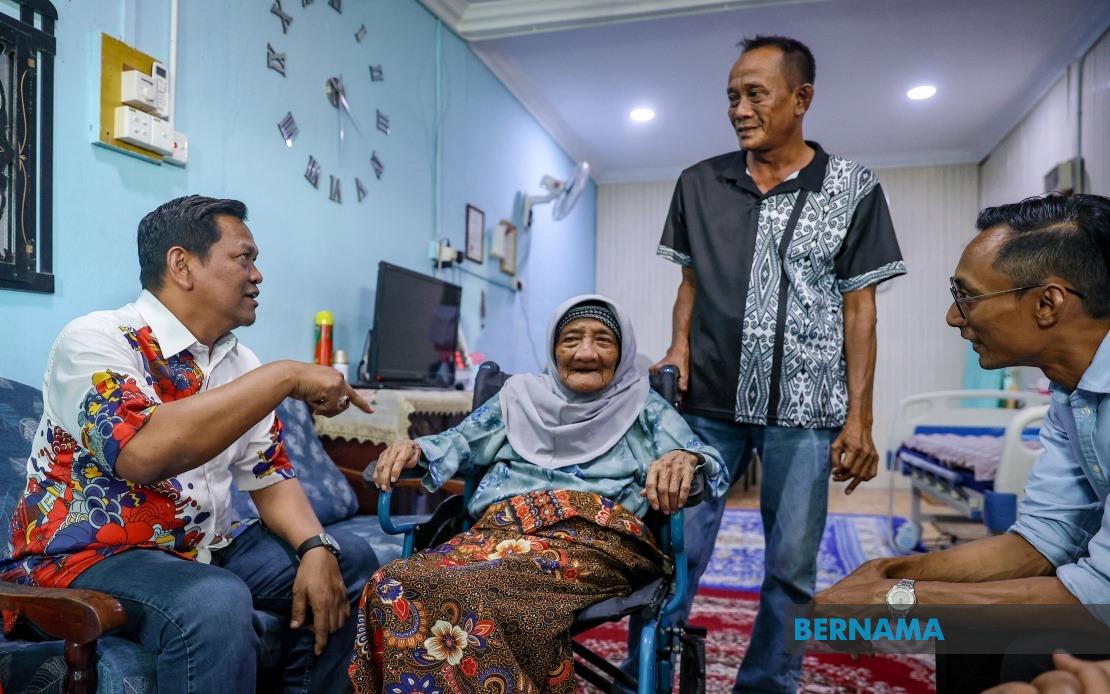
On June 23rd, officials implementing the programme visited elderly residents in Mersing during the Jiwa@Komuniti MADANI Sembang Santai World Cup Edition event. During these visits, they presented both financial contributions and healthcare equipment to beneficiaries, addressing immediate material needs whilst simultaneously acknowledging the dignity and citizenship status of recipients. Healthcare equipment distribution holds particular significance for elderly Malaysians managing chronic conditions, as such items often represent unaffordable luxuries for low-income households despite their necessity for maintaining independence and quality of life.
Among those assisted was Hamdan Abd Latif, a 71-year-old man now permanently bedridden, cared for entirely by his wife Meriam Abd Wahab, aged 66. Hamdan's trajectory illustrates the unpredictability of hardship in Malaysia: a retired firefighter whose career ended prematurely following a fishing accident in 2011, merely two weeks before his scheduled retirement. Medical investigations subsequently revealed the presence of a brain tumour, requiring surgical intervention. Though Hamdan recovered initially and was declared tumour-free, the illness's lingering effects gradually eroded his health until a bathroom fall precipitated a stroke, rendering him immobile.
Meriam's circumstances exemplify the hidden economic costs of eldercare within Malaysian households. Previously supplementing family income through sewing work, she abandoned all external employment to provide full-time care for her disabled husband. This transition from economic producer to unpaid caregiver, whilst economically rational given their circumstances, has drastically reduced household income at the precise moment when expenses have multiplied. The Ziarah Kasih assistance, whilst modest in absolute terms, addresses this gap between reduced income and elevated expenses, allowing the household to purchase necessary medications, medical supplies, and food without reducing nutrition or care quality.
Another beneficiary, Zainon Ibrahim aged 91, represents a different variant of vulnerability. Her son Jamaluddin Ismail, 64 years old, abandoned his career approximately two years ago to become his mother's full-time caregiver, with additional support rotating among his siblings. Jamaluddin's decision to retire from employment as a supervisor reflects the reality that no commercial care service was financially accessible or available in his area, forcing him to choose between his mother's welfare and his own economic security. Government assistance in such cases acknowledges that family-based care, though economically efficient compared to institutional alternatives, creates severe opportunity costs for working-age children who sacrifice their earning potential.
The targeting of elderly and infirm individuals through Ziarah Kasih reflects demographic realities shaping Malaysian social policy. As the population ages, the proportion of Malaysians over 65 will accelerate, whilst simultaneously family structures that historically provided intergenerational support have fragmented. Urban migration, dual-income household requirements, and changing family dynamics mean that traditional informal care systems increasingly fail to function. Government-sponsored assistance programmes partially compensate for these systemic shifts, though they cannot fully replace the informal support networks that once sustained vulnerable elderly across Malaysian communities.
The programme's emphasis on health equipment distribution carries additional policy implications. Many vulnerable elderly experience mobility limitations, chronic pain, or medical conditions rendering their homes unsafe or uncomfortable without appropriate aids. Basic items such as mobility frames, lifting equipment, or hospital beds remain expensive relative to low-income household budgets, yet prove essential for maintaining dignity and preventing secondary injuries. By subsidising or providing such equipment directly, the government reduces preventable hospital admissions arising from falls or complications stemming from inadequate home environments.
Ziarah Kasih also signals broader ideological positioning within the MADANI framework. Rather than framing assistance as charity or welfare dependency, officials frame it as engagement with citizens, using language emphasising the government's responsibility to interact directly with those it represents. This rhetorical shift, subtle but significant, reframes assistance recipients as citizens deserving government attention rather than unfortunate individuals requiring charitable intervention. For beneficiaries, this distinction affects both material outcomes and psychological experience, elevating their status within the political community.
The sustainability of such programmes depends fundamentally on institutional consistency and adequate fiscal allocation. Malaysian experience demonstrates that well-intentioned assistance schemes often collapse when political administrations change, budgets contract, or implementation capacity diminishes. The current MADANI government's explicit commitment to regular, ongoing assistance suggests determination to embed Ziarah Kasih within permanent bureaucratic structures rather than treating it as temporary political messaging. Success will require sustained political will, adequate budgeting, and careful monitoring to ensure resources actually reach intended beneficiaries rather than leaking to intermediaries or being captured by local officials.
For Malaysian policymakers, the visible engagement represented by Ziarah Kasih offers lessons about social policy design. Rather than distant institutional welfare provision, direct government-to-citizen assistance combined with healthcare support addresses both material poverty and the social isolation often accompanying it. The programme's focus on elderly and disabled individuals, groups frequently marginalised from mainstream economic activity, reflects recognition that not all poverty stems from moral failure or laziness. Instead, systemic vulnerabilities and biological realities place entire categories of people beyond the reach of conventional labour market solutions.
The success stories emerging from Mersing and comparable outreach sites will likely inform the programme's expansion across other states and communities. As the government continues gathering evidence about beneficiary needs, cost-effectiveness ratios, and community impacts, it can refine targeting mechanisms and assistance levels to maximise welfare improvements. For vulnerable Malaysians facing the intersection of old age, disability, and economic hardship, programmes like Ziarah Kasih represent tangible recognition that the political community has not forgotten them.