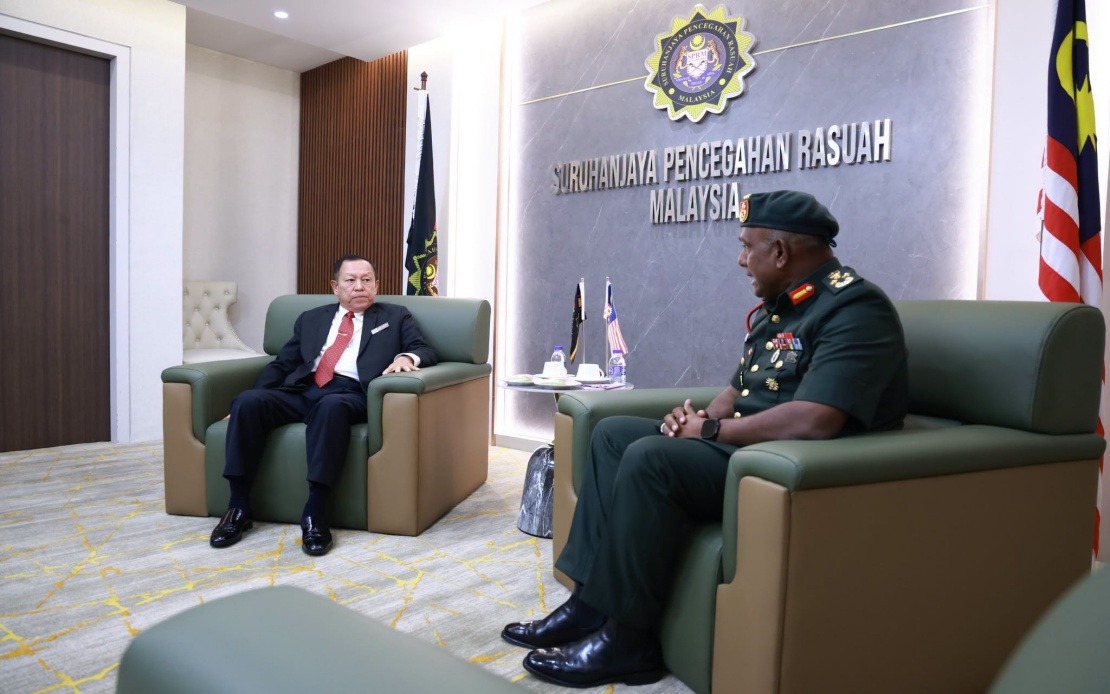
The Malaysian Anti-Corruption Commission and the Malaysian Armed Forces have recommitted themselves to a deepening collaborative framework designed to combat corruption across the defence sector and broader public institutions. At a meeting held at MACC headquarters in Putrajaya on July 7, the two organisations formally endorsed plans to expand intelligence sharing mechanisms, improve information exchange protocols, and elevate governance standards—reflecting growing recognition that effective corruption prevention requires coordination between law enforcement and military oversight bodies.
MACC Chief Commissioner Datuk Seri Abd Halim Aman highlighted the strategic importance of the partnership during discussions with newly appointed Malaysian Defence Intelligence Organisation director-general Lt Gen Datuk Fazal Abdul Rahman. Abd Halim underscored that the commission regards its relationship with the Armed Forces as foundational to Malaysia's anti-corruption mission, signalling that enhanced synergy between the two agencies will translate into more rigorous enforcement capacity and preventive mechanisms across defence establishments and related sectors.
The timing of this reinforced commitment carries particular significance given the Armed Forces' substantial budget allocation and operational scope. Defence ministries worldwide represent high-risk environments for corruption, given the scale of procurement contracts, international defence relationships, and classified operational budgets. By formalising intelligence-sharing arrangements with MACC, Malaysia's military leadership demonstrates proactive governance, aligning with international best practices that treat anti-corruption as a core component of institutional integrity rather than a peripheral compliance function.
Lt Gen Fazal, whose appointment became effective in May, used the occasion to reaffirm the Armed Forces' commitment to maintaining stringent governance standards and upholding disciplinary protocols throughout its operational hierarchy. His remarks emphasised that professional conduct and transparent decision-making are not negotiable principles but foundational to the military's institutional credibility and public trust. This framing positions anti-corruption work not as a burden imposed by external oversight but as integral to military professionalism and operational effectiveness.
The intelligence-sharing component of this partnership addresses a critical gap in Malaysia's corruption prevention infrastructure. Military intelligence units often possess insights into irregular financial flows, suspicious procurement patterns, and personnel misconduct that may not surface through conventional MACC investigations. Conversely, MACC's investigative expertise and forensic capabilities can help armed forces leadership identify vulnerabilities within internal control systems and strengthen accountability mechanisms. This reciprocal knowledge transfer creates multiplicative investigative capacity that neither organisation could achieve independently.
For Malaysia and Southeast Asia more broadly, this institutional arrangement reflects a maturing approach to governance challenges. Across the region, defence sectors have historically operated with greater opacity than civilian government branches, partly due to legitimate national security considerations. However, several Southeast Asian nations have found that structured cooperation between anti-corruption agencies and military oversight bodies can preserve operational security while substantially reducing procurement fraud, embezzlement, and abuse of authority. Malaysia's formalisation of such protocols positions it as a regional exemplar in this area.
The governance enhancement initiative signals intent to audit and modernise internal control frameworks within military procurement, financial management, and personnel administration. Such enhancements typically involve reviewing authorisation thresholds, implementing digital transaction systems that create audit trails, and establishing clearer segregation of duties across finance and procurement functions. These measures, though administratively demanding, have demonstrable returns in fraud prevention and operational efficiency—outcomes that ultimately benefit defence capability by freeing resources from corruption losses into genuine operational readiness.
Information exchange protocols represent another substantive dimension of the partnership. Armed forces personnel often encounter irregular activities during routine operations—suspicious business entities, unusual financial transactions, or individuals with unexplained wealth—that merit investigation but fall outside military jurisdiction. Formalised channels for reporting such observations to MACC ensure that potentially significant cases reach investigators with appropriate civilian law enforcement authority, while protecting military personnel who report concerns from retaliation or regulatory complications.
The presence of MACC Intelligence Division senior director Datuk Saiful Ezral Arifin and MAF Security and Counter Intelligence Directorate director Lt Col Muhamad Zainol Md Yusof at the meeting underscores that this partnership operates at technical and operational levels, not merely as a ceremonial political commitment. These officials manage the actual mechanisms through which intelligence flows, investigations are coordinated, and evidence is shared. Their involvement suggests that implementation structures are already taking shape, with practical protocols being developed to translate the strategic commitment into functioning systems.
For Malaysian civil society and taxpayers, this development carries direct implications. Defence budgets represent among the largest government expenditures, and reducing losses to corruption through effective oversight translates into genuine fiscal savings and improved military capability. Enhanced anti-corruption cooperation also bolsters public confidence in defence institutions and the integrity of personnel selection and promotion processes—crucial factors in maintaining military legitimacy and public trust during sensitive operations or national security challenges.
Regionally, the MACC-Armed Forces partnership may influence governance approaches in neighbouring countries facing similar challenges. Several Southeast Asian nations are actively strengthening anti-corruption frameworks, and Malaysia's experience with inter-agency coordination between specialised law enforcement bodies and defence oversight could provide instructive models. The partnership demonstrates that institutional rivalries and jurisdictional boundaries, common obstacles in developing governance systems, can be transcended through committed leadership and clear strategic alignment on national interests.
Looking forward, the effectiveness of this partnership will depend on sustained political backing, adequate resource allocation to both intelligence-sharing infrastructure and joint investigation capacity, and protection of personnel who raise corruption concerns. International experience suggests that without these enabling conditions, even well-intentioned agreements can devolve into symbolic gestures. Malaysia's demonstrated commitment to operationalising this partnership, evident in the senior-level engagement and technical preparations, suggests serious institutional intent to move beyond rhetoric toward functional anti-corruption capacity across the defence sector.

