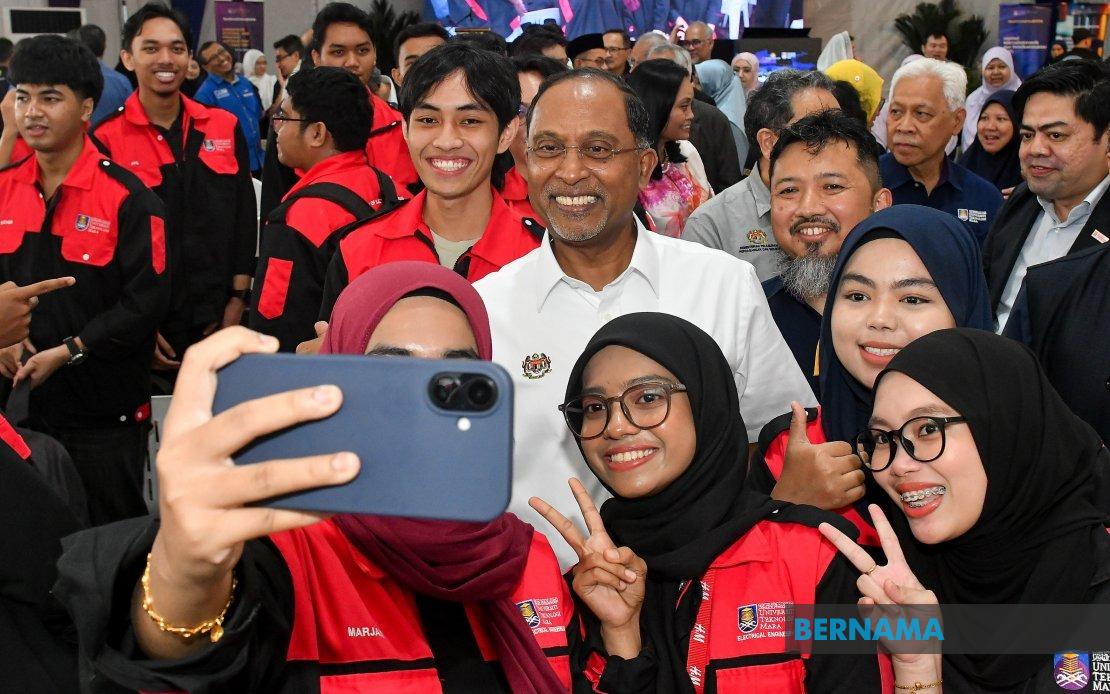
The commencement of Light Rail Transit 3 (LRT3) operations on the Shah Alam Line marks a watershed moment for Universiti Teknologi MARA (UiTM) Shah Alam and surrounding communities, fundamentally altering transportation dynamics across this expanding region of the Klang Valley. Higher Education Minister Datuk Seri Dr Zambry Abd Kadir highlighted during a visit to campus this week that the dedicated UiTM Shah Alam Station represents far more than an infrastructure investment—it signals a commitment to alleviating the daily mobility challenges that have long plagued students and staff navigating congested roadways to reach the sprawling educational hub.
The affordability dimension of this transit solution cannot be overstated for the student population. Prime Minister Datuk Seri Anwar Ibrahim's announcement of complimentary fares extending from June 29 through July 31 removes immediate cost barriers that typically constrain commuting choices among tertiary learners. By eliminating the transport expense variable during this introductory period, the government seeks to normalise public transit usage among younger demographics while gathering data on patronage patterns and service demand that will inform longer-term pricing structures. For a student body often operating within tight financial constraints, this temporary subsidy effectively redistributes discretionary spending capacity toward academic materials and living expenses.
The Shah Alam Line's comprehensive network architecture demonstrates planning that extends beyond serving a single institution. The corridor's 20 stations—stretching from Bandar Utama through Johan Setia—create connectivity threads throughout an increasingly integrated western metropolitan corridor. Stations including Kayu Ara, Damansara Idaman, Subang, Stadium Shah Alam, and the multiple Shah Alam urban nodes establish multiple entry and exit points that permit flexible journey planning for commuters whose origins and destinations span residential suburbs, commercial hubs, and educational precincts. This distributed approach differs markedly from centralised transit models that concentrate accessibility around singular downtown clusters.
Minister Zambry's observations about student enthusiasm during his campus visit underscore a generational receptiveness toward modal shift. The visible relief expressed by those previously enduring daily traffic congestion reflects accumulated frustration with single-occupancy vehicle dependency. For an institution educating engineers, technologists, and future economic leaders, the practical demonstration of efficient public transport infrastructure functions as embedded curriculum—demonstrating through lived experience the urban design principles and systems thinking that form theoretical components of their formal studies. This experiential learning reinforces technological literacy with tangible infrastructure appreciation.
Parallel to transit connectivity expansion, the minister unveiled the Semiconductor@UiTM initiative, representing a RM20 million institutional commitment toward positioning Malaysia within the global high-technology manufacturing ecosystem. This strategic initiative addresses a critical national vulnerability: despite Malaysia's established role supplying 13 per cent of global semiconductor output and generating over RM300 billion in annual economic value, the pipeline for domestically cultivated technical talent remains insufficient to sustain competitive advantage against emerging rivals in Vietnam, Thailand, and Indonesia. The initiative's architecture integrating infrastructure development, curriculum alignment with international standards, and direct industry-academia collaboration protocols recognises that human capital formation cannot proceed through classroom instruction alone.
The timing of Semiconductor@UiTM's launch reflects alignment with Malaysia's broader National Semiconductor Strategy, which recognises that technological leadership in advanced manufacturing demands sustained workforce development beginning at secondary and tertiary levels. By positioning UiTM as a focal point for Electrical and Electronics Engineering excellence, the initiative creates a gravitational centre that can attract additional public and private sector investments in complementary facilities and programmes. The university's commitment to translating government allocation into measurable infrastructure and curriculum outcomes establishes institutional credibility with multinational semiconductor corporations evaluating investment locations and supplier development partnerships.
The initiative's emphasis on cross-domain learning between academic researchers and industry practitioners represents a deliberate departure from siloed knowledge production. Students embedded within industry exposure frameworks gain familiarity with manufacturing protocols, quality assurance methodologies, and supply chain logistics that classroom laboratories cannot authentically simulate. Conversely, corporate partners benefit from access to emerging research, prototype development capabilities, and talent pipeline visibility that inform their long-term workforce planning. This bidirectional knowledge exchange model has proven particularly productive in Singapore's semiconductor ecosystem, where similar university-industry integration frameworks facilitated the city-state's evolution into a global design and fabrication centre.
Minister Zambry's assertion that UiTM's achievement should serve as a benchmark for other Malaysian universities signals recognition that semiconductor industry competitiveness cannot rest upon a single institution's efforts. The fragmented nature of Malaysia's higher education landscape—with research capability dispersed across multiple public and private universities—necessitates coordinated ecosystem development that permits specialisation without creating competitive duplication. Strategic differentiation, whereby UiTM anchors semiconductor engineering leadership while other institutions develop complementary niches in materials science, photonics, or manufacturing systems engineering, generates systemic strength exceeding isolated institutional excellence.
The convergence of improved transit connectivity and strategic workforce development initiatives at the Shah Alam campus reflects integrated policy thinking that recognises infrastructure and human capital as complementary rather than competing priorities. Students who can commute efficiently via LRT experience reduced fatigue and enhanced scheduling flexibility, permitting greater engagement with extended campus hours that characterise research-intensive learning models. The physical accessibility improvements compound with curriculum enhancement to position UiTM students as more globally competitive graduates entering multinational semiconductor corporations' early-career pipelines.
For the broader Southeast Asian context, Malaysia's deliberate positioning within semiconductor supply chains via simultaneous infrastructure and skills development represents strategic positioning amid regional competitive intensity. Vietnam's aggressive foreign direct investment recruitment, Thailand's established automotive supply ecosystem, and Indonesia's emerging digital manufacturing initiatives all pose challenges to Malaysia's historical market share. By leveraging UiTM's teaching and research capabilities combined with improved workforce logistics via LRT3, Malaysia reinforces its value proposition to semiconductor corporations evaluating regional production network expansion.
The LRT3 Shah Alam Line's operational commencement and Semiconductor@UiTM's institutional launch collectively demonstrate how infrastructure and education policy can function as mutually reinforcing levers of economic development. The free-fare promotional period through July 31 provides a crucial window for embedding public transit habits among younger demographics whose transportation choices will shape Klang Valley mobility patterns for decades. Simultaneously, the RM20 million semiconductor initiative invests in human capability formation aligned with emerging technological paradigms that will define Malaysia's competitive positioning throughout the coming decade.

