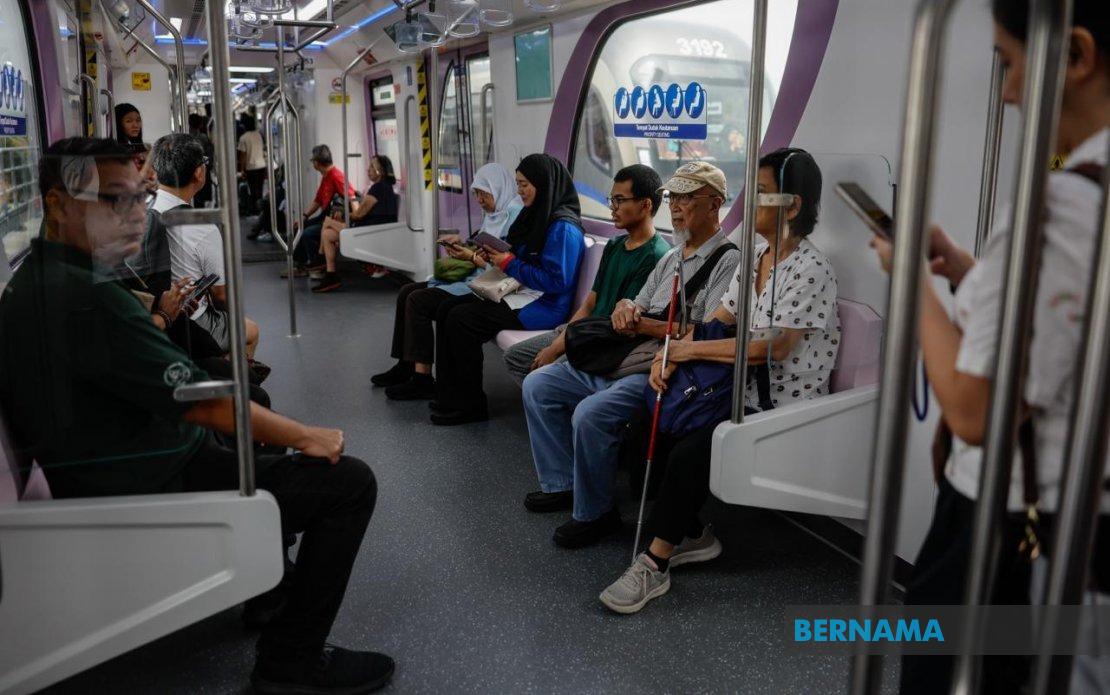
Malaysia's newest rapid transit corridor, the Light Rail Transit 3 (LRT3) Shah Alam Line, commenced operations on June 29 to an encouraging response from its initial wave of passengers. The RM16.63 billion investment represents a significant milestone in the government's broader infrastructure programme to modernise public transport connectivity across the Klang Valley region. Opening day testimonies from diverse commuter groups—spanning persons with disabilities, private sector workers, and students—revealed broad satisfaction with service quality, journey efficiency, and physical comfort standards, though feedback also highlighted specific areas requiring refinement to maximise inclusivity.
Visually impaired commuter Razlan Ibrahim, 40, provided particularly insightful assessment of the line's accessibility credentials following his inaugural journey from Kajang to Glenmarie 2. His experience underscored both genuine progress and remaining gaps in accessibility infrastructure. The tactile guiding pathways installed at stations such as Bandar Utama demonstrated thoughtful design integration, with Mr. Ibrahim confirming that these directional pathways effectively facilitated independent navigation toward facilities including accessible toilets, prayer rooms, and lift access. This tactile orientation system represents a marked advancement in Malaysian public transport accessibility standards, moving beyond mere compliance towards genuinely functional wayfinding solutions.
Yet Mr. Ibrahim's feedback also revealed the incompleteness of accessibility provisions across the line. Despite the effectiveness of tactile pathways, the absence of comprehensive Braille signage at critical junctures—particularly labelling for accessible facilities, gender-separated prayer areas, and elevator locations—creates information asymmetry for visually impaired passengers. This gap between physical accessibility and informational accessibility illustrates a common implementation challenge in developing world-class public transport: that accessibility encompasses far more than ramps and tactile surfaces. Without text in Braille, even well-designed physical infrastructure cannot deliver full independence and confidence for blind and low-vision users. Mr. Ibrahim's suggestion reflects legitimate advocacy for standard accessibility practice now commonplace in mature transit systems across developed Asia, from Singapore to Tokyo.
The commuter feedback regarding general service quality proved substantially more uniform and positive. Samantha Fong, a 26-year-old private sector employee, highlighted the line's primary functional advantage: direct routing between key nodes eliminates the journey fragmentation and time penalties that characterise transfers across multiple lines. For workers and students whose daily patterns cluster around the Bandar Utama commercial node and western suburban employment zones, the LRT3 Shah Alam Line delivers tangible time savings and reduced fare costs compared to conventional feeder bus arrangements. Ms. Fong noted that train frequency appeared adequate from opening day experience, with wait times remaining minimal, suggesting that Prasarana Malaysia Berhad's operational planning has anticipated passenger demand patterns competently.
Beyond immediate commuter efficiency, Ms. Fong's observation about potential women-only coach provision deserves analytical attention within the Malaysian context. Several peer transit systems across Asia—notably India's railways and certain Southeast Asian metro networks—have introduced segregated carriage sections specifically to address safety perceptions and harassment concerns among female commuters. While Malaysian urban rail systems have not historically implemented this approach, passenger advocacy for such measures suggests that safety anxiety, whether quantitatively justified or perception-based, remains a material consideration in mode choice among female commuters. Transit operators and policymakers would benefit from systematic research into whether dedicated women's coaches would genuinely increase female ridership or whether investment in enhanced security measures and lighting might prove more cost-effective solutions to underlying safety concerns.
Rainchie Lee, another first-day traveller, articulated a particularly valuable observation regarding the government's decision to implement one month of fare-free travel until July 31. Beyond the obvious consumer benefit, this promotional mechanism serves a crucial diagnostic function for the travelling public. By eliminating fare as a decision variable, the complimentary period creates genuine experimental conditions under which students, workers, and other commuter segments can assess the line's fit within their actual mobility patterns. This approach recognises that transport mode choice involves considerable psychological and habitual inertia; existing commuters require low-friction opportunities to test alternatives before committing to behavioural change. Moreover, the data generated during this month—boarding patterns, peak hour distributions, interchange flows—provides planners with empirical passenger behaviour insights that will prove invaluable for future service refinement and network integration strategies.
Prime Minister Datuk Seri Anwar Ibrahim's announcement of the free-ride promotion also extended to feeder bus services operated by Prasarana along the corridor, reflecting integrated transport thinking absent from some earlier Malaysian rail projects. This coordination between trunk rail service and supporting bus network acknowledges that isolated rail lines, however modern, cannot serve commuters living beyond walking distance of stations. The inclusive promotion encourages passengers to experience complete journey chains rather than treating rail and bus as separate mode options. Whether this complementary service architecture will generate sufficient patronage to justify the extended bus network expansion will depend substantially on factors including service frequency, reliability, and geographic coverage of bus feeder routes.
The RM16.63 billion project investment warrants contextualisation within Malaysia's broader transport development trajectory and regional comparison. This represents one of the largest single infrastructure commitments made by the government in recent years, comparable to major highway or port expansion projects. For a nation grappling with rapid urbanisation, congestion-related productivity loss, and climate considerations, substantial public transport investment represents sound strategic direction. However, the project's ultimate success will depend not merely on opening day experience but on sustained operational excellence, maintenance standards, and adaptability to evolving commuter needs. The positive initial feedback provides an encouraging foundation, but the gap between opening-day enthusiasm and long-term institutional effectiveness remains the critical test facing Prasarana and the broader public transport ecosystem.
Looking forward, the accessibility feedback loop initiated on day one requires systematic institutional response. The government should task relevant agencies with comprehensive accessibility audits across all LRT3 stations, extending beyond the Braille signage examples raised by Mr. Ibrahim to encompass audio announcements, platform screen door functionality for safety, accessible information systems, and staff training in disability awareness. Many advanced transit systems treat accessibility not as an afterthought but as an integral design criterion integrated from project inception through operations. Malaysia's public commitment to inclusive public transport, articulated through policies like the current implementation, must now translate into sustained operational practices and continual enhancement cycles.
The LRT3 Shah Alam Line's launch also carries implications for regional transport discourse within Southeast Asia. As a major metropolitan region of a middle-income nation implementing modern, investor-backed transit infrastructure, Kuala Lumpur's experience provides instructive case studies—both successes and challenges—for peer cities in Thailand, Vietnam, Indonesia, and the Philippines engaged in similar modernisation efforts. The emphasis on accessibility and inclusive design from opening day, despite implementation gaps, reflects evolving regional standards around transportation equity. The subsequent cycle of user feedback and service refinement will define whether Malaysia's transit ecosystem can mature beyond opening-day spectacle into genuinely world-class performance standards.

