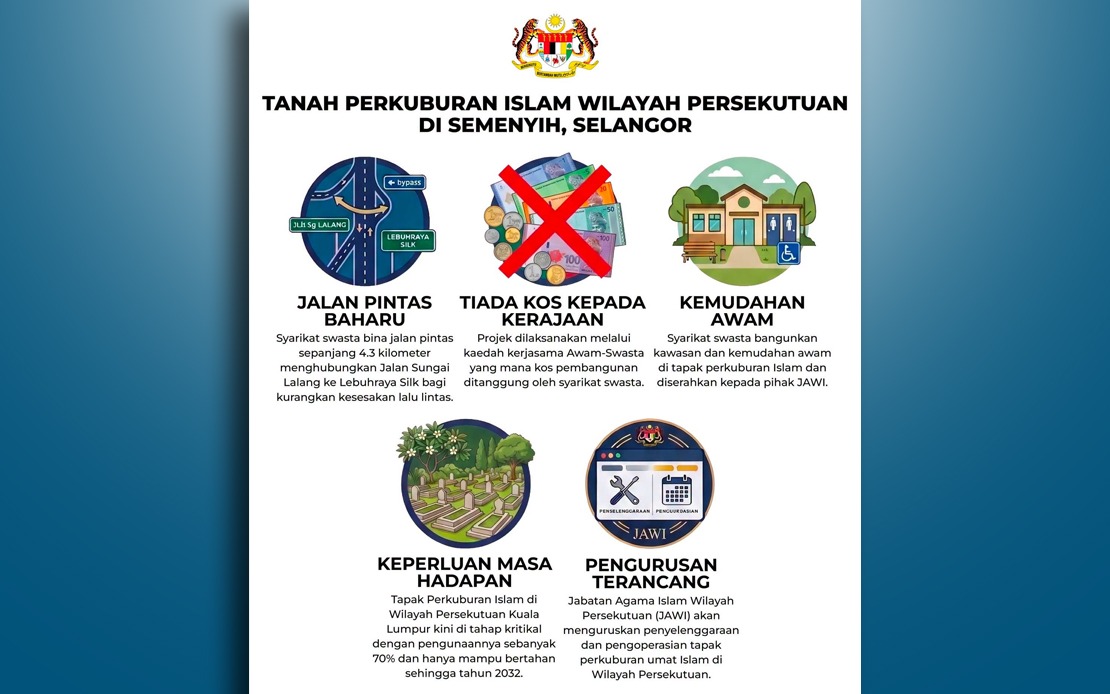
The government has moved to clarify the timeline and purpose of the Federal Territory Muslim Cemetery Development Project in Hulu Semenyih, Selangor, emphasising that the initiative traces its origins to 2005 and forms part of a coordinated strategy to manage Kuala Lumpur's acute shortage of Islamic burial land while simultaneously tackling localised traffic challenges in the region. Minister in the Prime Minister's Department (Federal Territories) Hannah Yeoh issued the statement through Facebook on July 8 after the project attracted confusion and speculation across social media platforms, where various versions of the development had circulated without comprehensive official detail.
The urgency underlying this initiative becomes apparent when examining the current state of Kuala Lumpur's existing burial infrastructure. The Islamic burial grounds presently serving the Federal Territory of Kuala Lumpur (FTKL) have already surpassed 70 per cent capacity utilisation, a threshold that signals an imminent crisis for funeral and burial administration. As of June 2023, only approximately 29 per cent of available plots remained—equivalent to 34,496 individual burial sites—and even this remaining inventory is projected to satisfy the community's needs only until approximately 2032. This tightening situation reflects broader demographic pressures within Malaysia's largest urban centre, where a rising Muslim population and the concentration of residents from across the country have progressively strained existing funerary infrastructure designed for earlier decades.
The proposed development encompasses a substantial 332.6-acre site owned by the Federal Lands Commissioner, where the developer will undertake construction of approximately 104,470 Muslim burial plots specifically designated for residents of the Federal Territory. This scale of expansion represents a transformative intervention in Kuala Lumpur's long-term planning, designed to secure adequate burial capacity for several decades beyond the anticipated 2032 depletion point. Beyond the primary cemetery function, the project incorporates comprehensive infrastructure elements including staff accommodation facilities, a surau for religious observance, administrative headquarters, visitor facilities including cafeteria and toilet blocks, security guardhouses, and foundational earthworks necessary to prepare the site. These ancillary provisions reflect recognition that modern cemeteries function as community facilities requiring diverse support services rather than purely as burial grounds.
The development structure employs a public-private partnership model wherein a private developer assumes full financial responsibility for infrastructure construction and provision, while the underlying land ownership remains with the Federal Lands Commissioner and operational control stays vested in the Federal Territories Islamic Religious Department (JAWI). This arrangement ensures that while private sector expertise and capital finance the physical development, religious administration and governance of the cemetery remain entirely within the purview of official Islamic institutions, precluding any suggestion of commercial operation of funerary services. The division of responsibilities reflects contemporary Malaysian governance approaches balancing efficiency gains from private sector involvement against preservation of public authority over culturally and religiously sensitive functions.
Allocating 10 per cent of the cemetery's total capacity for residents from surrounding Selangor areas demonstrates the project's recognition of cross-boundary demand patterns and broader regional demographic needs beyond Kuala Lumpur's strict administrative boundaries. This provision acknowledges that burial patterns frequently transcend municipal demarcations, with families scattered across metropolitan regions and individuals maintaining religious burial preferences connected to specific locations. The gesture toward regional communities also serves to mitigate potential local opposition in Hulu Semenyih by demonstrating tangible benefits to the surrounding population and presenting the development as addressing area-wide infrastructure deficiencies rather than merely Kuala Lumpur's internal challenges.
A complementary infrastructure component involves construction of a 4.3-kilometre link road connecting Jalan Sungai Lalang to the SILK Highway, a project element specifically designed to address traffic congestion patterns affecting the Semenyih area. Notably, the entire RM93.89 million cost for this road infrastructure has been designated as a development condition imposed by the Selangor state government and will be financed entirely by the private developer rather than public funds. This arrangement transforms the cemetery project into a mechanism for upgrading local transportation networks, providing residents with an alternative traffic corridor that should improve connectivity and reduce congestion on existing routes. The dual-purpose approach—simultaneously establishing burial capacity while improving traffic infrastructure—demonstrates integrated planning methodology addressing multiple community challenges through single major development.
The project has undergone extensive formal review processes intended to validate its feasibility and alignment with public interests. These assessments have included technical evaluations of engineering and site suitability, a Value Management Lab analysis examining efficiency and cost-benefit parameters, and approval proceedings conducted by both the Selangor state government and the Federal Government. This multi-layered approval framework reflects the complexity inherent in locating substantial facilities near populated areas and the necessity of coordinating between state and federal authorities in Selangor's specific administrative context. The thoroughness of review procedures aims to provide assurance that the location, design, and implementation approach have satisfied comprehensive evaluation standards before proceeding toward realisation.
For Malaysian readers and policymakers, this development carries significance extending beyond Kuala Lumpur's immediate concerns. The project exemplifies how major cities within Malaysia must proactively manage long-term infrastructure capacity, particularly for services addressing fundamental human needs like dignified burial according to religious traditions. The demographic pressures evident in Kuala Lumpur's burial situation reflect broader urbanisation trends affecting other Malaysian metropolitan areas, suggesting similar capacity challenges may emerge in Selangor, Johor Bahru, Penang, and other population centres within coming decades. The public-private partnership approach adopted here, balancing cost-sharing while preserving public institutional control over culturally sensitive functions, offers a potential governance model applicable to other essential services facing capacity constraints.
The timing of this clarification also underscores the contemporary challenge of information management in politically sensitive contexts, where social media speculation can rapidly generate public concern absent authoritative explanation. The Malaysian government's resort to official channels for direct communication reflects evolving recognition that major infrastructure projects require sustained public communication and transparent explanation of planning rationale, particularly when developments affect burial practices carrying profound religious and cultural significance. The clarification effort demonstrates commitment to addressing public confusion through systematic explanation rather than allowing narratives to crystallise unchallenged, an approach increasingly essential for maintaining public confidence in major government-facilitated developments.

