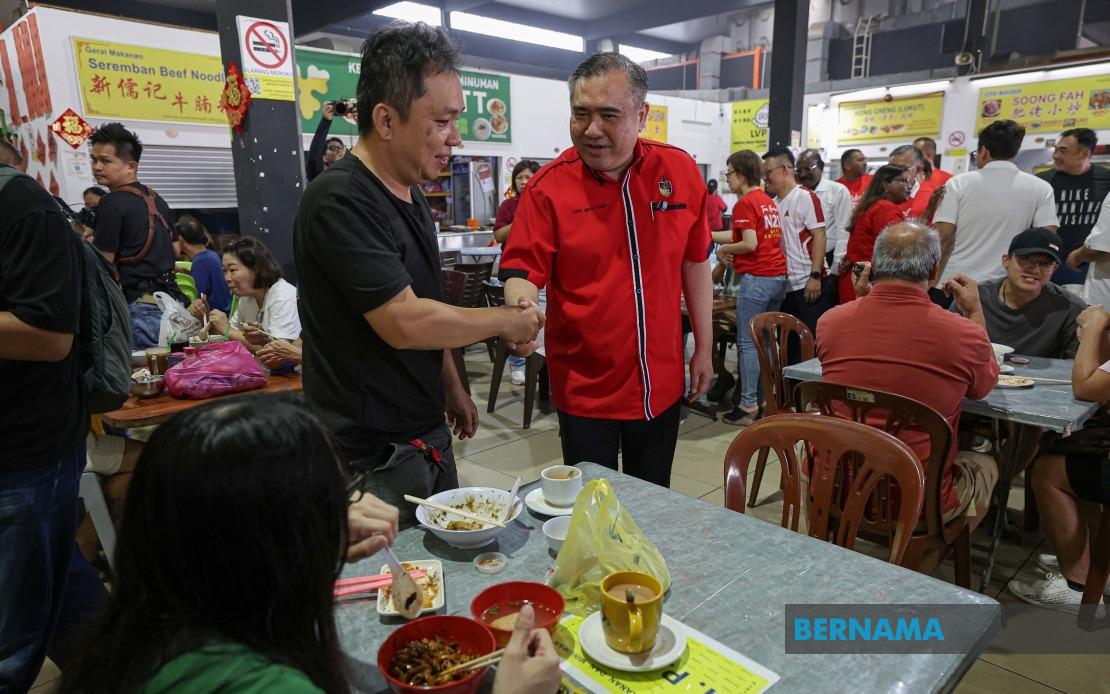
Transport Minister Anthony Loke has delivered a firm directive that all candidates, supporters, and campaign teams participating in the 16th Negeri Sembilan state election must maintain strict compliance with traffic regulations and road safety standards. Speaking in Seremban following a walkabout with Pakatan Harapan candidates, Loke stressed that adherence to these safety protocols is non-negotiable and essential for maintaining an orderly campaign environment free from preventable accidents.
The DAP secretary-general emphasised that winning the election, while important to all competing parties, cannot justify compromising public safety or breaking traffic laws. He highlighted the basic requirement of helmet usage as an indispensable foundation for campaign-related travel, particularly for those using motorcycles. This position reflects growing concern among political leaders about maintaining discipline within their own ranks while setting expectations for supporters during what can be high-energy periods of political activity.
Loke outlined how he has personally instituted helmet mandates within his own party's campaign operations, instructing all DAP teams to wear protective headgear whenever riding motorcycles throughout the campaign period. He provided a concrete example from the nomination day on July 19, when he participated in a convoy travelling from Pekan Titi to Kuala Klawang, where he made clear to all convoy participants that non-compliance with helmet requirements would result in exclusion from the group. This hands-on enforcement approach signals his intention to model the behaviour he expects from others.
Beyond helmet usage, Loke specifically condemned the practice of supporters riding on the tailgates of moving four-wheel-drive vehicles, characterising such behaviour as reckless and unnecessarily endangering lives. This particular warning suggests that campaign teams have been observed engaging in unsafe convoy practices where individuals perch precariously on vehicle exteriors while travelling at speed—a dangerous habit that election campaigns sometimes inadvertently encourage through their competitive, high-paced nature. By calling out this specific behaviour, Loke aims to prevent accidents that could taint campaign operations or result in serious injuries.
The minister's push for traffic compliance extends beyond his own party to encompass all political actors involved in the election campaign. He has called upon all parties, candidates, and leaders to demonstrate leadership by example, establishing a culture where observing traffic regulations becomes a visible part of campaign conduct. This approach recognises that public perception of political maturity and responsibility extends to how campaigns conduct their day-to-day activities, not merely their policy positions.
The Negeri Sembilan state assembly was dissolved on June 5, setting in motion the election process that culminated in nomination day on July 19. The Election Commission has scheduled August 1 as polling day, with early voting opportunities available on July 28 for eligible military personnel, police officers, and their spouses. This timeline compresses the campaign period into approximately six weeks, during which candidate visibility and ground activation become particularly intense, amplifying the risks associated with poorly regulated campaign travel.
The electoral roll for this state contest encompasses 889,490 registered voters across Negeri Sembilan. This population comprises 867,151 ordinary voters who will cast ballots on August 1, alongside 16,884 military personnel and spouses and 5,455 police officers eligible for early voting. The size of the electorate and the competitive nature of multiple constituencies mean that campaign teams will be conducting numerous events, convoys, and public engagements across the state during the coming weeks.
Loke's emphasis on traffic safety carries particular relevance in Malaysia, where road accident statistics remain a persistent public health concern. Campaign periods historically see increased vehicle movements and sometimes higher accident rates as teams conduct intensive ground operations across constituencies. By establishing clear safety expectations, Loke seeks to prove that political competition can occur within a framework of responsible public conduct, potentially setting a precedent that other state elections might follow.
The walkabout where Loke made these statements included six Pakatan Harapan candidates: Ho Weng Wah contesting Temiang, Lee Kai Yet in Mambau, Siau Meow Kong in Rahang, Nicole Tan in Bukit Kepayang, S. Mugunthan in Seremban Jaya, and Chew Seh Yong in Lobak. His public engagement with these candidates while simultaneously delivering the safety message demonstrates his intention to embed traffic compliance expectations throughout the coalition's campaign apparatus from the top down.
For Malaysian voters and observers, Loke's stance represents an important moment where a high-ranking politician explicitly connects political campaign conduct with broader public safety responsibilities. It challenges the notion that election periods warrant suspension of normal regulatory standards and instead asserts that mature democratic competition should occur within established legal and safety frameworks. As the campaign intensifies toward August 1, how effectively these standards are maintained will provide insights into the broader question of governance standards and civic responsibility among Malaysia's political class.

