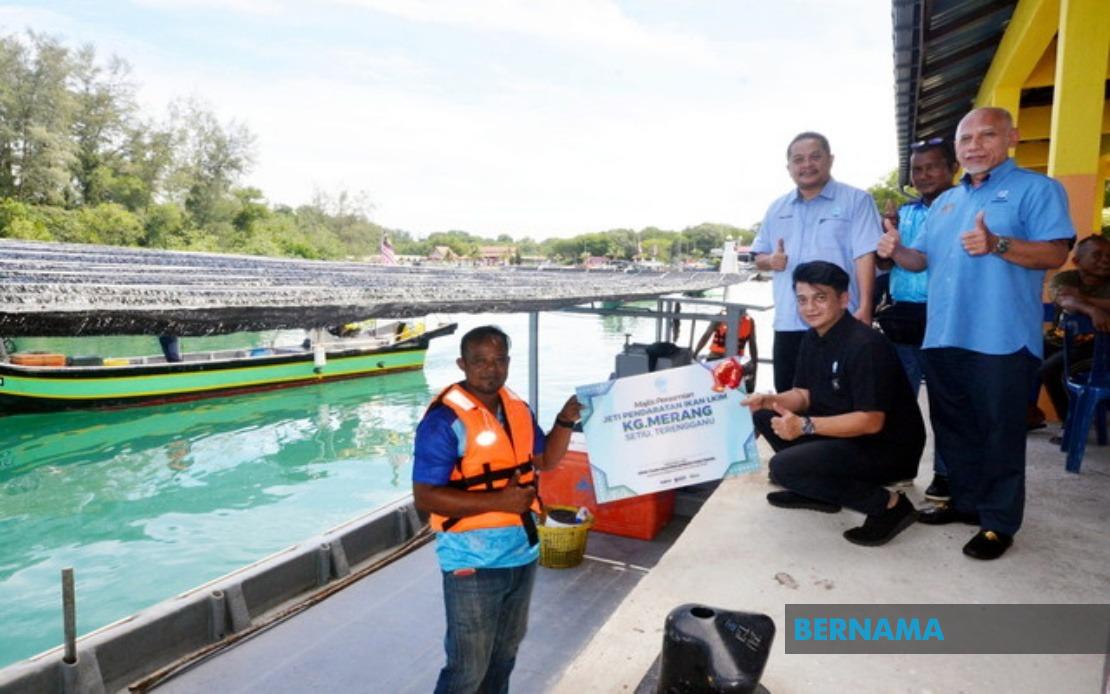
The Malaysian Fisheries Development Authority (LKIM) has committed RM2 million toward a nationwide programme to repair, upgrade, and construct fish landing jetties, addressing critical gaps in fisheries infrastructure that directly affect the livelihoods of thousands of fishing families across the nation. This investment, which commenced last year, represents a targeted approach to modernising landing facilities that remain central to Malaysia's fishing communities, particularly in Terengganu and other coastal regions.
At the official handover ceremony for the Kampung Merang Fish Landing Jetty in Bandar Permaisuri, LKIM chairman Muhammad Faiz Fadzil outlined the current state of the authority's infrastructure portfolio. The agency now oversees 372 fish landing jetties distributed throughout Malaysian waters, alongside 48 dedicated fisheries complexes and ports. This extensive network underscores the scale of Malaysia's fishing industry and the critical role that well-maintained landing facilities play in connecting independent fishermen to markets and ensuring supply chain efficiency.
Progress during the current financial year demonstrates tangible outcomes from the allocation. LKIM has completed construction of a brand-new fish landing jetty in Merang, while preparatory work continues on two additional projects—one in Perak and another in Labuan. Both facilities remain in the documentation and tender procurement stages, suggesting that the pipeline of infrastructure improvements extends beyond the current year. However, Muhammad Faiz acknowledged a persistent constraint that threatens to slow the pace of development. The current funding envelope, while meaningful, falls short of what would be required to address infrastructure deficits across all coastal districts simultaneously.
The Kampung Merang facility itself exemplifies the tangible benefits of targeted infrastructure investment. Built at a cost of RM500,000, the jetty officially commenced operations following the handover ceremony and is projected to serve 124 registered fishermen who operate 68 vessels. The new structure replaces an aging facility that villagers had originally constructed and maintained, but which no longer met contemporary safety or operational standards. This transition from informal, community-managed infrastructure to professionally engineered facilities reflects broader efforts to professionalise Malaysia's small-scale fishing sector.
Economic projections for the Setiu district, where Kampung Merang is located, suggest considerable upside potential from this infrastructure upgrade. Current fish landing records indicate that Setiu produces approximately 243 metric tonnes of fish annually. LKIM leadership expressed confidence that this figure will increase substantially once the new jetty reaches full operational capacity and fishermen become accustomed to its improved facilities and capabilities. Such increases would translate directly into higher volumes flowing through formal market channels and potentially improved price realisation for local producers.
The connection between landing infrastructure quality and fishermen's income remains a focal point of LKIM's operational philosophy. Muhammad Faiz emphasised that better-equipped facilities streamline the process through which fishermen market their daily catch, reducing time spent on landing procedures and enabling faster sales transactions. For fishing families whose household income depends almost entirely on the success of individual fishing expeditions, even marginal improvements in landing efficiency can yield meaningful income gains across a season. The new Kampung Merang jetty eliminates loading inefficiencies inherent in the previous structure and provides secure mooring that facilitates faster catch handling.
However, the authority faces a significant constraint in scaling this programme nationally. Muhammad Faiz formally requested that the government consider substantially increased allocations in the forthcoming federal budget. The RM2 million commitment represents progress, but achieving comprehensive modernisation of Malaysia's 372 existing jetties—let alone constructing additional facilities in underserved areas—would require substantially larger appropriations. This funding gap presents a policy challenge for the government, as inadequate landing infrastructure arguably represents a bottleneck that constrains productivity growth in the broader fisheries sector.
The strategic importance of fishing infrastructure extends beyond individual household economics. Fish landing facilities function as essential nodes within Malaysia's broader seafood supply chain, connecting primary producers in fishing communities to wholesalers, processors, and ultimately consumers domestically and internationally. Facilities that reduce post-catch losses, enable faster transport to processing facilities, and maintain product quality indirectly support Malaysia's seafood export competitiveness. Investment in landing infrastructure thus represents an investment in the country's agricultural export capacity and rural income generation.
The Merang project further illustrates how infrastructure development can support broader rural development objectives in coastal Terengganu. Fishing-dependent communities often experience above-average poverty rates and income volatility relative to urban populations. Strategic investments in essential production infrastructure can help stabilise incomes and reduce the economic pressures that drive rural-to-urban migration. By enhancing the profitability and efficiency of fishing operations, jetty improvements help anchor economically viable livelihoods in their home communities.
Looking forward, LKIM's infrastructure ambitions will likely intersect with broader policy discussions around economic stimulus and rural development. The authority's request for enhanced budget allocations comes at a time when many Malaysian states are prioritising infrastructure spending as a mechanism for supporting rural economies and employment. Whether future budgetary cycles provide the funding increases that LKIM seeks will substantially influence the pace at which Malaysia's fishing communities gain access to modern landing facilities. In the interim, projects like Kampung Merang will continue to demonstrate the direct economic returns that flow from targeted infrastructure investment in the fisheries sector.

