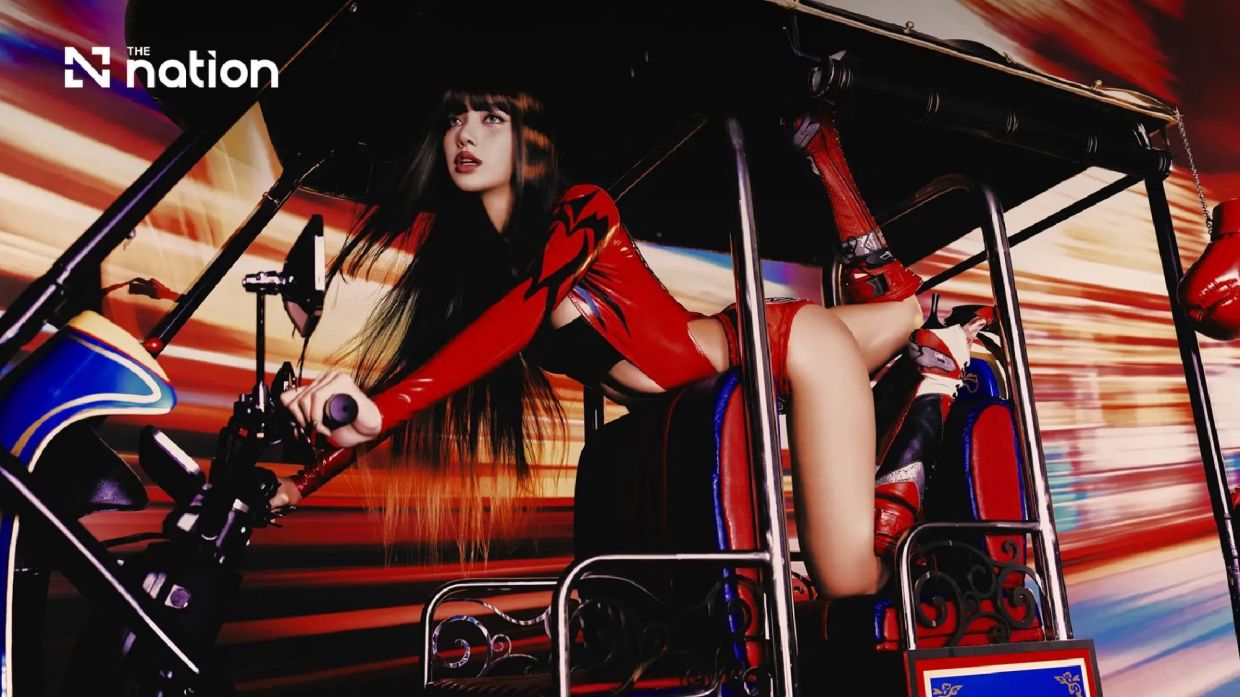
BLACKPINK's Thai member Lalisa "Lisa" Manobal is weaving her homeland's most recognisable cultural symbols into the visual DNA of her incoming single "SaWaDiKa", positioning Muay Thai and Thailand's beloved three-wheeled taxis as the focal points of a high-fashion campaign that arrives this week. The teaser images released ahead of Thursday's drop present Lisa in a contemporary reimagining of traditional boxing attire paired with cutting-edge styling, merging combat sports heritage with futuristic aesthetics in a way that speaks to both Thai audiences and her vast international fanbase.
The campaign imagery showcases Lisa in modified Muay Thai-inspired boxing shorts bearing her name in bold embroidery across the waistband, a styling choice that strips the sport's sacred traditions down to their visual essence before reconstructing them through a luxury fashion lens. A companion image places her astride a characteristic blue-and-red tuk-tuk, dressed in a sleek leather bodysuit and lace-up boots that echo the footwear worn by fighters in the ring. Streaking light effects surrounding the vehicle suggest velocity and momentum, creating a visual metaphor that transforms the humble transport icon into a vehicle for contemporary cool.
The single itself arrives on Thursday at 5pm Pacific Time and 8pm Eastern Time, materialising at 7am on Friday morning in Thailand—a carefully choreographed global release that ensures the Thai market receives the song at a natural waking hour. "SaWaDiKa" serves as the lead track from Lisa's forthcoming EP "PRESS PLAY", a six-song project scheduled for full release on October 23. The title is a stylised rendering of "sawasdee ka", the polite Thai greeting that forms the foundation of everyday courtesy in Thailand, a linguistic choice that positions the Thai language itself as a central character in the campaign rather than mere decoration.
The concept deliberately avoids straightforward reproduction of traditional Muay Thai ring wear, instead creating a dialogue between combat-sport references and forward-looking athletic fashion. By pairing Muay Thai—Thailand's most internationally recognised martial art—with the tuk-tuk, one of Southeast Asia's most visually distinctive modes of transport, Lisa's team has constructed a visual shorthand that communicates Thai identity to global audiences without relying on clichéd imagery. This approach reflects a broader strategy of presenting Thai culture not as a historical artifact to be preserved, but as a living, evolving force that can be reinterpreted through contemporary creative frameworks.
The promotional machinery surrounding the release began months before the single's formal announcement, when cryptic outdoor displays featuring "HELLO สวัสดีค่ะ [Sawasdee ka]" began appearing in major metropolitan centres including Bangkok, New York, Los Angeles and Mexico City. These billboards generated considerable speculation among Lisa's devoted fan community, who pieced together the campaign's identity through social media detective work before the artist herself confirmed the connection to new music. The strategy exemplifies how modern pop campaigns leverage fan engagement and online discourse as part of the promotional narrative itself.
That campaign announcement received swift validation from official Thai cultural institutions. Thapanee Kiatphaibool, governor of the Tourism Authority of Thailand (TAT), publicly endorsed Lisa's initiative in remarks posted beneath the singer's Instagram announcement, emphasising how the greeting's international promotion reinforces Thailand's reputation for warmth and hospitality. This institutional blessing carries significance beyond mere celebrity endorsement—it reflects Thailand's strategic recognition that Lisa, as a global cultural ambassador with unparalleled reach among younger international audiences, represents a powerful vehicle for soft power projection and tourism promotion.
Lisa's appointment as Amazing Thailand Ambassador in 2025 formalised a relationship that had already existed implicitly throughout her solo career. The tourism role mandates that she represent Thailand's character and cultural identity to international audiences, positioning her not simply as an entertainer with Thai roots but as an official representative of the nation itself. This formal arrangement transforms each creative choice within her music and visual campaign into something that carries diplomatic weight, making the decision to title a global single using a Thai greeting far more significant than a mere artistic preference.
The "SaWaDiKa" campaign extends a visual lineage that Lisa has been carefully constructing throughout her solo releases. Her 2021 debut "LALISA" incorporated traditional Thai dress, dance-inspired visual language and cultural musical inflections, with Lisa herself insisting on the inclusion of Thai elements despite the complexity of executing such a vision at that production scale. The accompanying music video presented her in an ornate gold Thai-inspired costume set against architecture and visual references to her native Buri Ram province, establishing a template for how she would integrate identity into international pop music.
"Rockstar", released in 2024, evolved that approach by transplanting Thai cultural elements into explicitly contemporary urban space. The video utilised Yaowarat Road within Bangkok's Chinatown and other recognisable Bangkok locations, creating a visual dialogue between futuristic pop aesthetics and the lived reality of Thailand's most vibrant urban environments. Rather than relegating Thai culture to heritage spaces, the production placed it firmly within the modern cityscape, suggesting that Thai identity and contemporary global pop culture are not competing forces but compatible and mutually enriching perspectives.
"SaWaDiKa" now represents the third major statement in this evolving artistic conversation, adding layers of meaning by incorporating not just visual symbols but language itself. The greeting transcends its communicative function to become a signature element of the campaign, appearing across outdoor advertising, streaming platforms and social media as a recognisable motif. This approach demonstrates how contemporary pop artists can leverage their platforms to introduce elements of their heritage cultures into global conversations, not through tourism boards or academic institutions but through the intimate, influential spaces where popular music actually reaches audiences.
The single's arrival comes at a moment when Southeast Asian artists have achieved unprecedented visibility within global pop structures, yet Lisa's consistent emphasis on Thai cultural specificity distinguishes her approach from colleagues who have moved toward placeless, culturally unmarked internationalism. By making Thai language, Thai sports, Thai infrastructure and Thai aesthetics the literal centerpieces of her campaigns, she has implicitly argued that local cultural rooting and global commercial success are not mutually exclusive but potentially reinforcing.
For Malaysian audiences and broader Southeast Asian observers, Lisa's ongoing project carries particular resonance. The region has historically grappled with questions about how to maintain cultural distinctiveness while participating in globalised entertainment industries. Lisa's answer—that cultural specificity can be a source of creative energy and commercial distinction rather than a limitation—offers a different model from the cultural homogenisation that often accompanies international pop success. As "SaWaDiKa" reaches audiences worldwide this week, followed by the full "PRESS PLAY" EP in October, her vision of culturally rooted global pop continues to gain institutional and commercial validation.

