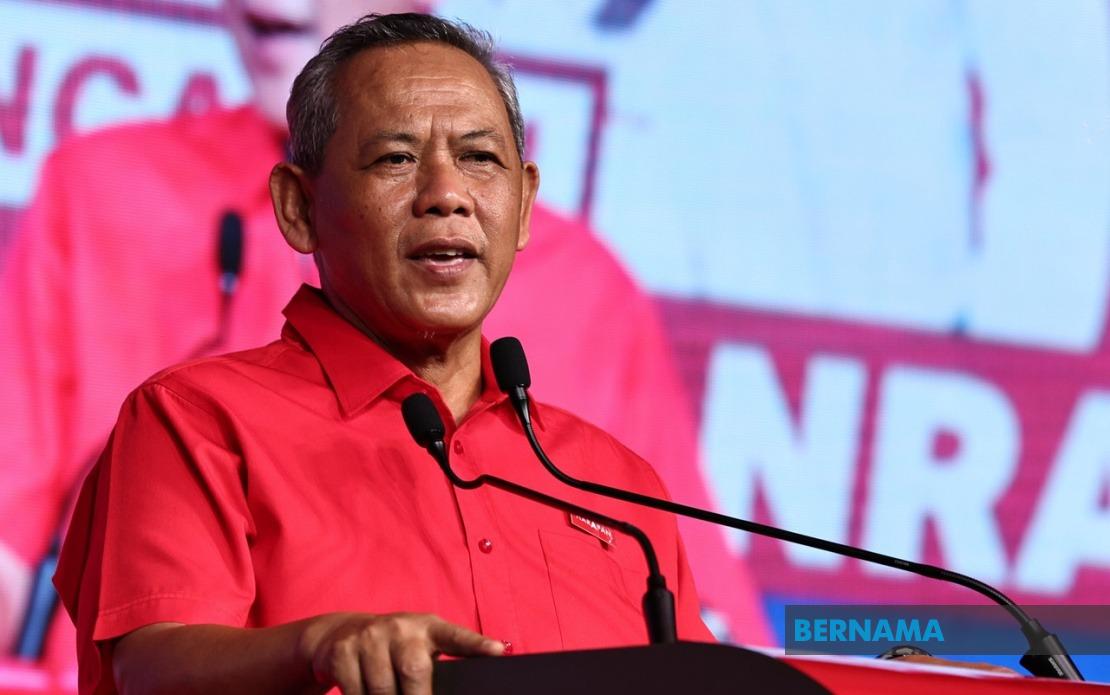
Menteri Besar Datuk Seri Aminuddin Harun has firmly rejected suggestions that his decision to contest the Linggi state seat in the forthcoming Negeri Sembilan state election signals an attempt to escape the Sikamat constituency, characterizing instead the move as a deliberate personal choice aimed at broadening his service to new communities.
Addressing speculation through a Facebook statement issued from Seremban on July 16, the Pakatan Harapan (PH) chairman for Negeri Sembilan emphasised his eagerness to extend his track record of constituency work to the residents of Linggi. He stated that should voters grant him the mandate, he would apply the same rigorous work ethic and commitment he had demonstrated across four consecutive election cycles in Sikamat.
Aminuddin's public clarification comes amid the typical political commentary that accompanies any high-profile candidate's decision to relocate constituencies, particularly when involving a state leader. The transition from defending an incumbent seat to opening a new electoral front frequently draws scrutiny about underlying motivations. His statement seeks to preempt such interpretations by framing the shift as an affirmative step rather than a defensive retreat.
Reflecting extensively on his political evolution in Sikamat, Aminuddin painted a detailed portrait of modest beginnings as an opposition figure constrained by minimal resources. He recounted operating from a modest office space situated above a ground-floor commercial unit, during years when his coalition commanded neither government resources nor substantial electoral machinery. Throughout that challenging period, community fundraising and volunteer-driven initiatives formed the backbone of grassroots service delivery, creating what Aminuddin characterizes as foundational memories of struggle and collective effort.
These early experiences in Sikamat, when PH remained outside government, appear to have shaped Aminuddin's political philosophy and constituent engagement approach. The contrast with contemporary circumstances, where Pakatan Harapan now governs Negeri Sembilan, underscores the remarkable trajectory of both the coalition and its leader within a single state context over recent years.
The Menteri Besar expressed profound gratitude toward Sikamat residents for their sustained support throughout his tenure representing the constituency. This acknowledgment serves a dual purpose: it recognises genuine community bonds built over multiple election cycles whilst simultaneously softening the narrative of departure by emphasizing continuity of goodwill and shared accomplishment rather than abandonment.
Aminuddin simultaneously extended his confidence in Nor Azman Mohamad, who has been selected as his successor in Sikamat. By publicly backing his replacement, Aminuddin attempts to ensure stable representation for the constituency whilst simultaneously legitimizing the succession process within PH's organizational framework. Such continuity pledges represent standard practice in orderly party transitions but carry particular weight when articulated by an outgoing legislator of ministerial rank.
The electoral mathematics of Linggi present a considerably different challenge compared to Sikamat's political terrain. Aminuddin will encounter Datuk Mohd Faizal Ramli, the incumbent assemblyman representing Linggi and a Barisan Nasional-backed candidate. Faizal's incumbent status and BN affiliation suggest a competitive contest quite unlike recent Sikamat contests, where PH's hold had strengthened over successive cycles. This transition to defending a marginal seat against an incumbent opposition candidate represents a genuine test of Aminuddin's personal appeal and organizational capacity beyond his established political stronghold.
The electoral calendar has been set with precision: nominations occur on Saturday, early voting is scheduled for July 28, and polling day arrives on August 1. This compressed timeline grants limited space for extended campaigning, placing emphasis on organizational preparation and candidate profile rather than drawn-out persuasion campaigns. For Aminuddin, the tight schedule provides little margin for error in establishing his candidacy within Linggi's electorate.
Aminuddin's decision to relocate carries implications extending beyond personal political calculation. It signals confidence in PH's organizational depth in Negeri Sembilan, implying that a capable replacement can competently hold Sikamat whilst the state's chief executive pursues electoral expansion elsewhere. Conversely, should Aminuddin lose Linggi, questions would inevitably surface regarding whether the risk of deploying a crucial leader in unfamiliar electoral territory was justified when Sikamat represented a safer political investment.
The broader strategic context involves PH's attempt to consolidate and expand its foothold in Negeri Sembilan following its ascendancy to state government. Aminuddin's shift toward Linggi can be interpreted as an offensive rather than defensive posture, one intended to capture additional assembly seats rather than protect existing territory. This interpretation contradicts the narrative of retreat implicit in claims about avoiding Sikamat, potentially reshaping how political observers assess both the move's rationale and the coalition's broader electoral ambitions within the state. Success in Linggi would reinforce such an interpretation; failure would resurrect alternative explanations regarding the decision's wisdom.

