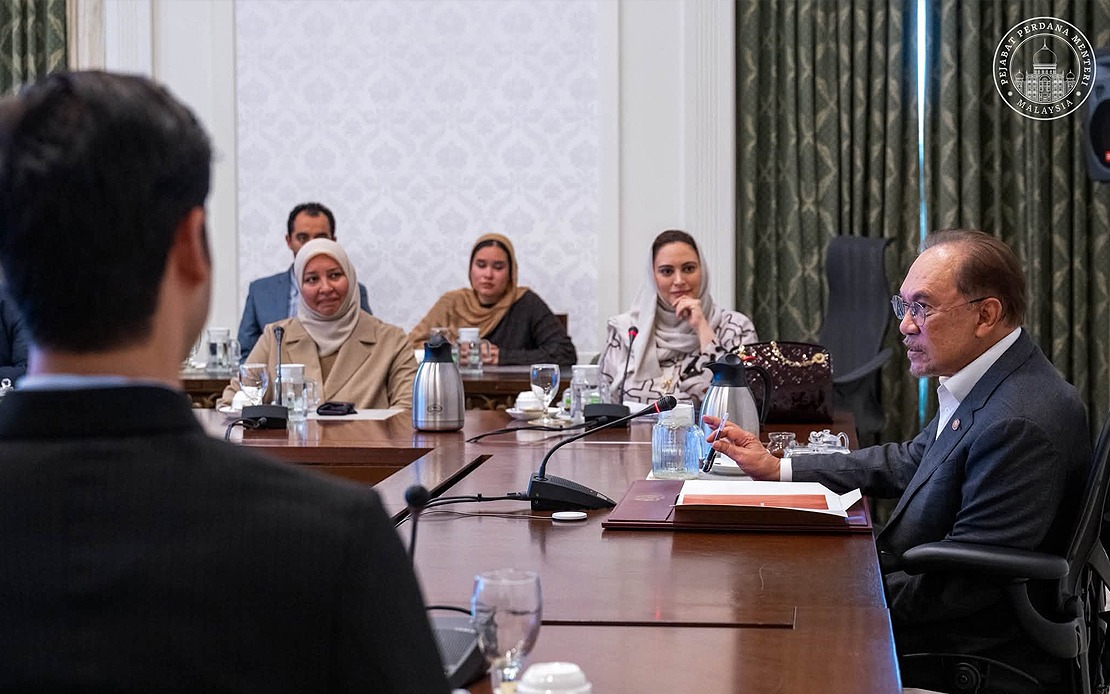
Prime Minister Datuk Seri Anwar Ibrahim has highlighted a central tension in contemporary governance: the need for leaders to evolve their approaches while remaining anchored to enduring principles. Speaking at the AZM Global Leaders Kuala Lumpur Summit 2026 held in Putrajaya, Anwar addressed 22 emerging leaders representing 12 nations, emphasizing that the path forward demands both intellectual flexibility and ethical constancy.
The summit brought together a carefully selected cohort of young leaders tasked with building networks that transcend geographical and cultural boundaries. Anwar's intervention at this gathering underscores the Malaysian government's investment in developing the next generation of cross-border collaborators and thinkers. The presence of participants from 12 different countries reflects the increasingly interconnected nature of regional challenges, from economic development to climate change and digital governance, which no single nation can address in isolation.
In his remarks, Anwar articulated a philosophy that distinguishes between flexibility in method and firmness in principle. He recognized that diverse cultural and social contexts demand leaders who can calibrate their approaches to local realities, yet he cautioned against allowing this pragmatism to erode the foundational elements that make leadership credible and institutions trustworthy. This balance between adaptation and consistency has become a defining characteristic of Anwar's public positioning, particularly as Malaysia navigates its transition toward a more pluralistic democratic model.
The Prime Minister's emphasis on wisdom, sound judgment, and patience speaks to a deeper concern about the velocity and nature of contemporary change. Young leaders entering positions of influence today face unprecedented pressures: rapid technological disruption, shifting geopolitical alignments, and populations increasingly skeptical of traditional institutional authority. Anwar's message suggests that durability in leadership comes not from rigid adherence to outdated methods, but from grounding adaptive strategies in unwavering commitment to trust and moral integrity.
The role of Muna AbuSulayman, identified as the project's founder, points to the involvement of regional thought leadership in shaping this initiative. AbuSulayman's involvement suggests the summit operates within broader networks of Southeast Asian and global intellectual discourse, where questions of ethical leadership and cross-cultural governance receive serious analytical attention. This places the Kuala Lumpur gathering within a larger ecosystem of leadership development initiatives that extend across the region and beyond.
For Malaysian readers and policymakers, Anwar's comments carry particular resonance given the country's own experience with leadership transitions and institutional reforms over recent decades. Malaysia's multicultural composition makes the question of how leaders navigate diversity while maintaining principled governance especially pressing. The Prime Minister's framing suggests that successful leadership in such contexts depends on leaders who can honor the distinct identities and values of different communities while advancing shared national interests.
The international dimension of the summit also reflects a strategic choice to position Malaysia as a convener and thought leader on governance questions. By hosting young leaders from across multiple nations and encouraging cross-border network-building, Malaysia positions itself as a venue where ideas about ethical, adaptive leadership can be incubated and disseminated. This soft power dimension complements more traditional diplomatic and trade engagement.
Anwar's invocation of patience as a necessary leadership quality merits particular attention in an age of immediate gratification and rapid communication cycles. Patience, in this context, likely refers to the willingness to allow foundational changes to take root without rushing toward visible results, and to resist the temptation to adopt expedient solutions that compromise long-term institutional credibility. This stands in contrast to some contemporary leadership trends that prioritize rapid action and demonstrable short-term wins.
The concept of "mutual benefit" that Anwar highlighted regarding future cross-border networks suggests an explicit rejection of zero-sum approaches to international and regional relations. This reflects Malaysia's historical positioning as a nation committed to multilateral cooperation, though it also represents an ideological stance in an era where great power competition increasingly emphasizes relative rather than absolute gains.
Looking forward, the success of initiatives like the AZM Global Leaders Summit will likely depend on whether the young leaders who participate can indeed internalize Anwar's dual message: that evolution and integrity are complementary rather than contradictory imperatives. Southeast Asian governance faces mounting pressures from economic inequality, digital transformation, climate impacts, and demographic change. Leaders who can navigate these while maintaining public trust will prove invaluable to regional stability and prosperity.
Anwar's framing also carries implicit criticism of leadership models that abandon principle for expedience, or conversely, that cling to outdated approaches in the name of tradition. By positioning himself as an advocate for this balanced approach, he articulates a vision of leadership suited to Malaysia's particular circumstances: a nation with deep historical roots, significant religious and cultural diversity, and considerable aspirations for regional and global influence. The challenge for emerging leaders globally, and particularly for those from the Asia-Pacific region, will be translating these philosophical insights into concrete institutional practices and policy choices.

