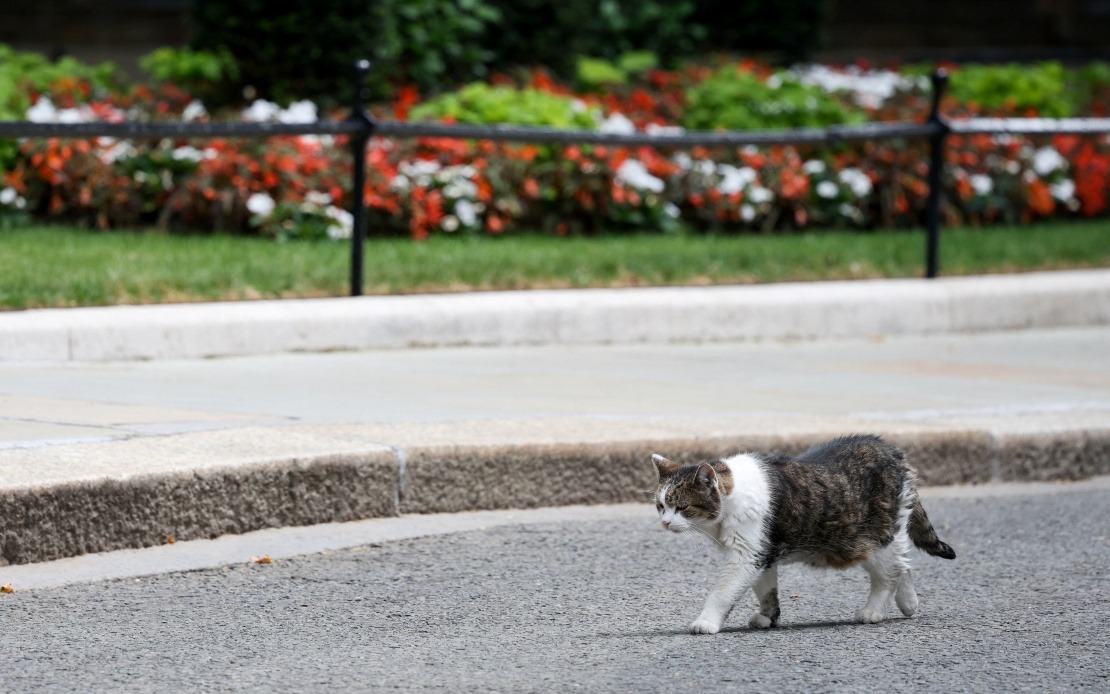
Britain's most famous feline has achieved what few politicians manage—longevity and continuity through some of the nation's most turbulent years in recent memory. Larry, the resident cat of 10 Downing Street, has now served through six prime ministers, a record that speaks to both his resilience and the considerable churn in British political leadership over the past decade and a half. The latest chapter in this remarkable tenure began when new Prime Minister Andy Burnham took office and convened his inaugural Cabinet meeting, with Larry appropriately spotted roaming the grounds of the prime minister's official residence on Tuesday, July 21.
The symbolism is difficult to ignore for observers of British politics, both domestic and international. While prime ministers come and go—some after just months in office, others after years of navigating crises and navigating party politics—Larry remains a constant presence at the heart of Westminster power. His tenure has coincided with some of the most consequential political events in modern British history, from the Brexit referendum and its bitter aftermath to pandemic management and economic turbulence. Through all of this, Larry has maintained his position as an unelected fixture with perhaps the most stable job in Downing Street.
For Malaysian and Southeast Asian observers, the spectacle of a nation's capital so focused on a cat during moments of political transition offers an interesting cultural contrast. While British media and public attention frequently gravitates toward Larry's activities—what he ate, where he slept, whom he acknowledged—the feline represents something deeper about institutional continuity and the role of tradition in the British system. In a region like Southeast Asia, where political transitions can be marked by considerable upheaval and institutional restructuring, the notion of a symbolic figure remaining unchanged across multiple administrations reflects a different approach to governance and institutional stability.
Larry first arrived at 10 Downing Street during David Cameron's premiership and has since witnessed the administrations of Theresa May, Boris Johnson, Liz Truss, Rishi Sunak, and now Andy Burnham. The cat's longevity outlasts most ministers, many of whom shuffle positions or exit politics entirely during their careers. This timeline captures an extraordinary period in British political history—the immediate post-Brexit era, the COVID-19 pandemic response, and multiple economic challenges that have tested the nation's political institutions and leadership capabilities. Through these seismic shifts, Larry has occupied a curiously important role in the nation's narrative about itself.
The image of Larry wandering outside the residence while the new Cabinet gathered inside carries its own weight. Cabinet meetings at 10 Downing Street represent moments when the machinery of government formally convenes to address pressing matters of state. Yet here was Larry, unbothered by the gravity of the moment, attending to his own priorities and rhythms. In many ways, this encapsulates the peculiarly British approach to blending the serious with the whimsical, where even during moments of high political consequence, there is space for the mundane and the quirky.
For those tracking British politics from afar, Larry's continued presence through six administrations also hints at questions about institutional memory and continuity. While politicians and civil servants change, and governments reshape priorities and policies, there exists within the machinery of Westminster something permanent and unchanging. The cat serves as an unintentional reminder that institutions can survive and persist regardless of who holds the top office. This has particular resonance in Southeast Asia, where questions about institutional strength, government continuity, and the relationship between individuals and offices remain ongoing preoccupations.
The public's affection for Larry has grown remarkably over his years at Downing Street, with the cat accumulating a significant following across British media and social media platforms. He has become something of a national character, with his comings and goings reported alongside more conventional political news. This phenomenon reflects something about how populations engage with politics and governance—sometimes through the gravitas of policy debate, but often through more humanising elements that make institutions feel accessible and real. Larry has become a bridge between the formal mechanisms of power and the everyday experience of citizens.
As Andy Burnham assumes his position as Prime Minister, Larry's continued presence signals both stability and the passage of time. The cat will undoubtedly feature in numerous photographs and news reports documenting this new administration, just as he has with his five predecessors. Whether he will remain for a seventh prime minister remains, of course, unknowable. But for now, Larry represents one of the few genuine continuities in British political life, a creature entirely indifferent to the political struggles that surround him, comfortable in his role as both witness and symbol.
The broader significance of such institutional symbols—even when they are felines—extends to how nations construct narratives about themselves and their governance. Britain, through its attachment to Larry, affirms certain values: tradition, continuity, eccentricity tempered with pragmatism, and the capacity to find levity even amid serious political business. For Malaysia and other nations in the region, observing how older democracies manage transitions through symbolic constancy offers interesting perspectives on governance beyond mere policy and procedure.

