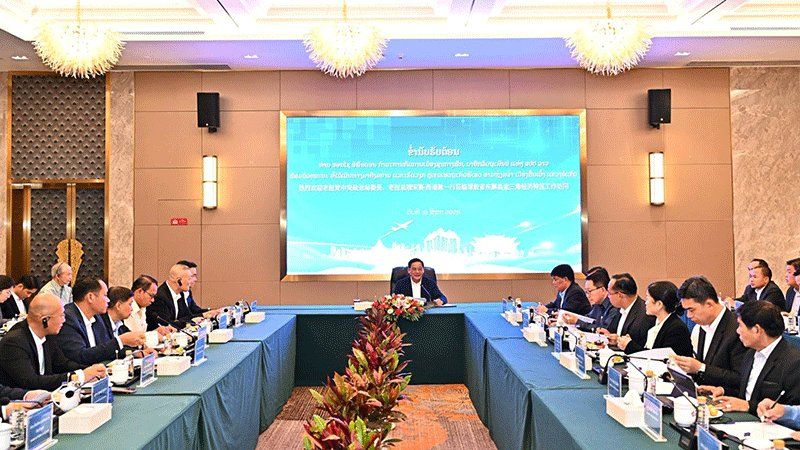
Prime Minister Sonexay Siphandone has intensified pressure on administrators of the Golden Triangle Special Economic Zone to enforce stricter oversight and redirect the massive investment enclave towards more sustainable and accountable development practices. During an inspection visit to the zone in Bokeo province's Tonpheung district on Tuesday, Dr Sonexay expressed concern that despite nearly two decades of operation and approximately US$10 billion in cumulative investment, the zone has fallen short of its potential and contractual obligations, prompting a high-level intervention to recalibrate management priorities.
The Golden Triangle Special Economic Zone, established in 2007 across 10,000 hectares, represents one of Southeast Asia's most strategically positioned investment corridors. Situated where the borders of Laos, Myanmar, Thailand and China converge along the Mekong River, the zone was designed to capitalise on its geographic advantages and proximity to major consumer markets. The initial development plan allocated 3,000 hectares for commercial activity and 7,000 hectares for preservation as forested areas, reflecting an intention to balance economic expansion with environmental stewardship. However, the trajectory of development has increasingly raised questions about whether the zone is delivering on the aspirations that attracted early investors.
A critical weakness identified by the Prime Minister's office is that only 60 per cent of activities specified in investment contracts have materialised. This significant shortfall—affecting approximately two decades of cumulative development—suggests systemic issues in enforcement, project management, or market conditions that have prevented investors from fulfilling their commitments. The underperformance metric indicates not merely sluggish growth but rather a fundamental disconnect between promised and actual economic activity, pointing to governance gaps that may have allowed inadequate accountability or monitoring mechanisms to persist unchecked.
Dr Sonexay's intervention centred on several operational and regulatory reforms. He instructed zone administrators to strengthen the one-stop-service system intended to streamline investment approvals and reduce bureaucratic friction. Concurrently, he demanded that authorities impose stricter enforcement of Laotian enterprise law, signalling that lax regulatory compliance may have been tolerated previously. Significantly, he mandated that all financial transactions—covering trade, investment, wage payments, service provision and other commercial activities—must be processed through the Lao banking system rather than circumventing formal financial channels. This directive addresses potential money-laundering risks and ensures government visibility over capital flows within the zone.
The Prime Minister also prioritised enhanced border controls, instructing officials to tighten entry and exit procedures within the zone. This measure reflects concerns about irregular movement of workers and goods across the porous boundaries where multiple nations converge. Accompanying this directive was a call for improved mechanisms to manage cross-border labour migration, particularly workers arriving from Myanmar, Thailand and China. Given the zone's substantial workforce of over 10,000 registered employees alongside unofficial populations of investors, residents and tourists, border management has become a critical governance challenge with implications for labour standards, tax compliance and security.
Additionally, Dr Sonexay ordered a comprehensive review and modernisation of concession agreements to ensure alignment with current Lao legislation. This retrospective alignment suggests that some agreements may have been structured under outdated legal frameworks or contained ambiguous terms that facilitated evasion of regulations. Strengthening the zone's Management and Administration Committee was also emphasised, implying that institutional capacity or political will to enforce existing rules had previously been inadequate. These structural reforms indicate a recognition that regulatory redesign, not merely exhortation, is necessary to achieve accountability.
The Prime Minister identified tourism, manufacturing, processing, transport, education and public health as priority sectors for concentrated investment and development. This sectoral prioritisation reflects Laos's broader economic strategy to move beyond extractive industries and develop higher-value, employment-intensive activities. Tourism development capitalises on the zone's cultural and geographic assets, while manufacturing and processing can integrate the zone into regional supply chains. Education and public health investments represent infrastructure development that enhances the zone's attractiveness to multinational investors seeking stable, skilled workforces and adequate social services.
Dr Sonexay's call for enhanced regional cooperation, including expanded airline connectivity and formalised worker-management protocols with neighbouring countries, acknowledges that the Golden Triangle's economic potential depends on seamless integration with Thailand, Myanmar and China. Improved air links would facilitate business travel and tourism, while coordinated labour policies would establish transparent, mutually beneficial cross-border employment frameworks. This diplomatic emphasis suggests that Laotian policymakers view the zone's underperformance partly as a regional coordination problem rather than purely a domestic management failure.
The zone currently hosts more than 10,000 registered workers, alongside over 10,000 investors, operators, residents and tourists, plus approximately 400 government officials deployed across various administrative functions. These figures indicate a complex, multi-stakeholder ecosystem that requires sophisticated governance. The substantial governmental presence—400 officials—raises questions about whether bureaucratic expansion has enhanced or hindered effective management and whether administrative structures are properly coordinated and incentivised to enforce regulations consistently.
For Malaysian policymakers and investors, the Golden Triangle SEZ's experience offers instructive lessons. The zone demonstrates how geographic advantage and substantial foreign capital can fail to generate proportionate economic returns without robust regulatory frameworks, consistent enforcement and accountability mechanisms. Malaysia's own special economic zones and development corridors—including the Iskandar Malaysia and East Coast Economic Region initiatives—have similarly encountered challenges balancing investor facilitation with regulatory oversight. Dr Sonexay's intervention suggests that periodic high-level reviews and regulatory recalibration are essential to prevent regulatory drift and ensure zones remain aligned with national development objectives.
Moreover, the Golden Triangle's labour-management challenges parallel concerns in Malaysia's manufacturing and services sectors regarding cross-border worker flows and informal employment. The Lao government's emphasis on channelling transactions through formal banking systems reflects growing regional emphasis on financial transparency and combating illicit capital flows—priorities that resonate across ASEAN as member states strengthen anti-corruption and anti-money-laundering frameworks. Southeast Asian investors and regulators should monitor how the Lao government implements these reforms, as successes or failures may inform best practices for special economic zone governance across the region.

