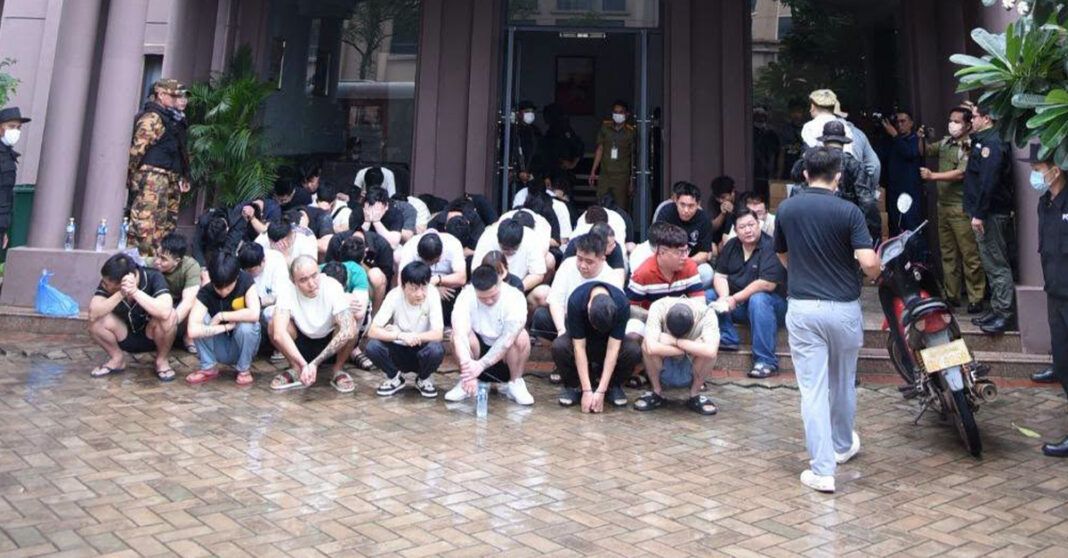
Laos has significantly escalated its enforcement operations against transnational scam networks, conducting a sweeping raid on 8 August at a telecommunications fraud and online gambling operation based in Vientiane's Thatluang Lake Special Economic Zone. The operation resulted in the detention of 261 suspects representing seven different nationalities, underscoring the international dimension of cybercrime operations now operating across Southeast Asia with apparent impunity. The scale of the arrests reflects growing concerns among regional governments about the proliferation of sophisticated criminal networks that exploit loopholes in cross-border enforcement and jurisdictional gaps.
Chinese nationals dominated the detained group, accounting for 153 individuals, while Vietnamese represented the second-largest contingent at 61 persons. Thai nationals comprised 36 of those held, with smaller representations including five Taiwanese, two Malaysians, two South Koreans, and two Myanmar nationals. The composition of the detainee list demonstrates how scam operations have become genuinely multinational enterprises, drawing participants from across the region and beyond. This diversity of nationalities suggests sophisticated international recruitment and organizational structures that span multiple countries and exploit the specific skills or vulnerabilities present in different labor markets.
Investigating officers recovered substantial amounts of equipment that would have facilitated the fraudulent activities. Police seized approximately 500 desktop computers and laptops alongside 2,355 mobile phones from the premises. The sheer volume of devices confiscated indicates an operation functioning at considerable scale, capable of orchestrating simultaneous fraud attempts across multiple channels and targeting numerous victims simultaneously. The building itself was identified as property belonging to Lao Thatluang Investment Development Co., Ltd., raising questions about corporate accountability and whether legitimate business entities inadvertently or deliberately facilitate illegal operations.
Laotian authorities have indicated their commitment to pursuing the investigation beyond the initial arrests, with officials explicitly stating their intention to identify and apprehend the operation's ringleaders and supporting network members for prosecution. This suggests the detained individuals may represent lower and mid-level operatives rather than the architects of the scheme, a common pattern in transnational criminal organizations where hierarchical structures insulate leadership from direct exposure. The prosecutorial framework referenced indicates Laos is prepared to deploy its legal mechanisms against the broader criminal ecosystem sustaining these operations.
The timing of this raid coincides with a broader governmental campaign targeting scam networks throughout Laos, demonstrating a coordinated and sustained policy response rather than isolated enforcement actions. Authorities have recognized that such criminal enterprises represent a significant threat to national reputation, attract unwanted international scrutiny, and generate substantial revenue for organized crime syndicates that potentially fund other illicit activities. The commitment to a nationwide crackdown suggests political will at the highest levels to address a phenomenon that has become increasingly visible and damaging.
Two days following the Thatluang Lake SEZ raid, Laotian authorities deported 41 Thai suspects to Thailand via the 1st Lao-Thai Friendship Bridge on 10 August, continuing a pattern of cross-border deportations that had commenced with the handover of 32 Thai nationals through the same crossing on 6 August. These successive deportations brought the cumulative number of Thai nationals removed from Lao territory to at least 73 individuals within a compressed timeframe. The rapid succession of deportations indicates either coordination between Laotian and Thai law enforcement or a deliberate Laotian strategy to expel foreign nationals involved in scam operations expeditiously.
The deportations originated from an earlier enforcement operation conducted on 18 July targeting the ST Vegas complex located in Dongphosy village within Hatsayfong district in Vientiane. That particular raid had yielded 589 suspected scammers in total, representing a substantially larger haul than the subsequent Thatluang Lake SEZ operation. Thai nationals predominated among those detained in the ST Vegas raid, followed by Laotian, Vietnamese, and Cambodian individuals. The progression from the ST Vegas operation through multiple deportations to the Thatluang Lake raid suggests authorities have been methodically dismantling an interconnected network of fraudulent enterprises operating across multiple locations.
For Malaysian readers and businesses, these developments carry important implications. Malaysian nationals appear in the detainee lists, albeit in limited numbers, indicating that Malaysian individuals remain susceptible to recruitment into transnational scam networks despite awareness campaigns. More significantly, the raids underscore vulnerabilities in Southeast Asia's cross-border enforcement coordination, particularly regarding how foreign nationals are recruited, deployed, and sometimes repatriated. The existence of these operations in Laotian SEZs raises questions about the adequacy of regulatory oversight in special economic zones throughout the region, which often operate under relaxed business licensing requirements and reduced governmental scrutiny.
The scale and sophistication of these scam operations represent a growing regional concern that extends beyond law enforcement into diplomatic and economic spheres. The proliferation of such networks damages confidence in the region's regulatory environments and potentially deters legitimate investment and business activity. For Malaysian businesses operating in or contemplating expansion into Laos or other Southeast Asian jurisdictions, the raids serve as a reminder that due diligence must encompass not merely contractual partners but also the broader security and regulatory environment. The Laotian government's demonstrated willingness to conduct high-profile enforcement operations may be partly motivated by international pressure and the desire to restore confidence in the country's business environment.
Looking forward, the effectiveness of Laos's crackdown will depend on sustaining enforcement efforts and preventing the rapid reconstitution of fraudulent networks in alternative locations. Criminal organizations typically respond to increased enforcement in one jurisdiction by relocating to less thoroughly monitored areas. Consequently, the regional implications of these Laotian operations may manifest as shifts in scam activity rather than genuine reduction in fraud targeting Southeast Asian and global populations. Thai, Vietnamese, and Cambodian authorities should anticipate potential displacement of these criminal networks to their territories unless coordinated regional enforcement frameworks emerge.

