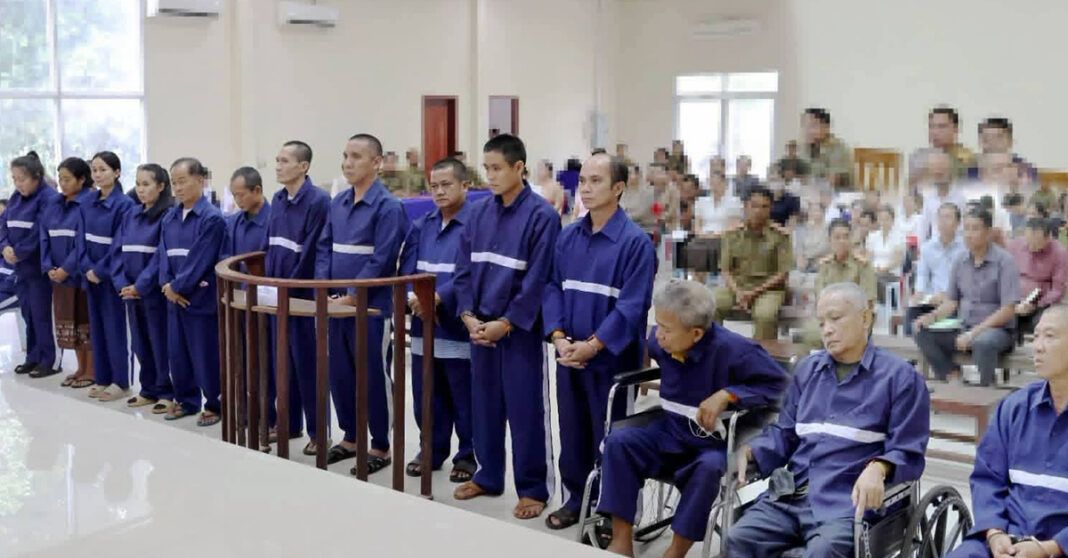
Laos has escalated its anti-corruption enforcement with a sweeping verdict from the Attapeu Provincial People's Court on July 30, when judges sentenced 15 provincial officials for large-scale embezzlement spanning four years. The ruling, announced by court office head Lattana Simavath, handed down life imprisonment to 10 of the defendants in what represents one of Attapeu Province's most significant corruption cases in recent memory. The sentence reflects intensifying judicial pressure on high-level officials across Southeast Asia's smaller economies, where governance safeguards remain fragile and asset recovery remains a persistent challenge.
The corruption network operated between 2021 and 2024 under the direction of Sulixay "Mou" Suliyalay, a 37-year-old former deputy section head at the provincial office's research department who orchestrated the scheme's mechanics. Court investigators traced approximately LAK 103.5 billion, USD 2,356,000, and VND 1.5 billion—totalling roughly USD 7 million at current exchange rates—moving through the defendants' hands during the investigation period. The defendants employed currency conversion tactics, deliberately shifting funds between Vietnamese dong, Lao kip, and Thai baht to obscure transaction trails and complicate forensic accounting. Such financial obfuscation across multiple currencies is common in the region, where porous borders and integrated trade networks create natural conduits for laundering proceeds.
Despite the gross flow of stolen funds, the court established that Attapeu Province's confirmed, quantifiable state loss reached LAK 51.9 billion (approximately USD 2.4 million), USD 2,316,000, and THB 60,000—a significantly lower figure that reflects the challenges inherent in proving damages in complex multi-defendant schemes. This distinction between traced funds and confirmed losses carries important implications for asset recovery efforts, as Lao authorities must demonstrate concrete state harm to secure restitution orders enforceable in both domestic and international contexts. For Malaysian observers, this underscores the complexity of cross-border financial crime investigation and the evidentiary burden placed on developing-economy judiciaries pursuing sophisticated embezzlement cases.
The 10 officials receiving life sentences included Sulichanh Phonkeo, the 55-year-old former Chief of the Provincial Office who held the highest rank among the convicted defendants. Sounnakhone Keoviengkham, 59 and former Head of Planning and Investment, and Khamphery Somthavone, 60, the retired former head of provincial finance, joined Phonkeo in receiving life terms. The court also sentenced Thounxay Mekdavong, another retired finance official, alongside Somsack Mountivong, Inpong Silavikone, Manisone Phetvilay, Nipaphone Phothilath, and Phouthidavanh Kaysonesena to life imprisonment. The breadth of this cohort—spanning finance, planning, and administrative functions across multiple rank levels—suggests a systematic institutional vulnerability rather than isolated misconduct by individuals.
The remaining five defendants received differentiated sentences reflecting their individual culpability. Outthali Singthammavong, the 43-year-old former head of administration, received 20 years imprisonment, while Simmali Khamman, a provincial office official, was sentenced to 18 years and six months. Keophouthone Vilathum, a former provincial finance official aged 47, drew 16 years and six months, indicating that the court distinguished between the primary architects and secondary participants. Souksavanh Bounphan, the 55-year-old former deputy head of provincial finance, received only five years, suggesting either limited direct involvement or significant mitigating factors. Phonpiloun Xaysombath, former deputy head of the accounting and audit department, received two years and six months, having already served seven months and 11 days in detention.
The case proceedings also encompassed a sixteenth defendant, Soukmay Soutbounlon, whose death during trial led the court to close proceedings against him individually. However, his seized assets remain liable for civil damages recovery, meaning his heirs may face reduced inheritance as the state pursues restitution through asset claims. This approach reflects regional courts' increasing sophistication in pursuing financial remedies beyond criminal incarceration, recognizing that personal imprisonment alone fails to restore stolen public resources.
The Attapeu verdict emerged amid an even broader anti-corruption wave sweeping Laos's capital, where the Vientiane Capital People's Court simultaneously pursued separate high-profile cases. In early July, that court sentenced 17 defendants across four distinct corruption investigations involving the State Inspection Authority, the Bank of the Lao PDR, the Agricultural Promotion Bank, the Ministry of Foreign Affairs, and Electricity of Laos. The aggregate damages and compensation ordered exceeded USD 27 million, with the Electricity of Laos hydropower corruption case alone accounting for more than USD 24.8 million in restitution orders. These verdicts targeted senior banking officials, foreign ministry personnel, and at least 10 life-sentenced defendants including former state enterprise executives and a Thai national convicted of involvement in hydropower scheme corruption.
The convergence of major corruption prosecutions across Laos's provincial and capital jurisdictions signals a deliberate governmental strategy to address institutional graft across multiple sectors simultaneously. The prominence of life sentences—applied routinely to senior officials found guilty of abusing fiduciary trust in financial, energy, and administrative domains—contrasts sharply with sentencing patterns in earlier years and suggests heightened policy commitment to deterrence through severe penalties. For Southeast Asian governments struggling with corruption's governance costs, Laos's approach offers both model and cautionary tale: aggressive prosecution may generate public confidence in institutions, yet the persistence of sophisticated schemes despite existing legal frameworks points toward persistent structural vulnerabilities requiring deeper reform beyond courtroom remedies.
The timing of these verdicts carries regional significance as Southeast Asian economies face mounting pressure from international financial institutions and development partners to strengthen anti-corruption machinery. Malaysia, as a regional economic leader with its own history of high-profile corruption cases, observes neighboring jurisdictions' prosecutorial models while calibrating its institutional approaches. The Attapeu and Vientiane cases illustrate how smaller economies' courts attempt to assert institutional independence and state capacity through high-visibility sentencing, though questions persist regarding whether such prosecutions reflect systematic reform or episodic enforcement against selected targets. Asset recovery—the practical dimension where stolen resources return to state treasuries—remains substantially more challenging than conviction, as demonstrated by the disparity between traced funds (USD 7 million) and confirmed recoverable losses (USD 2.4 million) in the Attapeu case alone.

