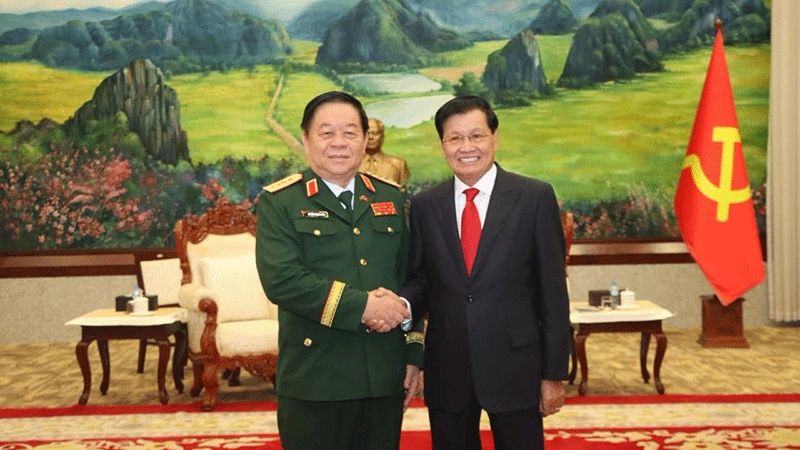
The leadership of Laos has celebrated the outcomes of recent military discussions with Vietnam, signalling a fresh round of strengthened defence cooperation between the two Southeast Asian neighbours. On August 6, President Thongloun Sisoulith, who also serves as Secretary General of the Lao People's Revolutionary Party Central Committee, met with General Nguyen Trong Nghia, Chairman of the General Department of Politics of the Vietnam People's Army, to discuss the implications of talks held between their respective military institutions.
General Nguyen Trong Nghia arrived in Vientiane on August 5 for an official three-day visit designed specifically to bolster defence collaboration and reaffirm the enduring special relationship between the two nations. The delegation's presence underscores the priority both governments place on their military partnership, which forms a cornerstone of broader regional security architecture in mainland Southeast Asia. Vietnam and Laos have maintained exceptionally close ties since the end of the Cold War, and defence cooperation remains one of the most substantive pillars of their bilateral engagement.
During the courtesy call at the presidential office, Thongloun emphasised the significance of the visit as a continuation of deepening ties between the two parties, governments, armies and populations. The Lao leader highlighted his appreciation for the delegation's presence and characterised the military talks as instrumental in expanding practical cooperation. By framing the discussions in terms of "great friendship" and "special solidarity," Thongloun invoked language deeply embedded in Lao-Vietnamese relations, reflecting shared revolutionary histories and ideological alignment that predates modern state relations.
The talks between the General Departments of Politics of both armies yielded concrete areas for expanded cooperation. According to the Vietnamese news agency's account of the meetings, senior defence officials from both sides have committed to enhancing coordination on multiple fronts. Political education initiatives represent a significant component of this partnership, aimed at ensuring that younger generations understand the historical foundations and contemporary relevance of Lao-Vietnamese friendship. This intergenerational transmission of solidarity reflects both governments' view that military ties alone are insufficient without complementary efforts to build popular support for the relationship.
Border management emerged as a priority area in the discussions between General Nguyen Trong Nghia and Lieutenant General Vongsone Inpanphim, the Deputy Minister of National Defence and Director General of the General Department of Politics of the Lao People's Army. The Laos-Vietnam border, stretching over 2,000 kilometres, remains a sensitive issue given historical complexities in the region and ongoing concerns about transnational challenges. Enhanced cooperation in this domain addresses practical security matters while demonstrating both governments' commitment to maintaining stability along their shared frontier and preventing unauthorised cross-border activities.
Military exchanges and personnel training constitute additional pillars of the renewed partnership framework. By rotating officers, facilitating training programmes and enabling joint exercises, both armies strengthen their operational interoperability and institutional understanding. Such exchanges also serve a broader diplomatic function, humanising military-to-military relations and building personal networks among defence professionals that can smooth cooperation during crises or periods of tension. For Laos, access to Vietnamese military expertise and training capacity represents significant strategic value given Vietnam's larger defence establishment and combat experience.
General Nguyen Trong Nghia's engagement with Laotian defence officials, including his meeting with Deputy Prime Minister and Defence Minister General Khamlieng Outhakaisone, demonstrated the high-level nature of the delegation and the formal significance both capitals attach to the visit. The selection of such senior personnel for bilateral discussions signals that the agenda encompasses strategic matters extending beyond routine military cooperation. Both generals reiterated their nations' commitment to treating defence collaboration as a fundamental element of their comprehensive strategic partnership, language that suggests this relationship encompasses political, economic and security dimensions.
For observers of Southeast Asian affairs, this visit illustrates the resilience and importance of the Laos-Vietnam axis in the region. While much international attention focuses on competition between major powers for influence in Southeast Asia, the bilateral defence relationship between these two neighbours remains one of the most institutionalised and consistently prioritised partnerships among regional states. Neither Laos nor Vietnam publicly frames their cooperation in oppositional terms toward other powers, though their alignment does reflect shared perspectives on regional autonomy and resistance to external pressure.
The emphasis on educating younger generations about Lao-Vietnamese history carries particular significance given demographic change across both nations. As time distances current populations from the shared revolutionary struggles that forged the partnership, deliberate efforts to inculcate understanding of this bond become necessary to maintain popular support for government policies. Both regimes recognise that strategic partnerships require domestic legitimacy, and framing defence cooperation as an extension of historical friendship rather than mere state interest helps sustain public consent for military expenditures and coordination.
The visit also reflects pragmatic considerations regarding border security, transnational crime and regional stability. Both countries face challenges related to drug trafficking, weapons smuggling and irregular migration along their frontier and across the broader Mekong region. Improved military coordination and information-sharing capabilities directly support law enforcement efforts and contribute to maintaining order in border communities. Enhanced border management, therefore, serves both security and development objectives by creating conditions conducive to economic activity and regional integration.
Looking forward, the outcomes of General Nguyen Trong Nghia's visit will likely translate into expanded military-to-military contact, joint training initiatives and possibly coordinated defence procurement or technological cooperation. Vietnam's position as a more militarily developed nation means Laos benefits substantially from access to its experience and resources. Simultaneously, Vietnam maintains strategic interests in ensuring stability in its western neighbour and preserving influence over Lao defence policy, making the investment in this relationship reciprocally beneficial.
The reaffirmation of commitment to defence cooperation during this visit demonstrates that despite regional uncertainties and evolving international alignments, the Laos-Vietnam partnership remains a stable constant in mainland Southeast Asian geopolitics. Both nations have invested substantially in this relationship across decades, and neither shows signs of deprioritising it. As the region navigates complex challenges ranging from great power competition to transnational security threats, the continued strengthening of these bilateral ties provides a foundation of predictability and shared interest that will likely endure.

