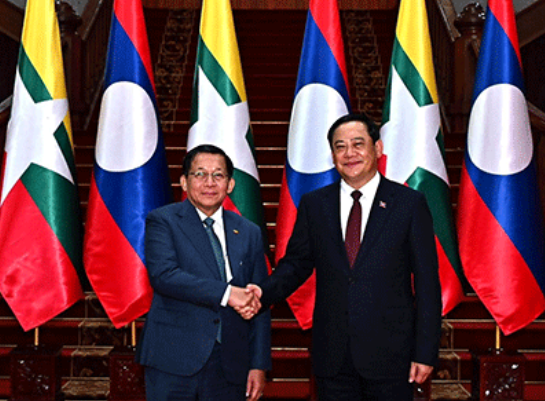
Myanmar President Min Aung Hlaing concluded a significant three-day state visit to Laos from July 3 to 5, cementing commitments between the two Southeast Asian neighbours to broaden their partnership across political, economic, and security domains. The visit, hosted by Lao President Thongloun Sisoulith, marked a milestone in relations between the countries, which have maintained diplomatic ties for seven decades. The Myanmar leader's choice of Laos as his first official destination following his assumption of office underscored the importance both capitals place on their relationship and signalled a mutual desire to accelerate cooperation in areas ranging from border management to regional integration.
The state reception at the Presidential Palace in Vientiane set a formal tone for the engagement, with President Thongloun and his wife Naly Sisoulith extending full ceremonial honours to the Myanmar delegation. This symbolic gesture reflected the depth of respect between the two governments and the traditional bonds linking their peoples. During bilateral talks, both leaders reviewed the trajectory of their partnership and explored opportunities to deepen institutional cooperation. President Thongloun took the occasion to commend Myanmar's recent democratic exercises, offering diplomatic recognition of the country's electoral processes and voicing confidence in its trajectory under Min Aung Hlaing's administration.
The framework for future engagement encompasses several strategic priorities that resonate throughout Southeast Asia's development agenda. Border security and information-sharing mechanisms emerged as central concerns, reflecting broader regional anxieties about transnational challenges including human trafficking, narcotics smuggling, and irregular migration. Both nations recognised that effective coordination at their shared frontier would benefit their populations and contribute to stability in the wider Mekong subregion. The two sides also committed to strengthening their participation in multilateral forums, particularly within the Association of Southeast Asian Nations, where Laos and Myanmar can amplify their voices on issues affecting developing economies in the region.
Practical cooperation agreements signed during the visit demonstrated the tangible dimension of renewed bilateral commitment. A memorandum of understanding on tourism cooperation between Laos' Ministry of Culture and Tourism and Myanmar's Ministry of Hotels, Tourism and Culture acknowledged the significant potential for visitor flows between the countries. Given the growing importance of tourism to Southeast Asian economies and the appeal of both nations' cultural heritage, this accord could facilitate people-to-people exchanges and generate economic benefits for communities in both countries. The establishment of sister-city relations between Vientiane and Naypyidaw further institutionalised cooperation at the municipal level, creating channels for direct engagement between local administrations.
Defence and security cooperation represents another pillar of the strengthened relationship. The two nations agreed to expand collaboration in these domains, recognising that mutual security interests and shared challenges warrant closer coordination. For Myanmar, which faces complex security dynamics in its borderlands, partnership with Laos offers opportunities for intelligence sharing and coordinated responses to transnational threats. For Laos, deepening security ties with a larger neighbour reinforces its own capacity-building efforts and diversifies its security partnerships beyond traditional relationships. These arrangements reflect a pragmatic approach to regional stability, particularly given the interconnected nature of security challenges in mainland Southeast Asia.
Parliamentary cooperation features prominently in the institutional architecture of the renewed partnership. National Assembly President Xaysomphone Phomvihane, in separate discussions with the Myanmar President, committed to strengthening ties between Laos' legislature and Myanmar's Union Parliament. This legislative dimension is particularly significant, as it suggests that both governments intend to embed their bilateral commitments in domestic legal frameworks and parliamentary oversight mechanisms. By encouraging their respective legislatures to actively monitor the implementation of bilateral agreements, both countries signal their commitment to translating diplomatic pledges into concrete policy outcomes that benefit their citizens.
The economic dimensions of the partnership extend across multiple sectors with direct implications for both nations' development strategies. Trade and investment featured prominently in discussions, reflecting recognition that economic integration can drive mutual prosperity. Transport infrastructure cooperation holds particular importance for landlocked Laos, which seeks to improve connectivity with neighbouring markets and reduce logistics costs for businesses. Energy cooperation also emerged as a key area, with potential applications ranging from hydropower development to electricity trade arrangements. Labour mobility agreements could facilitate the movement of workers across borders, supporting skills development and remittance flows that contribute to household incomes in both countries.
The handover of snake antivenom serum to the Lao Ministry of Health during the visit represented a humanitarian dimension often overlooked in discussions of state diplomacy. This practical gesture underscores how bilateral relationships can address public health challenges affecting ordinary citizens. Such cooperation on health security matters assumes greater relevance in the post-pandemic context, when Southeast Asian nations increasingly recognise the cross-border nature of health threats and the value of collective preparedness.
The Mekong-Lancang Cooperation framework figures prominently in the bilateral agenda, reflecting both nations' commitment to subregional development initiatives. This multilateral platform, which includes China and Thailand alongside Laos and Myanmar, addresses shared challenges in the Mekong basin including water security, agricultural development, and infrastructure integration. By strengthening their bilateral foundation, Laos and Myanmar enhance their capacity to engage constructively within this broader framework and to coordinate positions on issues affecting the Mekong region.
Cross-border air pollution emerged as a specific concern in bilateral discussions, a recognition that environmental challenges respect no borders and demand coordinated responses. During dry seasons, agricultural burning and industrial activities in one country can degrade air quality across the region, affecting public health in neighbouring states. The commitment to address this issue jointly signals an understanding that environmental stewardship and economic development must proceed in tandem, and that bilateral cooperation mechanisms can serve environmental protection objectives.
The Myanmar President's schedule, which included ceremonial activities such as laying a wreath at the Unknown Soldier Monument, conveyed respect for Lao national history and the sacrifices of the Lao revolutionary struggle. The participation in traditional Baci ceremonies and attendance at a state banquet embedded the official visit within cultural frameworks meaningful to both societies, elevating the engagement beyond transactional diplomacy to the realm of civilisational connection. These cultural dimensions reinforce the notion that Laos and Myanmar are bound by more than geopolitical convenience; they share historical experiences and cultural affinities that provide emotional substance to their partnership.
The planned extension of the visit to Luang Prabang, where the Myanmar delegation would visit temples and cultural landmarks in the UNESCO World Heritage city, continued this pattern of cultural engagement. Such tourism of heritage sites serves both symbolic and practical purposes, allowing the visiting delegation to appreciate Lao civilisation and creating opportunities for business and civil society interactions outside formal governmental channels. The inclusion of cultural tourism in a state visit suggests that the Lao government views cultural diplomacy as integral to deepening relationships and building sustained mutual understanding.
For Malaysia and broader Southeast Asia, the strengthening of Laos-Myanmar ties carries implications for regional stability and the effectiveness of ASEAN frameworks. When members invest in bilateral relationships and strengthen institutional mechanisms for cooperation, the association as a whole benefits from enhanced trust and improved capacity for coordinated action on transnational challenges. The emphasis on parliamentary cooperation and legislative oversight of bilateral agreements provides a model that other ASEAN members might emulate, potentially contributing to more accountable and responsive governance of regional partnerships. As Southeast Asia navigates complex geopolitical currents and economic transitions, the deepening of ties between its constituent members reinforces the foundational principle of regional solidarity that underpins ASEAN's relevance and effectiveness.

