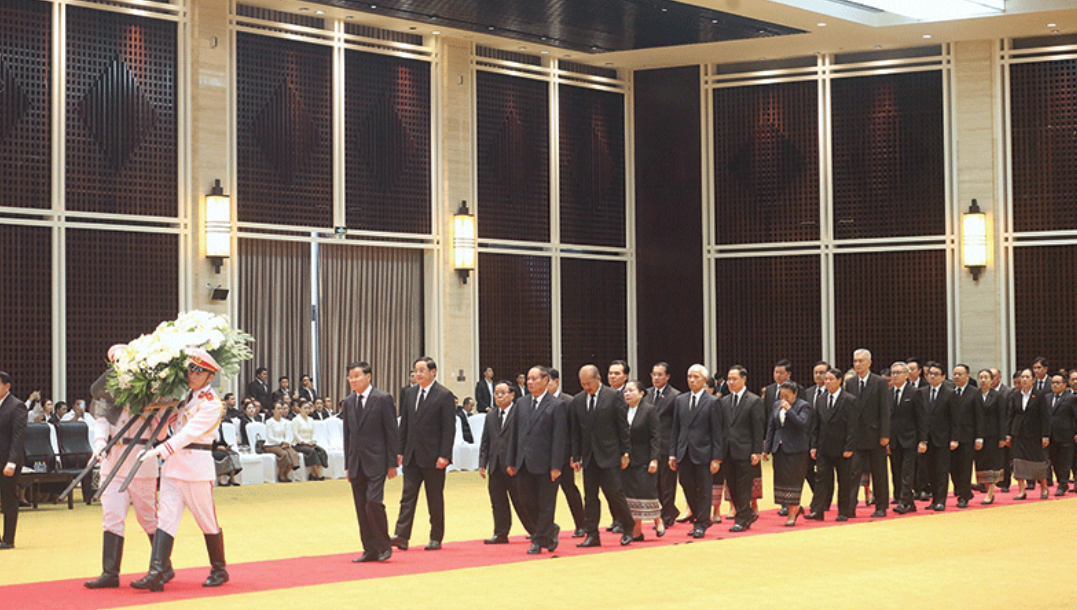
Laos observed solemn tribute ceremonies on Sunday and Monday as the country's top political leadership gathered to honour National Assembly President Xaysomphone Phomvihane, who died on Saturday. Party Secretary General and President Thongloun Sisoulith led the initial wreath-laying delegation at the National Convention Hall in Vientiane, where party and state leaders, members of parliament, government officials, and representatives from civil society organisations assembled to express condolences. The formal proceedings underscored the significance of Xaysomphone's passing as a major loss to the Lao political establishment.
Xaysomphone held the rank of Politburo member within the Lao People's Revolutionary Party Central Committee and served as president of the National Assembly, one of the most influential institutional positions in Laos's one-party system. Throughout his career, particularly during his tenure in the legislative body, he played a central role in strengthening parliamentary structures and shaping policy across defence, national development, and the nation's political and socio-economic trajectory. His four decades of dedicated service made his death resonate deeply throughout government institutions and among the broader population.
The ceremonial tributes revealed the intricate network of Laos's political elite. Prime Minister Dr Sonexay Siphandone led the government delegation, while Deputy Prime Minister and Finance Minister Santiphab Phomvihane—Xaysomphone's brother—represented the Phomvihane family. Other senior officials including Vice President of the National Assembly Sounthone Xayachack, Head of the Party Central Committee Office Dr Phet Phomphiphak, Justice Minister Khamphan Phommathat, and Lao Front for National Development President Prof Dr Kikeo Khaykhamphithoune participated in successive wreath-laying ceremonies throughout the weekend.
Xaysomphone was born on December 12, 1956, as one of six sons of former President Kaysone Phomvihane, who led Laos from the 1975 revolution until his death in 1992. His brothers—Xaysongkham, Santiphab, Thongsavan, Sanyahak, and Ounkham Phomvihane—occupy or have occupied significant positions within the Lao state apparatus, reflecting the prominent role of the Phomvihane family dynasty in post-revolutionary governance. This family prominence illustrates how political succession and institutional leadership in single-party systems often intertwine with dynastic considerations and familial networks.
The ceremony on Sunday extended beyond Lao officials to encompass international participation, particularly from Vietnam. Tran Thanh Man, a Politburo member and Chairman of Vietnam's National Assembly, led a Vietnamese delegation to pay respects at the National Convention Hall. Additionally, delegations from the Vietnamese Ministry of Public Security and Ministry of National Defence attended, reflecting the exceptionally close security and defence relationship between the two communist neighbours. Vietnam's participation underscores the intimate nature of Laos-Vietnam ties, which extend across party structures, military cooperation, and political decision-making.
Recognising the stature of the deceased, Vietnam declared two days of national mourning from August 10 to 11, a gesture that emphasizes how significant Xaysomphone's role was perceived across Indochina. Within Laos, the Party Central Committee, National Assembly, Government, and Lao Front for National Development jointly declared five days of national mourning spanning August 8 to 12. This extended period of official mourning permitted continued wreath-laying ceremonies through August 11, allowing not only senior officials but also ordinary citizens, foreign diplomats, and representatives from the business community to pay final respects.
The National Convention Hall remained open throughout the memorial period, transforming into a focal point for the country's political and social elite to process their grief collectively. Foreign diplomatic missions stationed in Vientiane visited to express condolences, signalling international recognition of Xaysomphone's stature in regional and bilateral affairs. The attendance of representatives from ministries, government agencies, and business leaders demonstrated how state funerals in Laos serve as occasions for the broader political and economic establishment to affirm solidarity and institutional continuity during transitions within the upper echelons of power.
The scale and formal nature of Xaysomphone's funeral arrangements—with full state honours—reflected his position as one of Laos's most prominent post-1975 political figures. His cremation, scheduled for August 12 at the That Luang esplanade, represented the culmination of the mourning period. That Luang, the most sacred Buddhist site in Laos and the symbolic heart of national identity, served as the location for honouring his remains, thereby elevating the ceremonial significance and linking his legacy to the nation's spiritual and historical foundations.
Xaysomphone's death occurs within a broader context of generational change among Laos's revolutionary leadership cohort. Many of the architects of the 1975 Lao revolution and architects of post-war state-building are now in their eighth and ninth decades or have passed away. His passing represents a tangible moment in this inevitable succession process, raising questions about how the Lao leadership will manage institutional transitions and whether the concentration of power within select family networks will persist or evolve in coming years.
The extensive tributes and international participation underscore how individual deaths within communist party elites extend beyond personal loss to encompass institutional continuity and regional stability considerations. For Malaysia and other Southeast Asian nations, Xaysomphone's funeral ceremonialism offers insight into how power operates within one-party systems in the region, particularly regarding the interplay between formal institutional roles and informal family and factional networks. The prominent role of Vietnamese participation and Laos-Vietnam solidarity demonstrated through the mourning period reinforces the enduring strategic alignment between these two socialist neighbours, a relationship that influences broader regional dynamics and ASEAN affairs.

