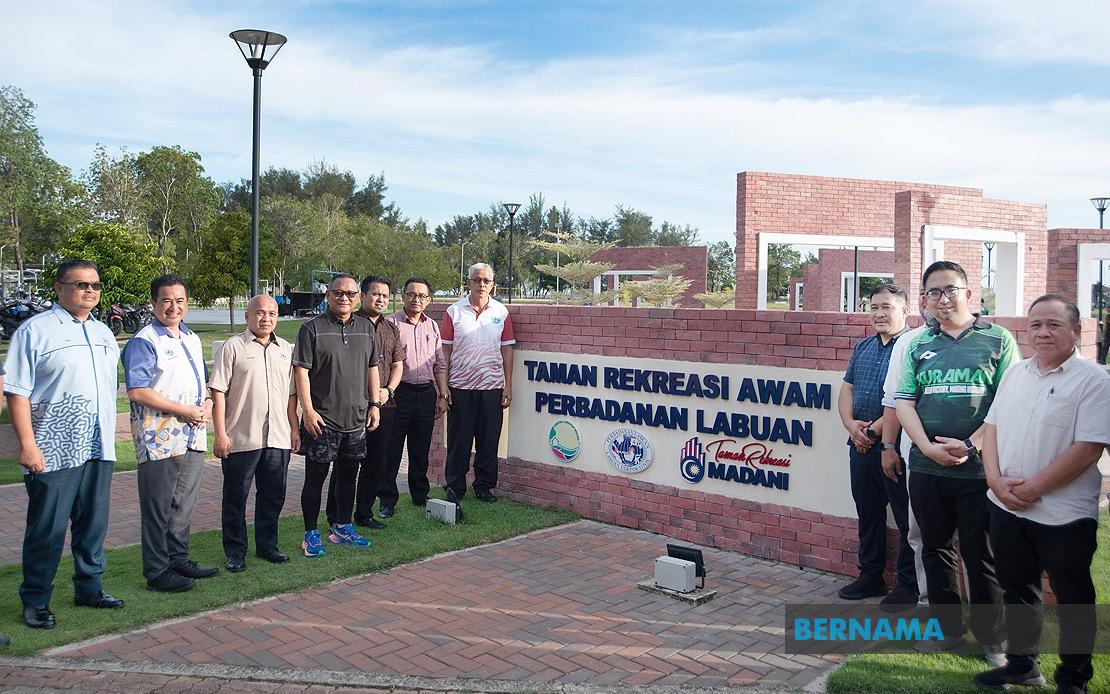
The Federal Territory of Labuan has taken a significant step toward improving public health and community engagement with the official opening of its upgraded Public Recreation Park at Tanjung Purun, positioned centrally within the town. The transformation, funded through the National Landscape Department under the Ministry of Housing and Local Government at a cost of RM495,382, forms part of the broader Madani Recreation Park initiative aimed at enhancing leisure infrastructure across Malaysia.
Labuan Corporation chief executive officer Rithuan Ismail explained that the facility represents a deliberate effort to create an accessible public space where residents of varying ages and fitness levels can pursue recreational activities. His remarks at the inauguration ceremony emphasised the facility's role as a social gathering point, particularly for families seeking structured exercise venues and visitors exploring the federal territory's recreational offerings. The park's design philosophy prioritises inclusivity, recognising that modern urban spaces must accommodate diverse population segments from young children to senior citizens.
The project's genesis lies in identifying the former LDA Field as an underutilised asset despite its geographic advantages. Situated in downtown Labuan with minimal accessibility complications and appropriate land dimensions, the site had languished for years due to infrastructure deficiencies. Poor illumination discouraged evening use, while degraded casuarina trees created safety hazards that further deterred public visitation. The decision to rehabilitate this existing municipal property rather than develop green space elsewhere demonstrates pragmatic resource allocation and commitment to revitalising underperforming civic assets.
The upgraded facility now incorporates several contemporary recreational features designed to appeal to health-conscious residents. An 800-metre jogging track provides safe, measured running surfaces for distance training and casual walking. Concrete seating areas offer resting points for visitors and spectators, while outdoor fitness equipment enables strength training without requiring expensive gym memberships. These amenities collectively position the park as a legitimate alternative to private fitness facilities, particularly valuable for lower-income households and those seeking outdoor exercise environments.
Looking forward, Labuan Corporation has committed to expanding the park's sporting infrastructure before 2024 concludes. The addition of three open courts will accommodate pickleball and sepak takraw—traditional and contemporary racquet sports with significant participation among Malaysian communities. Sepak takraw, in particular, carries cultural significance across Southeast Asia and remains popular in Labuan, suggesting the facility will resonate with local sporting traditions while introducing newer leisure activities to the population.
Rithuan's emphasis on public stewardship reflects an essential aspect of parks management often overlooked in discussions of municipal infrastructure. Facility degradation frequently occurs not from design or construction defects but from inadequate maintenance and user behaviour. By explicitly calling upon residents to preserve equipment and landscaping, Labuan Corporation acknowledges shared responsibility for sustaining public investments and extends ownership psychology beyond government agencies to the community itself.
The park's evening functionality holds particular significance for Labuan's residents. Tropical climates make daytime outdoor exercise challenging during peak heat hours, and improved lighting transforms recreational spaces into viable evening destinations. This consideration proves essential for working populations who cannot access facilities during business hours and for families balancing employment and childcare responsibilities.
Within the broader Malaysian context, this project exemplifies implementation of health promotion policies at territorial level. The Madani framework, prioritising citizen wellbeing, finds practical expression through such infrastructure investments. For a federal territory of Labuan's scale and demographics, strategically located recreational facilities can meaningfully improve population health outcomes by reducing exercise barriers and fostering physical activity habits across age groups.
The initiative also reflects growing recognition that public health extends beyond clinical interventions to environmental design. Accessible recreational infrastructure influences physical activity levels more substantially than individual health education campaigns, as it removes logistical obstacles to exercise participation. Communities with well-maintained public spaces typically demonstrate higher physical activity rates and associated cardiovascular health improvements compared to areas lacking such facilities.
For regional observers, Labuan's approach offers replicable lessons for other Malaysian municipalities seeking cost-effective community development. Converting underutilised existing properties minimises land acquisition costs while revitalising neglected areas, often improving urban aesthetics simultaneously. The Tanjung Purun project demonstrates that meaningful community infrastructure need not require extensive new development but can emerge through strategic rehabilitation of existing municipal assets.
Looking ahead, ongoing maintenance and responsive facility upgrades will determine whether this investment achieves its wellness objectives. Successful parks require regular attention, responsive governance addressing user needs, and community engagement in preservation. Labuan Corporation's visible commitment to phased improvements, exemplified by the planned sports courts, suggests organisational capacity to sustain long-term facility development rather than treating the inauguration as project conclusion.
The park represents more than recreational infrastructure; it embodies deliberate choices to prioritise community health, inclusive access, and quality-of-life improvement. As Malaysian urban areas continue expanding, such multipurpose recreational spaces become increasingly vital for counteracting sedentary lifestyles and maintaining social cohesion in rapidly developing communities.