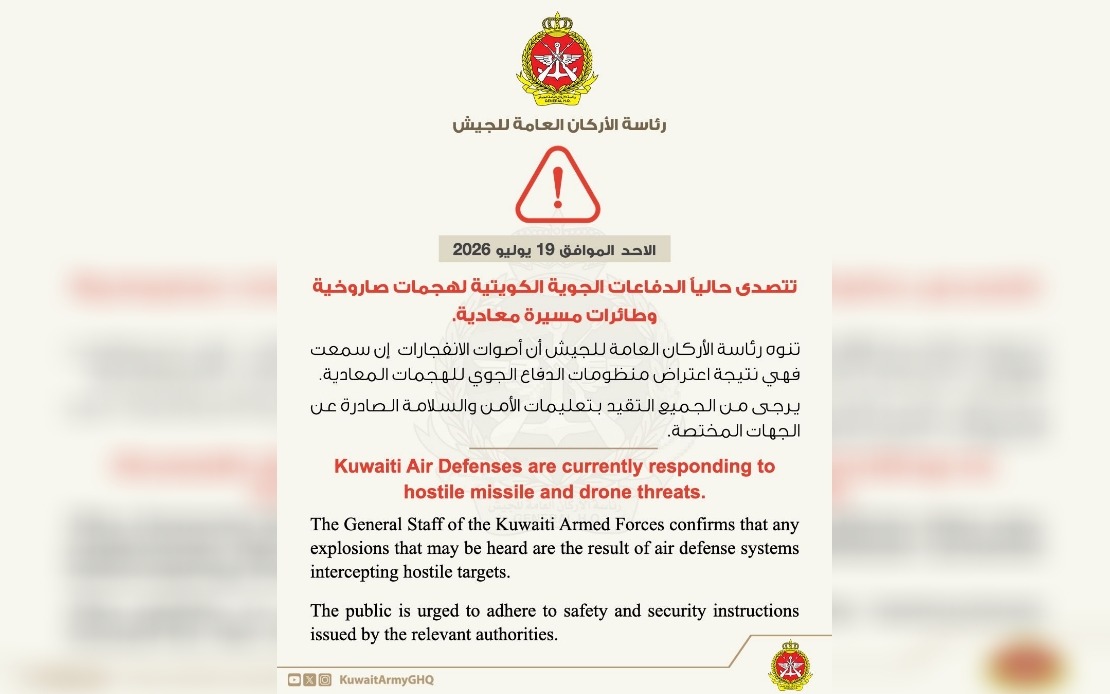
Kuwait's military announced on Sunday that the nation's defence forces are mounting active responses to sustained Iranian missile and drone attacks, marking an escalation in regional tensions that threatens to destabilise the Gulf and beyond. The Kuwaiti army confirmed through official channels that any loud explosions residents hear across the country result from air defence systems successfully intercepting hostile projectiles, and called on the public to remain vigilant and adhere to security protocols issued by local authorities.
The current military activity represents the latest chapter in an intensifying cycle of tit-for-tat strikes between the United States and Iran. Over the past week, American forces have conducted multiple rounds of strikes targeting Iranian military installations, to which Tehran has responded by launching salvoes of missiles and unmanned aircraft against facilities and military bases it identifies as American assets stationed throughout the region, with Kuwait serving as a key launch point and hub for US operations.
For Malaysia and other Southeast Asian nations with economic and diplomatic ties throughout the Gulf, the escalating confrontation carries serious implications. The region remains crucial to global energy supplies, and any further deterioration could disrupt shipping lanes, inflate oil prices, and undermine the stability that underpins regional commerce. Malaysian companies operating across the Gulf, particularly in oil and gas, defence contracting, and trade, face mounting operational risks as military tensions climb.
The strategic positioning of Kuwait amplifies the stakes. As home to significant American military infrastructure and a key regional ally of Washington, the emirate has become a focal point for Iranian retaliation efforts. The fact that residents are now hearing multiple explosions from air defence engagement suggests the volume and sophistication of incoming threats have reached levels not seen in recent years, potentially indicating a qualitative shift in Iran's military capabilities or willingness to escalate.
Earlier in June, Pakistan brokered a memorandum of understanding between Washington and Tehran designed to de-escalate tensions and chart a path toward lasting peace. Yet despite this diplomatic overture and the international attention it garnered, the agreement has failed to arrest the downward spiral of confrontation. Instead, the recent wave of strikes suggests both capitals remain locked in a competitive cycle where each action by one side triggers a proportional or amplified response from the other, making conflict de-escalation increasingly difficult.
The broader Middle Eastern context underscores how precarious the current situation has become. The region already contends with multiple conflict zones, sectarian tensions, and proxy warfare spanning Iraq, Syria, Yemen, and the Palestinian territories. A full-scale military confrontation between the US and Iran could rapidly draw in allied nations, activate dormant insurgent groups, and destabilise countries across the Gulf Cooperation Council, of which Kuwait is a founding member alongside Saudi Arabia, the United Arab Emirates, Qatar, Bahrain, and Oman.
For ASEAN members and regional observers, the deterioration warrants close attention given how Middle Eastern instability historically ripples across supply chains and geopolitical alignments affecting Southeast Asia. Japan, South Korea, and other major Asian economies depend heavily on Gulf energy exports, meaning any prolonged conflict would reverberate through global markets and affect growth prospects across Asia.
Kuwait's appeal to residents to follow official security guidance suggests authorities are preparing for the possibility of sustained Iranian operations. The request indicates military planners expect further incoming threats rather than an imminent cessation of hostilities. This defensive posture, combined with active air defence engagement, underscores that both regional and international actors are now operating under the assumption that direct military conflict between Washington and Tehran may persist regardless of diplomatic efforts.
The failure of Pakistan's June mediation framework to gain traction raises questions about whether current diplomatic channels possess adequate leverage or whether deeper structural incentives are driving both sides toward confrontation. Without renewed international diplomatic pressure or a significant shift in either capital's strategic calculus, the cycle appears likely to continue, with Kuwait and neighbouring states bearing immediate consequences while global markets and distant economies feel secondary shocks.

