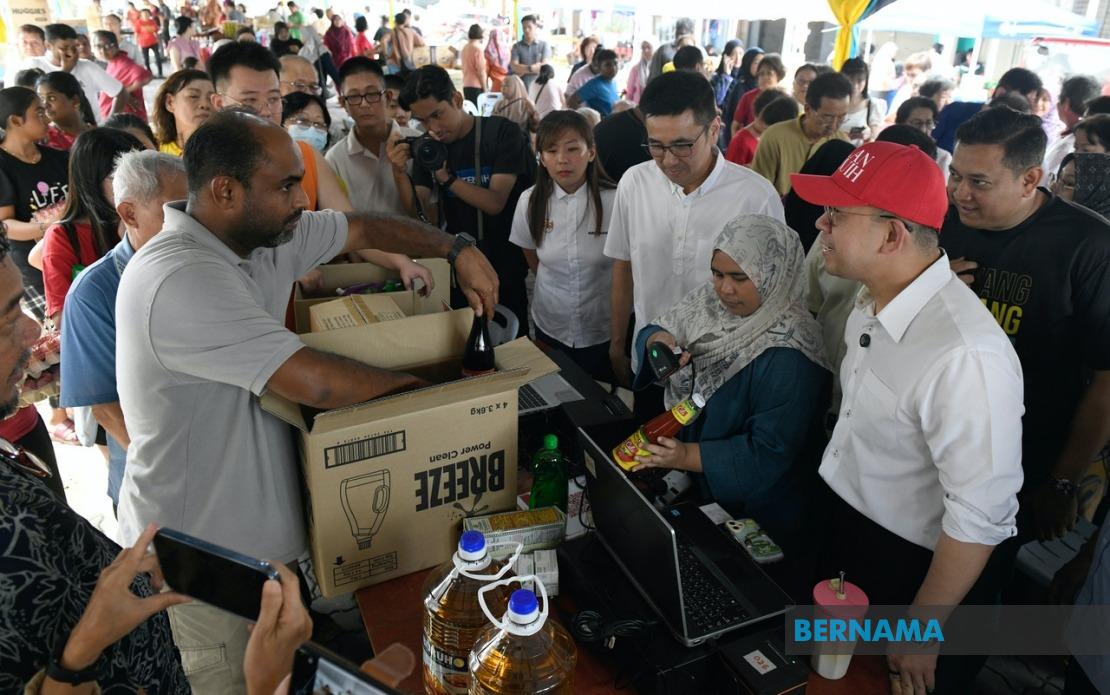
The government is doubling down on its commitment to empower Malaysia's micro, small and medium enterprises and cooperative movements, viewing them as essential engines for inclusive economic growth. At a programme launch in Nibong Tebal, Minister Steven Sim Chee Keong outlined how the Ministry of Entrepreneur and Cooperatives Development (KUSKOP) intends to deepen its engagement with grassroots business communities through targeted initiatives designed to unlock opportunities in the wholesale and retail trade sectors.
Sim pointed to compelling economic data to justify the ministry's strategic focus. According to figures released by the Department of Statistics Malaysia, the wholesale and retail trade sector has demonstrated remarkable resilience, posting a sales value approaching RM175 billion in April 2026. This represented growth of 15.3 per cent compared with April 2025, underscoring the sector's capacity to generate wealth and employment across the nation. For policymakers and business advocates, these numbers suggest that the conditions are ripe for smaller enterprises to expand their market footprint and customer networks.
The minister attributed this sector-wide momentum to a confluence of supportive factors. Government initiatives aimed at reducing living costs, stabilising commodity prices, and boosting worker incomes have combined with private sector dynamism to sustain domestic purchasing power. This macroeconomic backdrop has created conditions where local demand remains robust even as global trade faces mounting headwinds. The implication for Malaysia's MSME ecosystem is significant: the domestic market continues to offer avenues for growth without requiring immediate international expansion, lowering the barrier to entry for ambitious entrepreneurs.
However, Sim candidly acknowledged the external pressures confronting Malaysia's open economy. Trade tensions, tariff disputes, and geopolitical instability have created uncertainty in global markets. As a nation deeply integrated into international supply chains and trade networks, Malaysia cannot isolate itself from these shocks. Yet the ministry's analysis suggests that coordinated action between government, private enterprise, and community stakeholders has insulated domestic commerce from the worst of these external disturbances. This resilience reflects structural strengths in Malaysia's retail and wholesale ecosystems that local businesses can leverage.
The Jualan MADANI KUSKOP programme, unveiled in the Jawi state constituency, exemplifies KUSKOP's grassroots approach. Rather than confining support to policy announcements or centralised schemes, the ministry is bringing initiatives directly to local communities and business clusters. This on-the-ground engagement model recognises that MSMEs and cooperatives often lack sophisticated market intelligence, formal business networks, or access to decision-makers. By establishing direct touchpoints, KUSKOP aims to bridge information asymmetries and build genuine partnerships with entrepreneurs who might otherwise remain marginalised from growth opportunities.
For Malaysian MSMEs and small cooperatives, the sector's expansion opens concrete pathways for business expansion. As Sim articulated, the growth trajectory creates room for enterprises to diversify their product offerings, cultivate new customer relationships, and strengthen their integration within Malaysia's broader economic value chains. Cooperatives, in particular, stand to benefit from coordinated purchasing and distribution networks that can enhance their negotiating power with suppliers and wholesalers. Individual entrepreneurs may find it advantageous to formalise their operations or link with cooperative structures to access KUSKOP's support programmes more effectively.
The minister's emphasis on inclusive growth carries particular weight in the Malaysian context. Economic expansion that concentrates benefits among large corporations or urban centres risks deepening regional disparities and limiting social mobility. By channelling resources and attention toward entrepreneurs in constituencies like Jawi, KUSKOP signals that the government views small business owners as stakeholders in Malaysia's development narrative, not merely beneficiaries of trickle-down effects. This framing has implications for how local entrepreneurs perceive their role in the national economy and their receptiveness to government initiatives.
Sim, who represents Bukit Mertajam as Member of Parliament, positioned KUSKOP's work within a broader political commitment to grassroots economic empowerment. The ministry's programs are not presented as charity or welfare but as strategic investments in Malaysia's productive capacity. This distinction matters because it reframes entrepreneurship support as fundamentally about national competitiveness and economic dynamism rather than social assistance. For Southeast Asian observers, this approach reflects a regional trend toward viewing MSME development as central to sustainable, equitable growth.
The wholesale and retail sector's scale—generating nearly RM175 billion in quarterly sales—underscores why policymakers regard it as such a strategic priority. This sector touches consumers directly, generates employment across skill levels, and serves as an incubator for business talent. Unlike highly capital-intensive sectors, retail and wholesale commerce offer relatively accessible entry points for entrepreneurs with limited initial capital. By focusing KUSKOP's efforts here, the government addresses a constituency that can absorb policy support efficiently and translate it into tangible economic activity.
Looking forward, the trajectory of KUSKOP's initiatives will significantly shape Malaysia's competitive positioning in Southeast Asia's retail landscape. As e-commerce and digital commerce reshape consumer behaviour across the region, traditional wholesale and retail businesses face pressure to innovate. KUSKOP's programmes will need to evolve beyond conventional support mechanisms to address digital transformation, supply chain modernisation, and omnichannel capabilities. The extent to which the ministry equips MSMEs with contemporary business tools will determine whether local enterprises remain vibrant or gradually cede market share to more agile competitors.
The government's sustained commitment to KUSKOP reflects a recognition that economic growth must be anchored in broad-based business participation. Relying exclusively on foreign direct investment or large domestic conglomerates leaves too many Malaysians disconnected from prosperity. By systematically strengthening MSMEs and cooperatives in high-growth sectors like wholesale and retail, KUSKOP helps distribute economic opportunities more equitably. This approach, if executed effectively, can reinforce social cohesion while simultaneously enhancing Malaysia's overall economic resilience and dynamism in an uncertain global environment.

