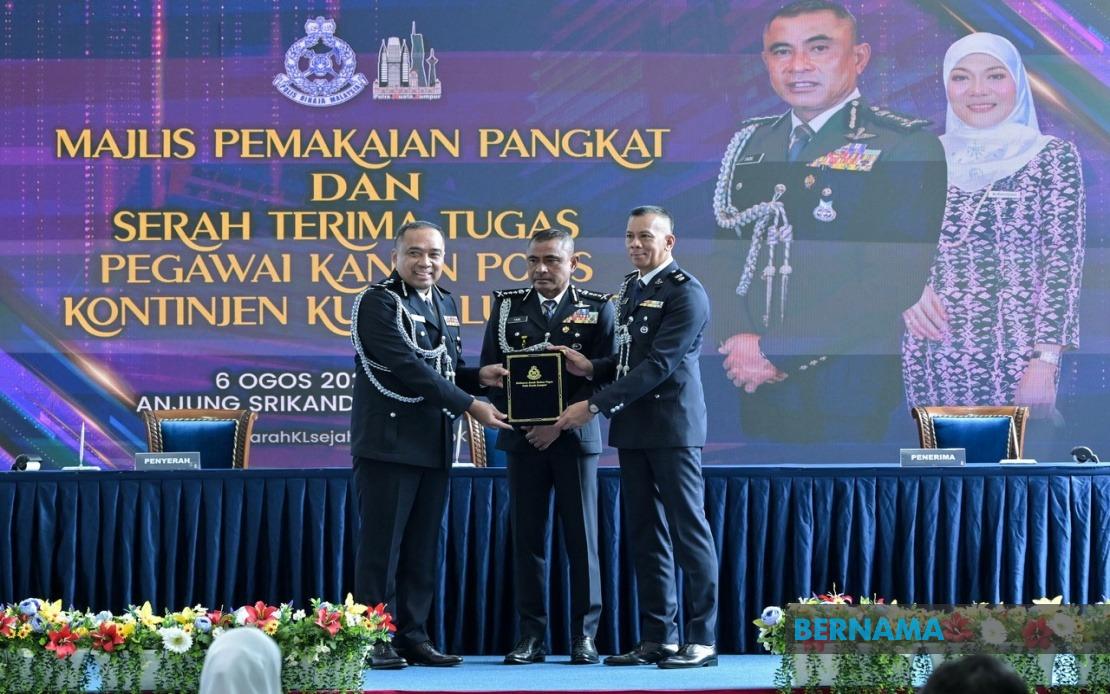
Kuala Lumpur's police force has undertaken a substantial restructuring of its senior command hierarchy, with Datuk Fadil Marsus, the city's police chief, presiding over a formal handover ceremony at contingent headquarters. The reorganisation touched on critical operational units and territorial commands within the metropolitan police structure, reflecting what authorities characterise as a necessary evolution in the city's law enforcement leadership.
The scope of the reshuffle encompassed six distinct appointments across both detective and intelligence portfolios. The Criminal Investigation Department witnessed the transition of its leadership from SAC Zulkarnain Samsudin to SAC Sazlee Adam, a move that also triggered cascading changes throughout the department's hierarchy. Running parallel to this, the Narcotics Crime Investigation Department transferred its command from SAC Haslah Bachok to ACP Kee Hang Kee, signalling the force's intent to introduce fresh perspectives to the nation's drug enforcement efforts in the capital.
Geographically, the reshuffle extended to Kuala Lumpur's two major district commands. Dang Wangi district, a region encompassing the city's historic core and business district, received Supt Nuzulan Mohd Din as its new district police chief, succeeding SAC Sazlee Adam whose appointment to the Criminal Investigation Department represented his vertical progression. Meanwhile, Sentul district, situated in the northern reaches of the federal territory, saw Supt Jasni Zolpa assume command from SAC Basri Sagoni, bringing what police officials suggest will be enhanced investigative coordination with the upgraded detective units.
Beyond the uniformed operational chain, the intelligence apparatus also underwent significant reorientation. The Special Branch's deputy chief position, responsible for intelligence gathering and operational coordination, transferred from SAC Kamaruzaman Md Alib to ACP Saefuddin @ Mohd Fitri Abdul Rahman. Concurrently, the Criminal Investigation Department's deputy chief role for intelligence and operations moved to Supt Ong Seng Keong from SAC Zulkarnain Samsudin, creating an interlocking structure where officers with recent investigative command experience now influence intelligence strategy at the departmental level.
The ceremonial nature of the handover, attended by Kuala Lumpur deputy police chief Datuk Mohd Azani Omar, underscores institutional emphasis on formal procedural continuity during periods of organisational change. Such ceremonies serve multiple purposes within police hierarchies—they provide public documentation of authority transfers, offer incoming officers a formal platform to acknowledge their predecessors' contributions, and signal to the broader force that leadership transitions follow established protocols rather than sudden disruptions.
Fadil's remarks during the ceremony positioned the appointments within a broader narrative of professional advancement tied to performance and institutional trust. He characterised promotions not merely as individual recognition but as organisational investments, with each elevation carrying implicit expectations of heightened integrity and professional conduct. This framing reflects the Royal Malaysia Police's persistent efforts to reinforce a meritocratic ethos, particularly crucial during periods when public confidence in law enforcement faces periodic scrutiny.
The police chief emphasised that leadership changes within the force represent essential mechanisms for organisational renewal. He articulated that periodic restructuring allows the institution to absorb new methodologies, leverage diverse operational experiences, and maintain strategic flexibility without compromising day-to-day public service delivery. This perspective acknowledges a tension familiar to large security organisations—the need for innovation and fresh thinking against the risk of operational disruption during transitions.
For Malaysia's federal capital, the reshuffle carries particular significance given Kuala Lumpur's status as the nation's primary commercial, political, and diplomatic hub. The city confronts crime challenges spanning transnational trafficking networks, sophisticated property crimes targeting foreign investors, and organised narcotics distribution. Effective command structures directly influence operational success in these domains. The appointment of officers with demonstrated detective and intelligence capabilities to both investigative and territorial posts suggests an attempt to create synergies between forensic investigation capabilities and street-level policing.
Fadil's call for strengthened commitment toward crime control, drug abuse prevention, and investigative capacity enhancement indicates that the reshuffle responds to perceived operational deficiencies or evolving security threats rather than purely routine rotation. References to increasingly complex security challenges suggest the Kuala Lumpur force is recalibrating its command structure partly in response to threats that standard departmental boundaries traditionally fail to address—suggesting the force may be refocusing on interdepartmental coordination mechanisms.
The inclusion of community policing and public liaison within Fadil's stated priorities signals a broader strategic direction beyond traditional law enforcement. By explicitly linking leadership appointments to community engagement capacity, the police chief positions the reshuffle as part of a deliberate programme to strengthen police-community relationships, particularly important in an urban centre with diverse residential and business communities and vocal civil society sectors.
For regional security analysts and Malaysian observers, the reshuffle demonstrates the force's capacity for managed institutional renewal. Unlike sudden leadership changes that can generate uncertainty, the formal ceremony and clear articulation of strategic intent provide stability signals to both internal personnel and external stakeholders. Such structured transitions become important benchmarks for institutional health within security forces operating under democratic governance frameworks.
The timing of the reshuffle, announced during a period of ongoing discussions about police reform and modernisation within the Malaysian government, positions Kuala Lumpur's force as implementing leadership development practices aligned with national police modernisation initiatives. The appointments of younger-ranked officers to senior positions, particularly in intelligence and specialised investigation roles, may signal a gradual demographic shift within the command structure—potentially addressing retention and succession planning challenges that merit private force leadership attention across the region.

