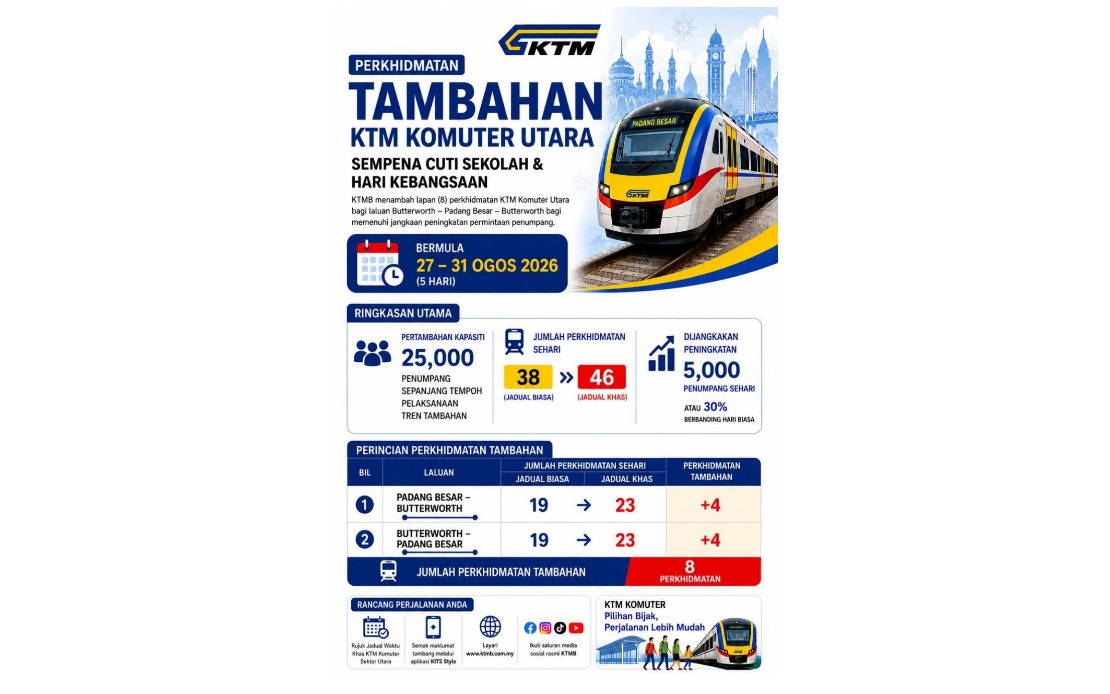
Keretapi Tanah Melayu Berhad (KTMB) is rolling out eight additional train services across its Northern Sector network between Thursday and Monday, August 27 through 31, to manage the anticipated wave of passengers travelling during Malaysia's school holidays and National Day celebrations. The expanded timetable targets commuters moving between Penang, Kedah and Perlis, three states historically experiencing elevated transport demand during this festive period.
The railway operator's decision reflects a strategic response to predictable seasonal travel patterns. By implementing a dedicated KTM Komuter Northern Sector Special Timetable, KTMB aims to prevent overcrowding and provide smokers and families with genuine alternatives to private vehicles and express bus services that typically dominate the corridor during public holidays. This aligns with broader government ambitions to encourage modal shift toward rail as congestion grips Malaysia's major thoroughfares.
Under the enhanced schedule, daily services along the Butterworth-Padang Besar-Butterworth route will expand from the standard 38 to 46 trains daily—a 21 per cent increase in capacity. This redistribution splits evenly, with four supplementary services added to each direction. The Padang Besar to Butterworth segment will offer 23 daily departures instead of 19, whilst the return journey likewise grows to 23 trains from its regular 19, providing passengers with more flexible departure windows throughout daylight hours.
KTMB anticipates a 30 per cent rise in overall passenger volume compared to ordinary operating days, suggesting the rail operator expects approximately 30,000 additional journeys during the five-day initiative. The eight extra trains are designed to accommodate roughly 5,000 additional passengers daily, totalling around 25,000 over the implementation period. Such projections underscore the latent demand for regional rail services when capacity constraints are temporarily relaxed—a signal that enhanced permanent investment might yield significant ridership gains.
For Malaysian travellers, particularly those residing in Perlis, Kedah and Penang who maintain inter-state connections, this temporary service expansion offers practical benefits. Students returning home for holidays, families visiting relatives, and workers commuting to administrative or commercial hubs gain genuine scheduling flexibility. The staggered additional services throughout the day reduce waiting times and crowding, creating a more comfortable travel experience than passengers might expect during peak seasons.
The Northern Corridor represents a vital arterial link historically underserved relative to demand. Rail transport along this spine remains vulnerable to displacement by private vehicles and long-distance coaches, particularly when perceived waiting times or service reliability deteriorates during congested periods. By demonstrating that targeted capacity augmentation can meet identifiable seasonal peaks, KTMB gathers operational data that may justify permanent service enhancements—a development that would strengthen the region's public transport ecosystem and potentially influence urbanisation patterns across northern Malaysia.
From a regional Southeast Asian perspective, Malaysia's approach to temporary service expansion during peak travel seasons differs markedly from some neighbours. Thailand's State Railway and Indonesia's PT Kereta Api generally deploy additional services for Eid and Chinese New Year, yet systematic responses to school holidays remain less developed. KTMB's proactive stance suggests institutional capacity to understand demand drivers and mobilise resources accordingly—capabilities that supporting states like Penang and Perlis should cultivate as rail becomes increasingly central to regional economic connectivity.
Passengers wishing to utilise the enhanced timetable should access schedule information through multiple channels: the KITS Style mobile application, KTMB's official website, and the company's official social media platforms. This multi-channel approach recognises that Malaysian commuters range from digitally native university students to older travellers more comfortable with website navigation. Advance journey planning is strongly recommended, both to secure preferred departure times and to allow coordination with onward transport connections, particularly for travellers originating from Perlis or Kedah where last-mile connectivity options remain limited.
The initiative reflects KTMB's broader strategic positioning as a modernising transport provider. Rather than treating holiday periods as operational challenges requiring mere crisis management, the railway operator frames them as opportunities to showcase expanded capacity and service reliability. Such messaging matters for long-term ridership growth: passengers who experience seamless travel during peak periods develop confidence in rail services generally and prove more likely to choose trains for future journeys, even outside holiday seasons.
State governments in Penang, Kedah and Perlis might view this intervention as a proof-of-concept for permanent service enhancement. If occupancy rates during these five days approach projected levels, the economic case for retaining additional permanent services becomes substantially stronger. Enhanced rail capacity reduces pressure on increasingly congested highways, lowers accident risks, and generates environmental benefits through reduced per-passenger emissions—factors that justify infrastructure investment in an era of climate consciousness and urbanisation challenges.

