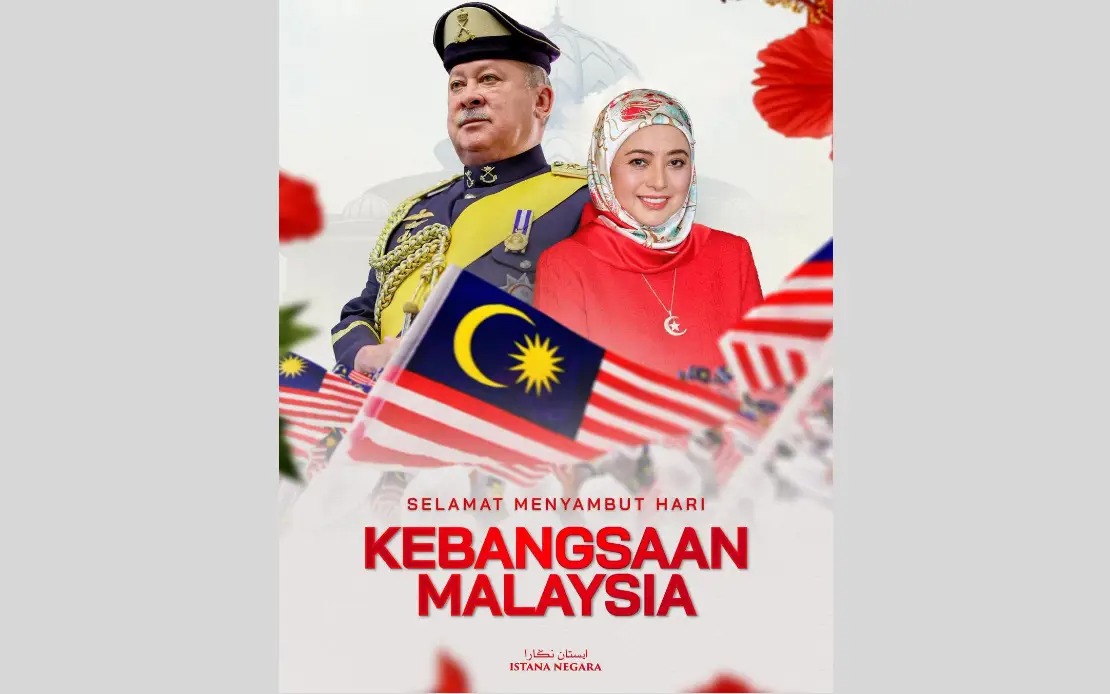
Sultan Ibrahim Sultan Iskandar and Raja Zarith Sofiah marked Malaysia's 69th National Day on August 31st by extending formal greetings to the nation, with Their Majesties' message shared through the monarch's official social media channels. The gesture underscored the symbolic importance of the annual commemoration, which celebrates the federation's founding principles and continued national progress.
The royal couple arrived at the Putrajaya venue at 8 am to preside over the day's principal festivities, where they were formally received by Prime Minister Datuk Seri Anwar Ibrahim and his spouse, Datuk Seri Dr. Wan Azizah Wan Ismail. Communications Minister Datuk Seri Fahmi Fadzil, who chairs the National Day and Malaysia Day Main Committee for the 2026 observances, was also present to welcome their majesties.
This year's celebration operated under the thematic banner of "Malaysia MADANI: Kesejahteraan Dinikmati"—translating roughly to the enjoyment of wellbeing across society. The framework reflects the government's policy priorities centring on equitable prosperity and the protection of the nation's pluralistic character. By anchoring National Day festivities to this conceptual framework, organisers deliberately positioned the celebration as an affirmation of Malaysia's commitment to addressing citizen welfare whilst honouring its multicultural foundations.
The formal proceedings began with a military ceremony that established the day's ceremonial tone, followed by cultural and artistic performances designed to showcase Malaysia's diverse creative traditions. A carefully choreographed parade then proceeded through Putrajaya, incorporating elements intended to visually represent the Malaysia MADANI philosophy of prioritising people's wellbeing and celebrating national diversity.
The scale of participation reflected substantial planning and coordination. Organisers mobilised 10,819 participants distributed across 76 contingents, supplemented by 22 brass bands providing musical accompaniment. The procession featured 11 decorated floats alongside 328 military, naval, and air force assets, demonstrating the integration of Malaysia's defence forces into the civilian celebration. Animal handlers brought 112 service animals, further enriching the visual spectacle and public engagement.
Transportation represented another dimension of the celebration's messaging. Organisers incorporated 22 electric vehicles into the parade—a deliberate inclusion signalling the government's commitment to environmental sustainability and modern technological adoption as components of Malaysia's development trajectory. This symbolic element appealed particularly to younger audiences and aligned with regional and global sustainability imperatives gaining political salience across Southeast Asia.
The human formations displayed on spectator terraces constituted a sophisticated component of the celebration's visual narrative. Organisers arranged participants into 26 distinct patterns that collectively constructed a comprehensive representation of Malaysia's multicultural fabric. This human graphic approach created an experiential dimension beyond passive observation, involving thousands in the active construction of national identity messaging.
For Malaysian audiences, these celebrations carry significance extending beyond ceremonial convention. The Malaysia MADANI framework has emerged as the administration's primary policy narrative, attempting to synthesise economic development, social inclusion, and institutional reform under a unified conceptual umbrella. By anchoring National Day commemoration to this vision, authorities reinforce its centrality to contemporary governance priorities and implicitly position it as the natural continuation of the nation's founding principles and postcolonial trajectory.
Regionally, Malaysia's National Day celebrations project soft power messaging to neighbouring Southeast Asian nations and international observers. The emphasis on unity amid diversity addresses ongoing regional conversations about managing plural societies and maintaining social cohesion amidst demographic and economic dynamism. The scale and sophistication of Putrajaya's festivities, featuring hundreds of military assets and thousands of civilian participants, also subtly reinforces Malaysia's institutional capabilities and organisational competence to audiences across the region.
The royal participation lends constitutional weight and continuity to proceedings. The monarchy's presence at such celebrations reaffirms the institution's symbolic role as custodian of national identity transcending party politics and temporary administrations. For a federation historically defined by negotiated constitutional arrangements balancing competing communal interests and regional sovereignties, the crown's ceremonial prominence serves as a unifying reference point potentially transcending the contentious nature of Malaysian electoral politics and policy disputes.
The timing of this commemoration occurred within Malaysia's broader political calendar, following recent shifts in the parliamentary coalition supporting the administration and preceding state and federal electoral contests scheduled for coming years. National Day celebrations consequently function simultaneously as expressions of national unity and platforms for subtle political messaging, where governing coalitions demonstrate their capacity to organise national events and articulate unifying national visions.
Looking forward, the Malaysia MADANI narrative will likely remain central to the government's communications strategy through the 2026 National Day commemoration cycle. The theme's emphasis on shared prosperity and inclusive development addresses economic anxieties and social fragmentation concerns animating Malaysian political discourse. Whether the policy substance underlying this thematic framework achieves measurable citizen welfare improvements will substantially influence its political resonance in subsequent electoral cycles and national celebrations.

