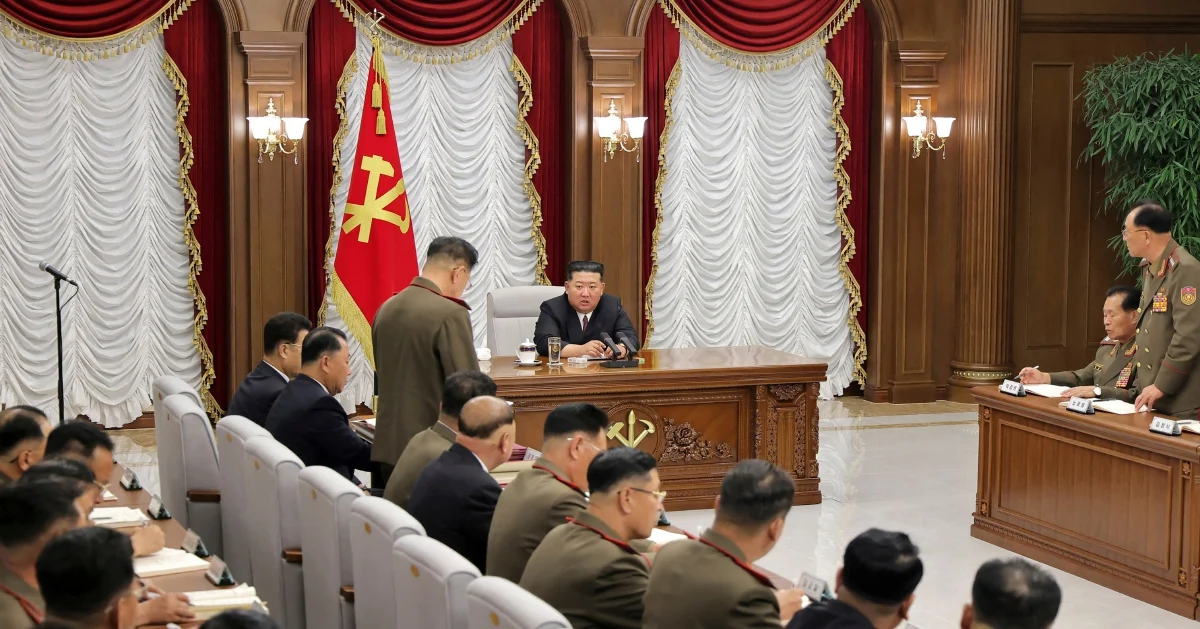
North Korea's leader Kim Jong Un has moved to remove a senior military official from the ruling Workers' Party of Korea, citing corruption allegations as the grounds for expulsion. State media disclosed the action on Saturday, with official pronouncements characterising the accused official's alleged acceptance of bribes as a serious "political crime" warranting swift party discipline.
The expulsion represents a notable development in how Pyongyang's leadership handles senior personnel within its armed forces, one of the most sensitive institutional pillars of the regime. Military officials occupy a uniquely powerful position in North Korean governance, controlling vast resources and wielding significant influence over the country's security apparatus. Any public acknowledgement of wrongdoing among this echelon typically carries broader implications about the regime's internal power dynamics and Kim Jong Un's willingness to enforce accountability.
Official channels in Pyongyang have historically been reluctant to publicise instances of high-level graft, preferring to handle such matters through opaque internal mechanisms. The decision to publicise this particular case suggests that Kim Jong Un's administration may be attempting to demonstrate commitment to rooting out corrupt practices, or alternatively, that the accused official's transgressions were deemed sufficiently egregious to warrant public censure as a deterrent to others.
The characterisation of bribery as a "political crime" rather than a mere administrative or financial transgression underscores how the regime frames corruption within its ideological framework. In North Korean official discourse, such offences are positioned as attacks on the system itself, conflating personal enrichment with disloyalty to the state and its supreme leader. This framing serves both to justify severe punishments and to reinforce the narrative that the regime operates under uncompromising standards of propriety.
The military sector in North Korea has long been a source of concern regarding resource allocation and financial irregularities, given the vast sums dedicated to defence spending and weapons development. Officers positioned within procurement chains, logistical networks, or strategic industries encounter numerous opportunities to extract illicit benefits. By publicly addressing corruption within military ranks, Pyongyang may be attempting to signal that it recognises these vulnerabilities and is taking corrective action.
From a regional security perspective, internal purges and discipline within North Korea's military carry implications for stability and decision-making coherence. Officers who face uncertainty about their positions or fear sudden removal may adopt more cautious approaches to policy implementation, while leadership that appears willing to enforce standards could strengthen institutional compliance. However, such purges can also create factionalism and reduce operational effectiveness if they undermine trust within command structures.
The timing and publicity of this action also warrant consideration within broader patterns of elite management under Kim Jong Un, who has consolidated power through a combination of strategic appointments, removal of potential rivals, and occasional displays of regime accountability. Demonstrating that even military figures are not immune to consequences serves multiple purposes: it projects an image of principled governance, creates an environment of vigilance among subordinates, and potentially removes individuals whose growing power bases might threaten central authority.
For observers monitoring North Korea, such incidents provide rare glimpses into the regime's internal workings and priorities. The fact that state media chose to report this case, rather than handle it through silent dismissal or internal party mechanisms, signals confidence in the regime's narrative control and suggests that leadership views the message as valuable for domestic consumption. Citizens and officials alike receive the signal that corruption will be punished, even at elevated ranks.
The expulsion also reflects broader trends across authoritarian systems in the region, where leaders periodically conduct anti-corruption campaigns to simultaneously address genuine institutional problems and consolidate personal power. In the North Korean context, where institutional checks on leadership authority are minimal, such campaigns remain one of the few mechanisms through which regime accountability is publicly demonstrated, however selective or strategic such demonstrations may be.
Looking ahead, this case may signal the opening of a broader examination of military finances and conduct, or it may prove to be an isolated instance of public discipline applied for specific strategic reasons. Either way, the incident underscores the persistent challenge that even tightly controlled authoritarian systems face in policing their security apparatus, and the complex calculations involved when leadership must balance institutional cohesion against the imperatives of anti-corruption enforcement and power consolidation.

