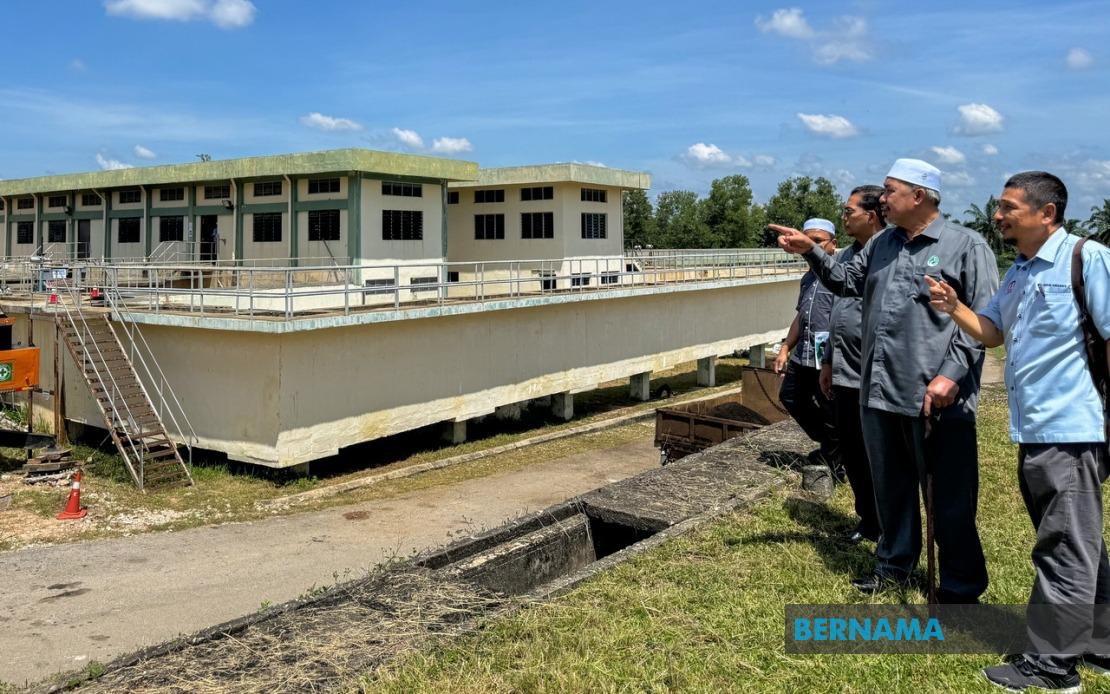
Residents across three districts in Kelantan are set to experience a significant improvement in water availability following completion of a RM11.5 million infrastructure project at the Merbau Chondong Water Treatment Plant. The upgrade, which will substantially increase treatment capacity and water quality, is expected to commence supplying residents in Machang, Pasir Puteh, and southern Kota Bharu from early September, delivering relief to approximately 34,000 account holders who have endured recurring shortages.
The transformation represents a near doubling of the facility's production capacity. According to Datuk Dr Izani Husin, chairman of Kelantan's Public Works, Infrastructure, Water and Rural Development Committee, the enhanced plant will produce up to 80 million litres of treated water daily, compared with the previous 45 million litres. This expansion addresses a persistent challenge that Air Kelantan Sdn Bhd faced in expanding supply without compromising water purity—a constraint that had effectively capped output despite growing demand from the expanding population in these districts.
The technological foundation underpinning this improvement centres on the installation of a Xylem Underdrain Leopold filtration system, which represents a significant departure from the plant's original treatment methodology. This advanced technology enables the facility to process between 70 million and nearly 90 million litres of raw water daily while maintaining stringent quality standards. The capacity to handle substantially greater volumes without degradation marks a crucial turning point for water security in regions that have struggled with supply instability during peak consumption periods and dry seasons.
Water quality improvements accompany the capacity gains. The upgrade has successfully reduced the Nephelometric Turbidity Unit (NTU) reading—the standard measure of water clarity and purity—from above 10 NTU to 3 NTU. This considerable improvement in treated water clarity and safety reflects the effectiveness of the filtration system and should reassure residents concerned about supply reliability and health impacts. The achievement of these quality metrics represents not merely an expansion of supply but a fundamental upgrading of the water delivered to taps across the three districts.
The completion timeline remains tight but achievable. Project officials indicated that construction work would be finished by the end of July, with distribution from the upgraded system commencing in early September. This sequencing allows for final testing and system integration before residents begin experiencing the benefits of increased supply. For households that have experienced water rationing and intermittent supply, the transition to full operation represents a tangible shift in daily life.
Beyond the immediate upgrade, state planners are pursuing longer-term solutions to address water security across Kelantan. The government and Pengurusan Aset Air Berhad (PAAB) are collaborating on construction of the Machang 1 Water Treatment Plant, a RM120 million facility projected for completion by 2030. This new installation will generate 50 million litres daily exclusively for Machang's expanding population, allowing the upgraded Merbau Chondong facility to redirect capacity toward other districts experiencing deficits. The phased approach acknowledges that demand continues outpacing supply across Kelantan's growing urban centres.
The Machang 1 project remains in the agreement finalization stage between the state government and PAAB, with formal contractor appointment contingent on these negotiations concluding. This administrative phase, while essential for project governance, represents a delay factor that means the largest component of long-term relief lies several years away. Nevertheless, the existence of confirmed funding and timeline targets suggests genuine commitment to systematic capacity expansion rather than ad-hoc emergency responses.
Kellantanese authorities have framed these initiatives within a broader remediation strategy. Air Kelantan Sdn Bhd has reportedly resolved approximately 70 percent of water supply problems affecting 270,000 user accounts across the state. Management aims to achieve at least 90 percent problem resolution by 2035, establishing a measurable long-term target that acknowledges the scale and persistence of Kelantan's water infrastructure challenges. This decade-spanning commitment suggests authorities recognize that water security improvements require sustained investment and systematic planning rather than one-off solutions.
The Merbau Chondong upgrade carries significance beyond Kelantan's borders. Water infrastructure constraints affect economic development, public health, and quality of life across Southeast Asia. Kelantan's experience—where treatment facilities operated below capacity due to quality concerns, and where demand continuously outpaced supply—mirrors challenges across the region. The solution implemented here, utilizing advanced filtration technology to expand capacity without sacrificing purity standards, demonstrates a technical pathway that water utilities in other Malaysian states and neighbouring countries might adapt to their circumstances.
For residents in Machang, Pasir Puteh, and Kota Bharu, the September commencement represents the culmination of advocacy for improved services. The expansion should reduce reliance on emergency tanker supply, lower water rationing frequency, and diminish the time spent managing household water storage and contingency measures. These daily quality-of-life improvements, while unglamorous compared to major development announcements, directly influence productivity, health, and residential satisfaction across affected communities.
The project underscores the evolution of Kelantan's approach to water management. Rather than accepting chronic shortages as inevitable, authorities have prioritized capital investment in treatment capacity and quality control. The RM11.5 million commitment to Merbau Chondong, coupled with the planned RM120 million Machang facility and stated resolution targets, indicates a strategic pivot toward proactive infrastructure development. Success in executing these projects may establish a template for addressing water supply challenges that affect numerous other Malaysian districts facing similar demographic and climatic pressures.

