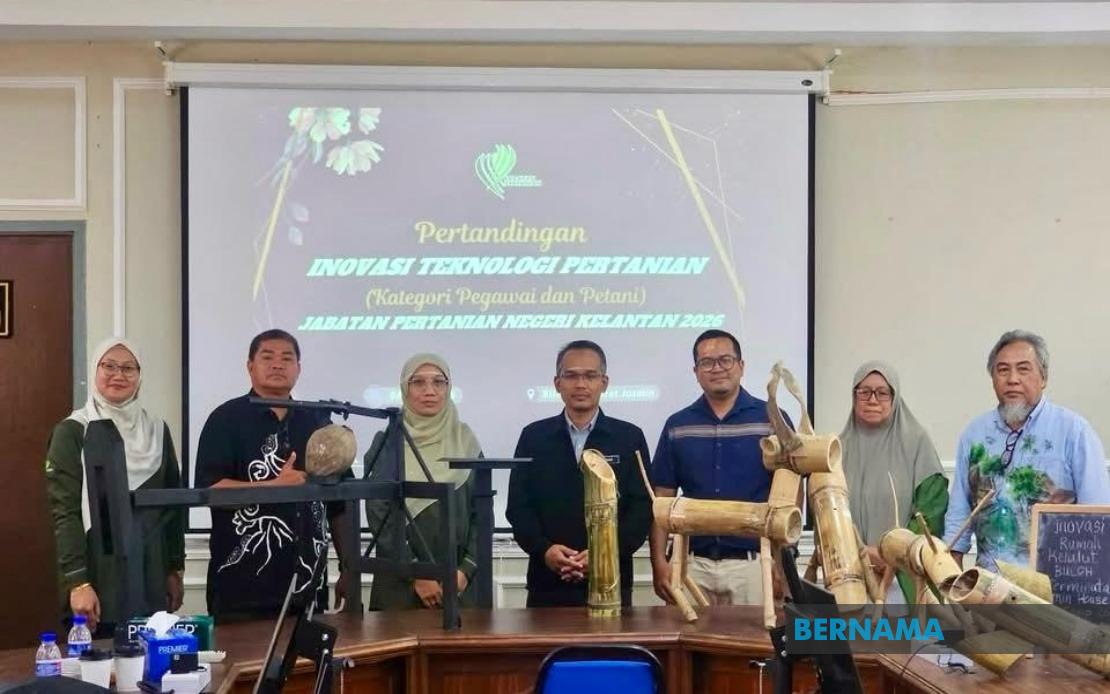
A groundbreaking coconut processing device has emerged from the agricultural sector in Kelantan, attracting significant attention from industry experts and agricultural authorities. Che Adnan Che Kadir, a 56-year-old plantation entrepreneur based in Kampung Chetok, Pasir Mas, has developed a portable dehusking machine that recently garnered a four-star rating at the Kelantan Department of Agriculture's 2026 Agricultural Technology Innovation Competition. The achievement marks a pivotal moment not only for Che Adnan's entrepreneurial venture but also for the broader agricultural mechanisation landscape across Malaysia's northeastern region, where traditional farming methods still predominate despite growing pressures to modernise operations.
The genesis of this innovation lies in the practical challenges faced on Che Adnan's own six-hectare farm. Traditional coconut dehusking requires considerable time and physical labour, with workers typically spending two to three minutes per fruit using conventional hand methods. Beyond the temporal inefficiency, the process carries genuine occupational hazards, with sharp implements and repetitive motions creating injury risks that plague smallholder and commercial operations alike. Che Adnan's solution addresses these pain points directly: his lightweight 3.5-kilogram device reduces processing time to approximately one minute per coconut, with experienced operators achieving results in as little as 40 to 45 seconds. This represents a 60 to 70 percent efficiency gain that could meaningfully alter labour economics for farmers across coconut-producing states.
What distinguishes this innovation from merely solving a farm-specific problem is the recognition by competition judges that the underlying mechanical principle holds broader potential. The judging panel, comprising representatives from the Kelantan Department of Agriculture, the Malaysian Agricultural Research and Development Institute, and local polytechnics, proposed that the device could be adapted for other produce requiring dehusking or similar preparatory processing. Durians and areca nuts were mentioned as candidates, with durian processing emerging as the priority target for further development. This focus makes considerable strategic sense: durian cultivation has exploded across Malaysia over the past decade, driven by rising domestic consumption and robust export demand from China and other regional markets. The labour bottleneck in durian processing—particularly the skilled handling required to safely open and prepare premium fruits—remains a significant constraint on production scaling.
Che Adnan expressed genuine surprise at the trajectory his farm project has taken. What began as a personal solution to operational inefficiencies has now attracted institutional support and positioned him as a potential innovator capable of serving the broader agricultural sector. The recognition at state level carries concrete implications: Che Adnan has been selected as a candidate to represent Kelantan at National Innovation Week, scheduled for late September in Putrajaya, where state winners compete at the national stage. Success at that level would elevate the innovation's profile substantially and potentially unlock additional funding and partnership opportunities.
The development pathway forward hinges significantly on securing further institutional support. Che Adnan has identified several design refinements recommended by the judging panel that require investment to implement. A national innovation grant, available through the agricultural technology support system and carrying a RM10,000 prize component, could provide the capital needed to enhance the device's functionality and durability while scaling production specifications. Such funding is crucial not merely for incremental improvements but for validating the technology's performance across different fruit types and farm scales. Moving from a prototype designed for one farmer's specific needs to a commercialised product serving diverse agricultural contexts requires engineering validation, standardisation, and safety certification.
The implications of this innovation extend beyond individual farmer benefit to structural questions about agricultural mechanisation in Malaysia. The country has long struggled to attract younger workers to farming, with migration to urban centres and manufacturing sectors draining rural labour pools. Technological solutions that reduce the physical labour burden and injury risk associated with agricultural work could help make farming more attractive as a viable career path. Moreover, for smallholder farmers who dominate Malaysian agriculture, affordable and portable mechanisation tools represent a pathway to productivity gains without requiring massive capital investment in large industrial machinery.
The durian adaptation angle particularly resonates given the crop's explosive commercial importance. Malaysia's durian exports have surged dramatically in recent years, with premium varieties commanding exceptional prices in Asian markets. Processing bottlenecks at the farm and initial processing level can delay shipments and affect fruit quality. A technology that accelerates opening and preparation while maintaining the integrity of premium fruits could meaningfully enhance competitiveness for Malaysian exporters competing against Thai and Vietnamese suppliers. The domestic market dimension is equally significant, as the growing durian tourism industry and retail expansion create steady demand for efficiently processed fruits.
Che Adnan's approach to development reflects pragmatic understanding of the commercialisation process. Rather than rushing to market with the current prototype, he is actively seeking to incorporate expert feedback and secure financing for proper refinement. This measured strategy increases the likelihood of producing a genuinely viable product rather than a novelty with limited practical application. The involvement of MARDI and polytechnics in the judging process also suggests potential pathways for technical collaboration as development proceeds, connecting an individual innovator with institutional research capacity.
The success of this initiative also illuminates broader questions about agricultural innovation ecosystems in Malaysia. The Kelantan Department of Agriculture's establishment of a structured innovation competition demonstrates institutional commitment to identifying and nurturing farmer-led solutions. Such competitions serve multiple functions: they provide recognition and validation for agricultural entrepreneurs operating outside formal innovation bureaucracies, they surface practical problems requiring technical solutions, and they create networking opportunities between farmers, researchers, and policymakers. The fact that judges immediately recognised cross-application potential suggests these platforms generate genuine value beyond ceremonial recognition.
Looking ahead, the trajectory from coconut dehusking to durian processing represents a natural expansion that could consolidate Che Adnan's position as an agricultural technology innovator. Success in adapting the technology would require understanding distinct mechanical properties of durians compared to coconuts, but the fundamental principle of powered mechanical opening for hazardous tasks transfers logically. If the durian version reaches commercialisation, it could establish a template for further adaptations across other processed agricultural commodities. Areca nut processing, also labour-intensive and hazardous, could follow as a subsequent development target.
The economic context surrounding this innovation matters significantly. Rising labour costs and workforce shortages across Malaysian agriculture create compelling market demand for mechanisation solutions, particularly at the smallholder scale where traditional labour-intensive methods still predominate. A successful, affordable durian processing device could address a genuine commercial need while generating returns sufficient to sustain Che Adnan's innovation efforts. The RM10,000 national innovation grant, while modest in absolute terms, signals official recognition and could attract additional private investment if the technology demonstrates promise at national competition.
For Malaysian agriculture more broadly, the Che Adnan case exemplifies how innovation need not originate from research institutions or large corporations but can emerge from farmers responding to their own operational challenges. The policy implication is clear: creating platforms and providing modest financial support for farmer-innovators to develop and refine their solutions represents a cost-effective strategy for driving sectoral advancement. As Malaysia seeks to modernise its agricultural base while maintaining its competitive advantage in high-value crops like durian, supporting individuals like Che Adnan who bridge the gap between practical farming knowledge and technological innovation becomes increasingly important.

