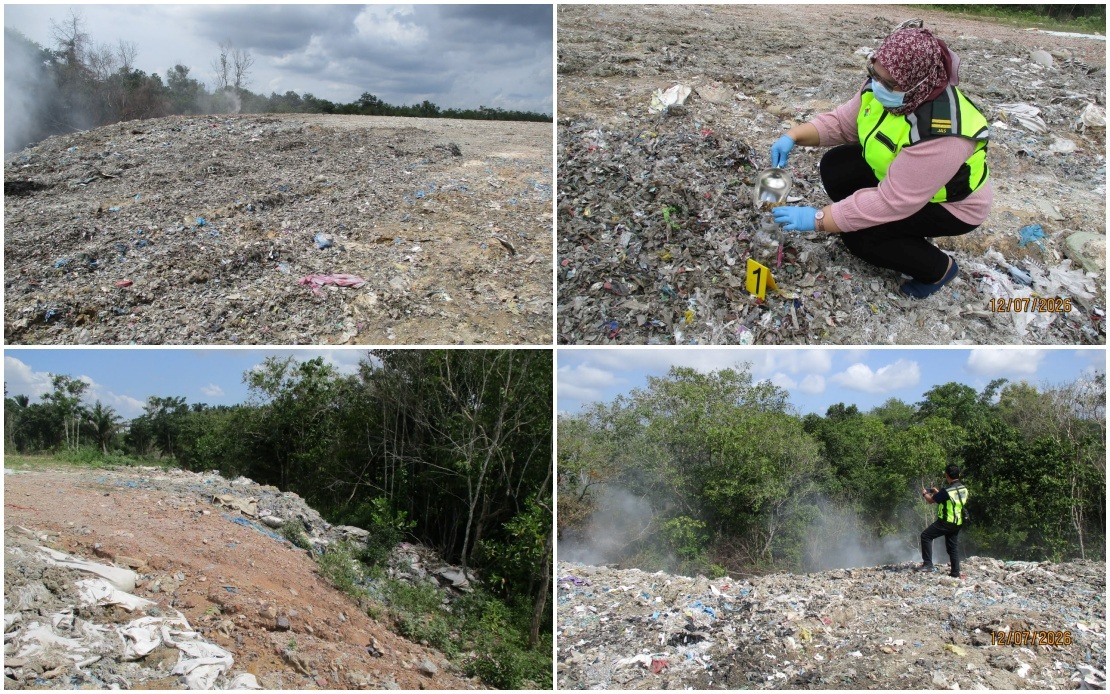
Environmental authorities in Kedah have uncovered an illegal solid waste disposal site in Bukit Banyan, near Sungai Petani, where irresponsible contractors have been conducting open burning to extract valuable metals from domestic refuse. The discovery came after the state's Department of Environment responded to public complaints about persistent burning odours in the area, prompting an immediate investigation that exposed what appears to be an organised dumping operation lacking any official sanction.
Sharifah Zakiah Syed Sahab, director of the Kedah Department of Environment, confirmed that the illicit dumping ground covers approximately 250 square metres of cleared land and contains substantial quantities of domestic waste. The presence of smoke at the site indicated active open burning, a practice commonly employed by waste collectors attempting to recover metals such as copper and aluminium from discarded electrical appliances and industrial scraps. This method, while economically motivated, poses severe air quality and health risks to surrounding communities and represents a brazen violation of Malaysia's environmental protection framework.
Investigations have established that the contractor operating the site carried out waste collection activities in industrial areas throughout the district, later transporting the accumulated refuse to the Bukit Banyan location for disposal and processing. The operation functioned entirely without the mandatory written approval required from the Environment director-general, a clear breach of regulatory obligations. The sophisticated nature of the dumping and burning operation suggests a deliberate circumvention of proper waste management channels rather than ad-hoc illegal disposal by private individuals.
The environmental breach exposes weaknesses in monitoring mechanisms across Kedah's industrial waste streams. Industrial areas generate substantial quantities of mixed waste containing valuable recyclable materials, and the existence of an unauthorised processing site indicates that legitimate disposal infrastructure may be inadequate or excessively costly for some operators. This creates perverse incentives for contractors to seek cheaper, unregulated alternatives that externalise environmental and health costs onto local residents and the broader ecosystem.
The Kedah Department of Environment has initiated comprehensive laboratory analysis by collecting solid waste samples from the site and forwarding them to the Department of Chemistry for detailed composition assessment. These results will help establish the precise nature of materials being processed and quantify the extent of environmental contamination. Such analysis is essential for understanding whether additional environmental remediation efforts will be necessary at the Bukit Banyan location itself, particularly regarding soil contamination from burned residues and ash accumulation.
Prosecution efforts will proceed on multiple fronts under the Environmental Quality Act 1974. The primary charge involves Section 29A(1), targeting the open burning practice itself, while Section 34A(6) addresses the operation of a sanitary solid waste landfill without requisite authorisation. These dual charges reflect the severity of the violations and provide prosecutors with multiple legal avenues to pursue accountability. The maximum penalties under these provisions are substantial enough to deter similar future violations, though enforcement consistency remains crucial for credibility.
The case will now be escalated to the Solid Waste and Public Cleansing Management Corporation (SWCorp), the national enforcement body with jurisdictional authority over solid waste management practices across Malaysia. SWCorp's involvement ensures that the matter receives attention from specialists equipped with comprehensive authority to impose penalties, mandate corrective action, and implement ongoing monitoring protocols. The corporation's intervention also creates opportunities for coordination with other enforcement agencies if the investigation reveals connections to additional unlicensed dumpsites or waste trafficking networks.
This discovery underscores mounting pressure on Malaysia's waste management infrastructure. As industrialisation accelerates across northern Peninsular Malaysia, waste generation in concentrated manufacturing zones like those in Kedah has expanded significantly. The capacity of formal waste disposal and recycling systems has not kept pace, creating gaps that criminal and quasi-criminal operators exploit. Legitimate waste processors complain of constrained capacity and rising costs, while local government authorities lack resources for comprehensive monitoring of dispersed industrial areas.
For Malaysian environmental regulators, the Bukit Banyan case illustrates the critical importance of responsive public reporting mechanisms. The discovery resulted directly from community members reporting suspicious burning and odours, demonstrating that environmental violations remain visible to local populations. However, translating public alerts into swift enforcement action requires adequately resourced departments with rapid response capabilities. Many state-level environmental agencies operate with skeleton crews managing sprawling industrial districts, limiting their capacity to investigate complaints promptly.
The incident also highlights the informal economy's deep integration into Malaysia's waste stream. Scrap metal recovery and waste processing have become increasingly professionalised activities employing hundreds of workers across the country, yet remain largely invisible in official statistics and regulatory frameworks. These informal waste processors occupy an ambiguous space between necessity and illegality, extracting economic value while generating substantial environmental externalities. Addressing this dynamic requires not merely enforcement but engagement with waste recycling economics to understand why legitimate channels remain inaccessible to many operators.
Surrounding communities in Bukit Banyan face both immediate and cumulative health consequences from the open burning operation. Combustion of mixed waste generates hazardous air pollutants including dioxins, furans, and particulate matter, alongside visible smoke that degrades air quality across a broader geographic radius. Prolonged exposure to emissions from open burning has been linked to respiratory disease, cardiovascular complications, and developmental impacts in children. The operation's closure represents vindication for residents who reported their concerns and successful activation of environmental protection mechanisms, though remediation and health monitoring may be necessary.
The broader policy challenge for Malaysian regulators extends beyond enforcement to systematic waste prevention and management infrastructure expansion. Industrial waste streams remain inadequately segregated at source, complicating legitimate recycling operations and creating perverse incentives for informal extraction methods. Regional cooperation within Southeast Asia could also enhance capacity, as some neighbouring countries have developed more efficient industrial waste processing technologies and secure disposal infrastructure that Malaysian operators might access through formal frameworks rather than illicit alternatives.

