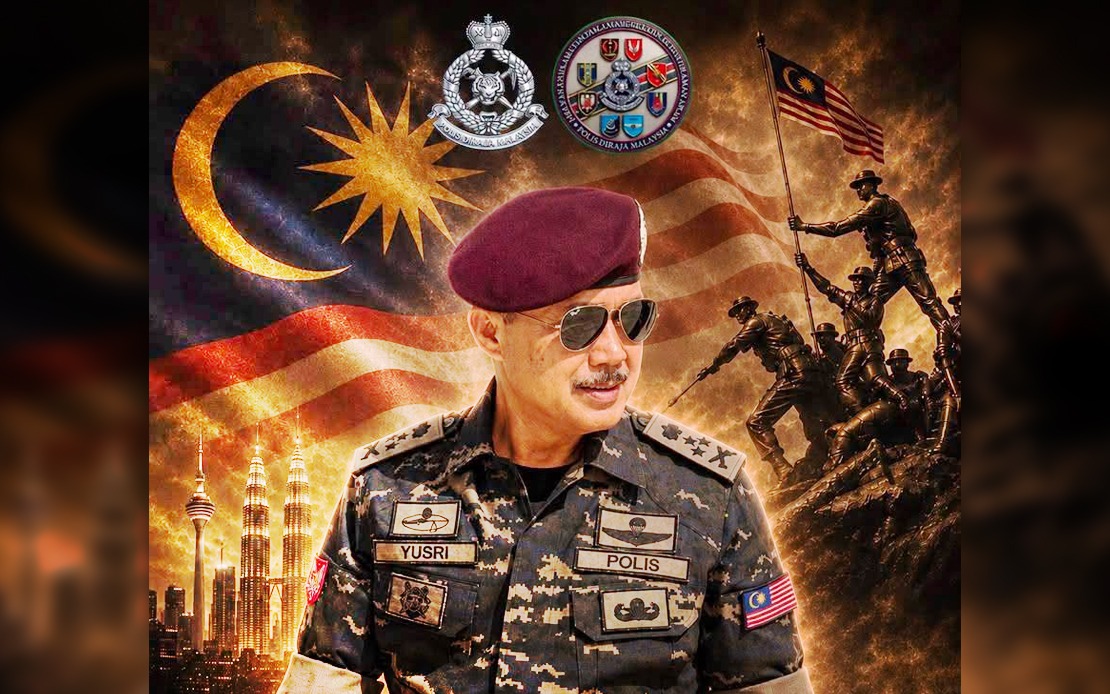
Datuk Seri Mohd Yusri Hassan Basri is trading in his high-powered motorcycle for the saddle this year, switching from leading the police detachment on a BMW R 1250 RT bike to commanding a 595-strong Royal Malaysia Police contingent from atop a white horse named Al-Sakb at the 69th National Day Parade at Dataran Putrajaya on Monday. As the director of the Department of Internal Security and Public Order (KDNKA), the shift marks a symbolic transition that reflects both his career trajectory within the police hierarchy and the evolution of how Malaysia's premier law enforcement agency presents itself during the nation's most important ceremonial occasion.
The change of mount comes as part of a broader reorganisation of the PDRM's parade presence, with the Federal Reserve Unit's Mounted Unit now forming the vanguard of the police contingent. This specialised unit comprises 20 mounted officers and personnel supported by 20 horses, creating a striking visual impact that bridges Malaysia's police heritage with contemporary security operations. The decision to elevate the Mounted Unit to lead position underscores the police force's commitment to maintaining ceremonial excellence whilst projecting an image that resonates with Malaysian public sentiment around tradition and national pride.
For Mohd Yusri, the transition presents both a professional milestone and a personal challenge. Having previously commanded the Traffic Investigation and Enforcement Department (JSPT) and later the Bukit Aman Crime Prevention and Community Safety Department (JPJKK), he has navigated various roles within the police establishment. However, assuming leadership of KDNKA—an agency responsible for internal security and maintaining public order—required him to undergo more than a month of intensive horsemanship and parade protocol training. This preparation was essential not merely for personal competence but to ensure that the movements of the entire mounted contingent remained choreographed, disciplined, and reflective of the standards expected at a national celebration.
The training regimen reflects the meticulous planning that goes into Malaysia's National Day Parade each year. Synchronisation between rider and horse, coordination with the broader contingent, and the physical demands of leading a mounted procession for an extended period all necessitate genuine preparation. Mohd Yusri acknowledged during the full rehearsal that this represented "quite different" and "presents a challenge," suggesting that whilst police leadership demands adaptability, certain roles require specialised skill development beyond administrative competence. The rehearsal itself served as validation that preparations had reached an optimal level, providing confidence that execution on the actual day would unfold smoothly.
Beyond the mounted spectacle, the KDNKA contingent represents a comprehensive showcase of Malaysia's police operational diversity and technological advancement. The General Operations Force and Air Operations Force will deploy alongside the mounted unit, presenting a multifaceted display of security capabilities. The contingent will feature ten newly acquired All Terrain Tactical Assault E-Bikes (ATEB)—cutting-edge electric motorcycles supplied to the GOF for security and border patrol missions, high-risk special operations, and conflict management scenarios. These vehicles exemplify how modern policing integrates advanced technology to address contemporary security challenges, from cybersecurity threats to transnational trafficking.
The air component will be represented through a flypast by an AW139 helicopter operated by PDRM, extending the parade's visual scope beyond terrestrial demonstrations. This helicopter serves critical functions in aerial reconnaissance, search and rescue operations, and rapid response capabilities—functions that extend the police force's operational reach across Malaysia's diverse geography. The inclusion of air assets signals to the public that national security infrastructure encompasses sophisticated multi-domain capabilities, reassuring citizens that police operations transcend traditional ground-based enforcement.
Additional parade elements underscore the breadth of specialised policing functions within the force. The K9 Unit will deploy 16 trained dogs, showcasing canine capabilities in detection, apprehension, and protection operations. Elite force personnel will demonstrate tactical proficiency, whilst the integration of electric motorcycle technology provides a tangible representation of how law enforcement adapts to sustainability imperatives and operational efficiency requirements. Together, these components create a narrative arc that moves from tradition (mounted police), through contemporary capability (tactical operations and elite forces), to future-oriented innovation (electric vehicles and air operations).
Mohd Yusri's emphasis on ensuring "everything runs smoothly and perfectly" reflects broader institutional priorities around projecting competence and professionalism. In the Malaysian political context, where public confidence in police performance fluctuates based on high-profile cases and operational effectiveness, National Day parades serve as important platforms for institutional image-building. The police contingent's performance and presentation contribute to broader perceptions of state capacity and organisational discipline. For a department tasked with internal security in a diverse, multicultural nation grappling with security challenges ranging from religious extremism to organised crime, such symbolic demonstrations matter considerably.
The call for public attendance and family participation reflects another dimension of the parade's significance. By encouraging Malaysians to gather and "experience the National Day atmosphere with their families," Mohd Yusri taps into longstanding traditions of collective national celebration. The National Day Parade functions as a unifying event that transcends partisan politics, allowing citizens from different backgrounds and regions to affirm shared belonging. The police contingent's role within this larger ceremony positions law enforcement as custodian of public order and national stability—functions that gain particular resonance in multiethnic Malaysia where communal harmony remains an ongoing negotiation.
Weather considerations, mentioned almost in passing, nonetheless underscore the logistical complexities of such events. A mounted procession's success depends significantly on atmospheric conditions affecting both horse performance and overall comfort for officers and spectators. The invocation of "Alhamdulillah" (praise be to God) alongside practical acknowledgment of weather uncertainty reflects how Malaysian officials navigate both procedural management and cultural-religious frameworks in governance contexts. The hope for improved weather conditions demonstrates how even carefully orchestrated state events remain subject to natural forces beyond bureaucratic control.
The integration of traditional and modern elements within the KDNKA contingent offers a broader commentary on contemporary policing philosophy. Rather than abandoning ceremonial tradition in favour of purely functional displays, the police force preserves mounted units whilst embracing electric motorcycles and helicopter assets. This balanced approach suggests recognition that legitimacy in law enforcement derives from multiple sources—historical continuity, demonstrated capability, and forward-thinking innovation all contribute to public confidence. For Malaysian audiences increasingly attuned to debates about government accountability and security effectiveness, such comprehensive demonstrations of police capabilities and professionalism carry genuine persuasive weight.
As Malaysia approaches the 69th National Day celebration, the parade's police contingent will serve as a microcosm of broader institutional aspirations and capabilities. Mohd Yusri's leadership of the mounted unit, combining personal challenge with representational responsibility, embodies the multifaceted demands of contemporary police leadership in Malaysia. The visible integration of tradition, operational specialisation, and technological advancement provides tangible reassurance to citizens that security institutions remain attentive to both heritage and future imperatives. Whether this symbolic presentation translates into sustained public confidence depends ultimately on how police institutions perform in actual operations, but the parade itself—meticulously rehearsed and carefully choreographed—demonstrates that Malaysian law enforcement takes seriously the presentation of professional capability and institutional credibility during moments of national significance.

