The pre-dawn fire that tore through Kampung Lok Buta in Kota Kinabalu on August 30 has left a community reeling from one of the most tragic residential disasters in recent memory. The blaze claimed the lives of three young victims—Nana Abdullah, 4, her six-year-old brother Mohd Asrul Abdullah, and their eight-year-old cousin Nurfarahdilah Mohd Tajihah—while consuming more than 200 houses in its path. The incident occurred at 1:40 am, catching residents largely unaware and preventing many from escaping the rapidly advancing flames that would ultimately displace over 200 families from their homes.
In response to the scale of the disaster, authorities moved swiftly to establish coordinated relief operations across the affected settlement. Two temporary shelter centres have been activated at Dewan Kampung Likas and Dewan Damai to provide immediate refuge for the displaced families. These facilities are serving as central hubs for victim registration, documentation of losses, and the systematic distribution of emergency aid from government agencies and private donors. The decision to centralise relief efforts reflects recognition that such a large-scale displacement requires meticulous coordination to prevent duplication of assistance and ensure that those most vulnerable receive priority support.
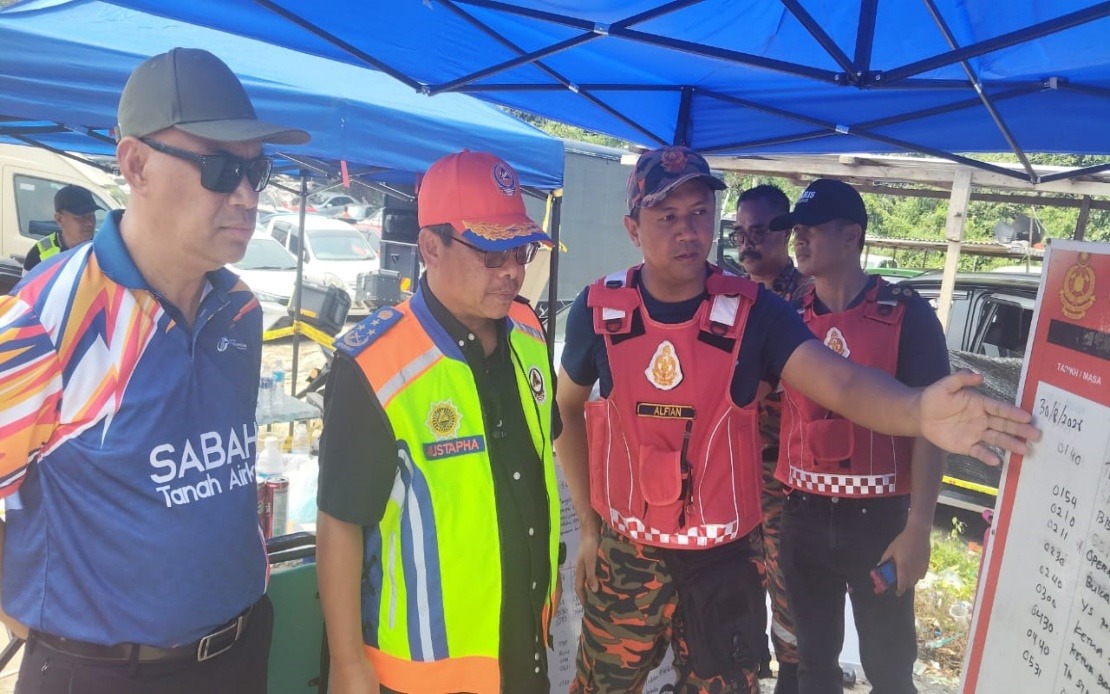
The Kota Kinabalu City Hall formally designated the fire-ravaged area as a disaster zone, unlocking access to additional resources and enabling faster deployment of government assistance mechanisms. Datuk Mustapha Sakmud, the Minister in the Prime Minister's Department overseeing Sabah and Sarawak affairs, visited the scene on the day of the disaster to assess conditions firsthand. Accompanying him was Datuk Seri Dr Sabin Samitah, both the mayor of Kota Kinabalu City Hall and chairman of the District Disaster Management Committee, underscoring the seriousness with which local and federal authorities are treating the incident.
Beyond immediate shelter and relief distribution, Mustapha identified a critical secondary concern that extends the disaster's reach beyond physical displacement. A significant proportion of the affected households contain school-age children currently enrolled in primary and secondary institutions, higher education facilities, or vocational training programmes across the city. The fire threatens to disrupt their academic progress during a crucial period of the school calendar, creating a cascade of educational losses that could affect these students' long-term outcomes. To mitigate this risk, Mustapha pledged to coordinate directly with the Ministry of Education to establish tailored support schemes ensuring that affected students from schools, higher education institutions, and Technical and Vocational Education and Training providers can continue their studies without interruption.
The incident has already prompted high-level political engagement, signalling the issue's significance within state governance circles. Mustapha indicated that the Malaysia Agreement 1963 Implementation Action Council—a body bringing together federal and state leadership—will convene to discuss the disaster's broader implications and recovery strategy. Both Prime Minister Datuk Seri Anwar Ibrahim and Sabah Chief Minister Datuk Seri Hajiji Noor are expected to attend, with the Kota Kinabalu mayor potentially presenting a detailed briefing on damage assessments and required interventions. This institutional escalation suggests that officials recognise Kampung Lok Buta requires not merely emergency response but sustained policy attention to rebuild infrastructure and community capacity.
The loss of three children has reverberated through the community and raised urgent questions about residential fire safety and emergency response capabilities in densely populated settlements. The victims' ages—ranging from four to eight years old—amplify the tragedy's emotional weight, particularly among parents in similar housing situations across Sabah. Their deaths underscore vulnerabilities in informal or semi-formal residential areas where fire prevention infrastructure, evacuation procedures, and emergency access may lag behind standards in more formally developed zones. The incident highlights enduring challenges in rapid urbanisation areas where population concentration sometimes outpaces corresponding investments in safety systems.
Minister Mustapha also committed to providing initial financial assistance to the families of the three deceased children, recognising that bereavement compounds the material losses these families have already sustained. This immediate hardship support, while modest in scope, represents the state's acknowledgment of its responsibility toward those who have suffered the most severe consequences. Beyond this gesture, the broader question of comprehensive medium-term reconstruction assistance—encompassing housing, livelihood restoration, and psychosocial support—will require sustained government commitment extending well beyond the immediate crisis phase.
The incident places renewed focus on disaster preparedness infrastructure in Kota Kinabalu, a city experiencing rapid residential expansion into areas that may not have adequate fire suppression systems, emergency warning mechanisms, or evacuation planning. Local authorities will face pressure to audit fire safety standards across informal and semi-formal settlements, particularly those with densely clustered wooden or makeshift structures that accelerate fire spread. The Kota Kinabalu City Hall faces a critical opportunity to translate this tragedy into catalysts for systemic improvements in building codes, fire prevention education, and emergency response protocols. Whether these changes materialise will ultimately determine whether Kampung Lok Buta becomes a historical marker prompting meaningful safety reform or simply another disaster remembered for its human cost without institutional learning.
For Malaysian readers and policymakers across the broader Southeast Asian region, the Kampung Lok Buta fire exemplifies vulnerabilities persistent in rapidly growing urban environments where housing demand outpaces regulatory capacity and safety infrastructure development. The incident raises questions about urban planning priorities in the context of accelerated rural-to-city migration, the adequacy of relief systems for handling sudden large-scale displacement, and whether existing institutional frameworks can effectively coordinate multi-agency responses at the speed disasters demand. The coming weeks will reveal whether the high-level political engagement announced by Minister Mustapha translates into concrete policy changes or remains symbolic acknowledgment of tragedy without substantive follow-through.

