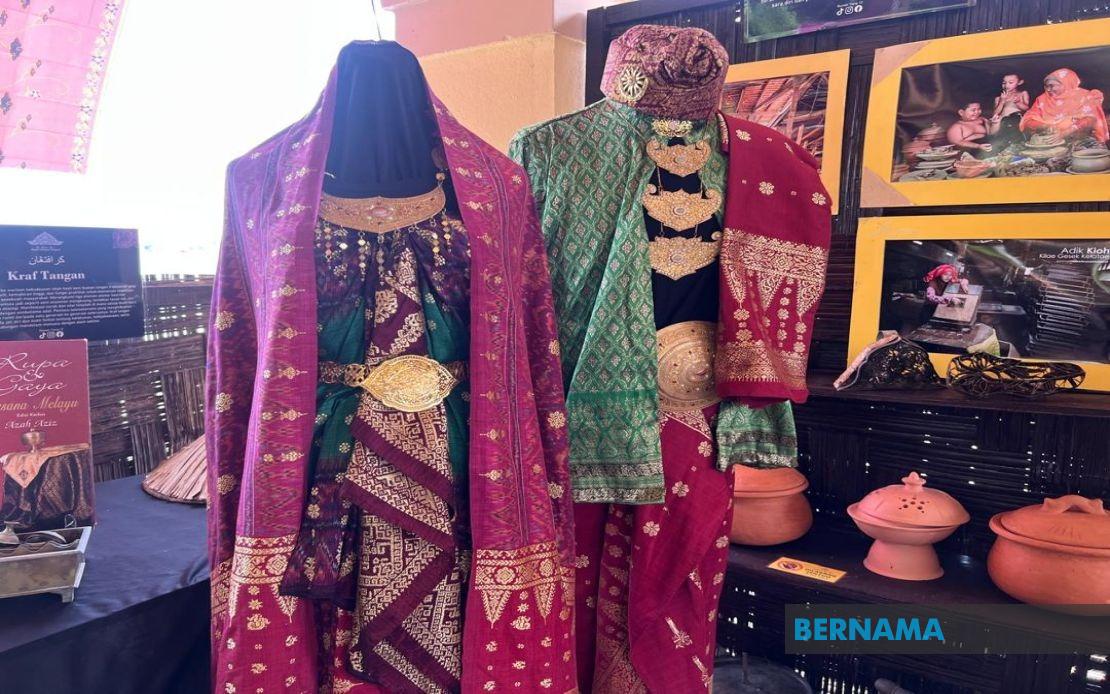
The centuries-old tradition of Kain Lima weaving—a distinctly Malaysian textile craft that once symbolised royal prestige—teeters on the edge of extinction as the number of practitioners continues to shrink. Nik Mohd Murdani Nik Hassan, caretaker of Galeri Rumah Tiang 12, voiced concern about the craft's diminishing presence during the Festival Kesenian Rakyat Kelantan held in Tok Bali, underscoring the urgent need to document and celebrate this vanishing cultural treasure before knowledge of its production methods disappears entirely.
What distinguishes Kain Lima from other traditional Malaysian textiles is the sophistication of its technical execution. The weaving process hinges on a labour-intensive combination of tied or tie-dye threads that create intricate motifs and a distinctive colour-reflection effect impossible to replicate through conventional methods. Unlike songket, which relies on the insertion of gold or silver threads into a woven base, Kain Lima demands meticulous arrangement of multiple coloured threads before the weaving even begins, with each motif positioned with exacting precision to achieve the desired final appearance.
For those versed in traditional textiles, identifying authentic Kain Lima requires understanding its unique structural characteristics. Nik Mohd Murdani explained that trained eyes can distinguish Kain Lima from songket and other heritage fabrics through several markers: the distinctive pattern compositions, the underlying weaving structure, and the materials incorporated into the work. These technical differences reflect generations of accumulated knowledge passed down through weaving families, knowledge that exists increasingly only in the minds of aging practitioners rather than in active production.
The economic value of genuine Kain Lima pieces reflects their rarity and the extensive labour required for production. Contemporary market prices range from RM3,000 to over RM4,000 per piece, with variation determined by factors including age, motif complexity, physical condition, and the refinement of the weaving work itself. This valuation positions Kain Lima as a luxury commodity, yet paradoxically, the scarcity that drives high prices also indicates the craft's vulnerability. Historical records show that Kain Lima was exclusively worn by royalty in the form of sarongs, shawls, and ceremonial garments, establishing it as a marker of elite status within Malay society.
Galeri Rumah Tiang 12 has emerged as a crucial repository for Kain Lima preservation efforts since Nik Mohd Murdani joined the institution in 2020. The gallery functions as both a museum and educational space, housing collections of Kain Lima pieces from private collectors who recognise the importance of public access to these textile treasures. By bringing these artefacts out of private storage and displaying them in an organised, contextualized setting, the gallery fulfils a pedagogical mission alongside its conservation role.
The exhibitions mounted at the gallery serve multiple constituencies simultaneously. For the general public and casual visitors, the displays offer a first opportunity to observe the tangible differences between Kain Lima, songket, and other traditional Malaysian textiles—differences that become increasingly difficult to witness as production ceases and existing pieces remain sequestered in private hands. This educational function becomes ever more critical as the generation familiar with these textiles through daily cultural practice ages without transmitting their knowledge to younger Malaysians.
Younger craft practitioners are beginning to recognise the value locked within these heritage exhibitions. Nur Anira Akmal Che Abdul Aziz, a 34-year-old handicraft maker from Pasir Mas, exemplifies this emerging consciousness among contemporary artisans. She attended the Festival Kesenian Rakyat Kelantan exhibition specifically to deepen her understanding of various heritage textile types and their production methodologies, viewing the exhibition as a source of technical and aesthetic inspiration for her own creative work.
Nur Anira's approach reflects a broader potential pathway for Kain Lima preservation: rather than attempting to resurrect the craft in its original form—a task complicated by the scarcity of remaining knowledgeable practitioners and the economics of traditional production—contemporary makers can incorporate elements of Kain Lima's aesthetic sensibility and technical sophistication into new works that honour the heritage while responding to contemporary markets. Each exhibition visit, she noted, stimulated new ideas for enhancing her craftwork while deepening her understanding of why these traditional textiles merit preservation.
The challenge facing Kain Lima preservation is fundamentally one of intergenerational knowledge transfer in an economic context that makes traditional production increasingly unviable. The months or weeks required to complete a single piece of Kain Lima represent labour costs that modern markets struggle to justify, particularly when machine-made alternatives proliferate at vastly lower price points. Young Malaysians entering the workforce face career calculations that rarely point toward textile craftsmanship, creating a demographic cliff whereby knowledge passes out of living memory.
Regional context amplifies these concerns. Across Southeast Asia, similar traditional textiles face comparable pressures from globalisation, urbanisation, and shifting consumer preferences. Malaysia's experience with Kain Lima parallels challenges confronting Javanese batik, Thai silk weaving, and Cambodian ikat production—all facing questions about sustainability and transmission. What distinguishes Malaysian efforts thus far is the institutional commitment through galleries and festival programming, though observers question whether exhibition-based preservation can adequately substitute for living, economically viable production traditions.
The path forward likely requires multiple simultaneous interventions. Documentation projects must capture remaining practitioner knowledge through video, photography, and detailed written records before it disappears. Museums and galleries must continue expanding access to existing pieces while contextualising them within broader narratives of Malay cultural achievement. Educational initiatives could introduce Kain Lima to students as both artistic achievement and technical accomplishment worthy of study. Economic models must be explored that allow contemporary makers to engage with Kain Lima traditions without requiring economic self-sacrifice.
Ultimately, the disappearance of Kain Lima weaving represents a broader erosion of Malaysia's tangible cultural heritage. Unlike monuments or archaeological sites that remain physically present even when no longer actively used, living crafts traditions can vanish entirely within a single generation, taking with them centuries of accumulated technical knowledge and aesthetic refinement. The efforts at Galeri Rumah Tiang 12 and similar institutions suggest awareness of this urgency, yet whether such preservation initiatives prove sufficient to halt Kain Lima's decline toward extinction remains uncertain.

