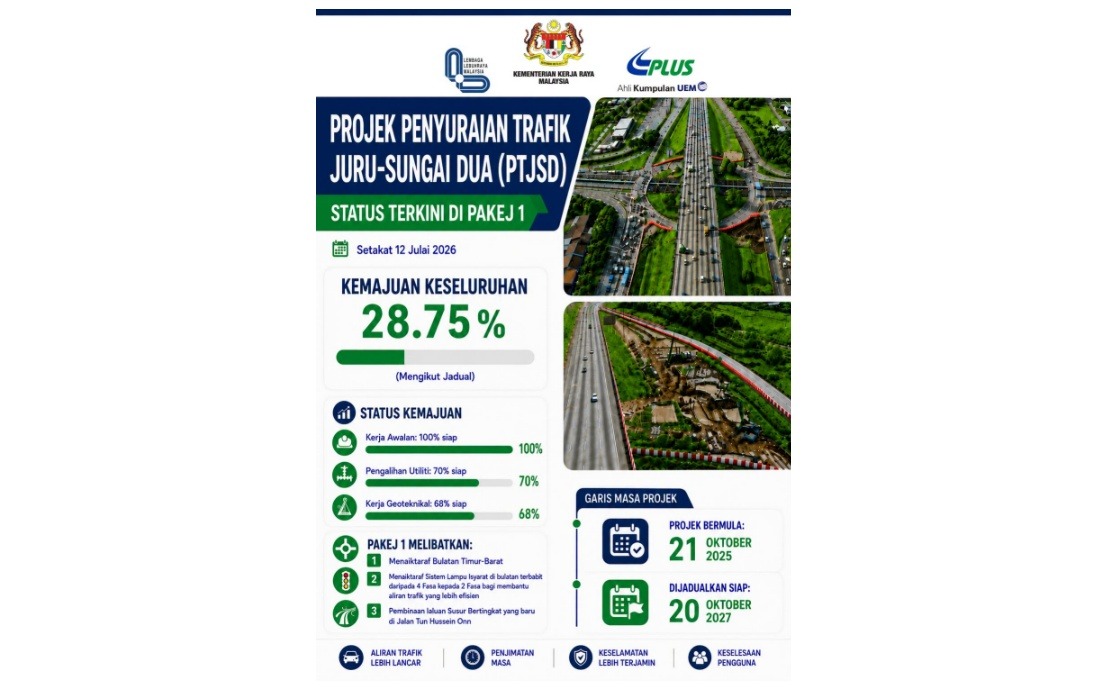
The Juru-Sungai Dua Traffic Dispersal Project (PTJSD) continues advancing without delay, with the first major package now standing at 28.75 per cent completion as of July 12. PLUS Malaysia Berhad, the highway operator spearheading the initiative, has confirmed that the project maintains its scheduled delivery timeline, with all preliminary groundwork fully finished and critical utility displacement work progressing steadily at 70 per cent completion.
This ambitious undertaking represents a concerted response to one of Malaysia's most pressing transportation challenges. The Juru-Sungai Dua corridor serves as the primary arterial route connecting Penang with the northern peninsula states, making it essential infrastructure for both daily commuters and interstate commerce. With approximately 200,000 vehicles traversing this route daily, the current congestion levels have become untenable, turning routine journeys into protracted ordeals during peak traffic periods.
The project's technical scope encompasses transformative improvements across a 17.3-kilometre stretch spanning three districts in Seberang Perai—South, Central, and North. Package 1, which is currently underway, focuses on reconfiguring the East-West Roundabout, implementing an enhanced traffic signal management system designed to optimize vehicle throughput, and constructing an elevated slip road along Jalan Tun Hussein Onn. These interventions address specific bottlenecks that have chronically impeded traffic flow in this densely utilised corridor.
Geotechnical investigations and site preparation activities have now reached 68 per cent completion, demonstrating the scale of foundational work required before major construction commences. The progression of these preliminary phases signals that the project remains on trajectory for its October 2027 conclusion, a timeline that would deliver relief to the travelling public within a reasonable timeframe. The coordination between PLUS Malaysia, the Ministry of Works, and the Malaysian Highways Authority indicates institutional alignment around this infrastructure priority.
The financial commitment underpinning this initiative is substantial, with an estimated outlay of RM3 billion reflecting both the scope and complexity of the work involved. This investment reflects government and private sector recognition that infrastructure spending in the transport sector yields considerable returns through congestion reduction, improved economic productivity, and enhanced quality of life for residents and regular users of the corridor.
When operational, the new direct Juru-Sungai Dua route will fundamentally alter travel patterns through the region. Projections indicate that approximately 30 per cent of current traffic will shift onto this dedicated pathway, thereby relieving congestion on existing routes. The anticipated outcome is dramatic: peak-hour travel times are expected to compress from the current 60-minute standard to just 20 minutes, representing a two-thirds reduction that would substantially improve both personal mobility and commercial efficiency.
Beyond raw speed, the project promises multifaceted benefits to stakeholders. Traffic flow optimization reduces driver stress and vehicle emissions associated with congestion, while enhanced safety features embedded in the roundabout redesign and slip road geometry should decrease accident rates. The improved experience for highway users and neighbouring residents reflects a design philosophy that considers holistic community impact rather than merely channelling vehicles through a corridor.
For Malaysian readers, this initiative carries broader significance within the nation's infrastructure development narrative. Northern Penang and Seberang Perai represent economically dynamic regions with sustained population and industrial growth, making transport capacity expansion essential to future competitiveness. The project demonstrates how targeted, substantial infrastructure investment can address specific regional bottlenecks that threaten economic momentum and livability.
The progression metrics disclosed by PLUS Malaysia—particularly the completion of preliminary works and steady advancement in utility relocation—suggest competent project management and adherence to engineering timelines. These early-stage indicators, though not definitive predictors of long-term success, provide stakeholders with reasonable confidence in the enterprise's viability. Highway projects of this magnitude frequently encounter unforeseen complications; early disciplined execution positions the PTJSD favourably against such risks.
From a Southeast Asian perspective, this project exemplifies how developed-market ASEAN economies are addressing urbanization pressures through targeted transport infrastructure. The region faces growing congestion as economic development concentrates populations in core corridors, and solutions like the PTJSD reflect adaptive responses to these challenges. The route's importance as a connector between Penang and northern peninsula states also underscores how intra-ASEAN connectivity improvements can facilitate trade and people movement across the region.
Stakeholders should note that the October 2027 completion target represents the current baseline, subject to the contingencies inherent in large-scale infrastructure delivery. Material cost fluctuations, labour availability, regulatory changes, and unforeseen ground conditions could influence timelines. Nevertheless, the project's current trajectory suggests that decision-makers have established realistic schedules with adequate buffer provisions.
For commuters and businesses reliant on the Juru-Sungai Dua corridor, the PTJSD offers concrete hope that chronic accessibility challenges will yield to engineering solutions. The 200,000 daily users of this route can anticipate meaningful improvements in journey predictability and travel times within three years, potentially unlocking economic productivity gains and lifestyle benefits that justify the substantial public and private sector commitment underlying this initiative.

