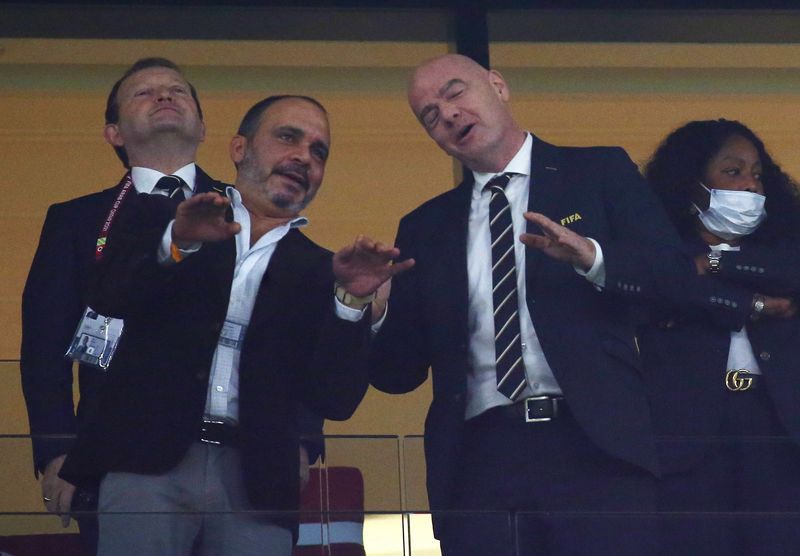
The president of Jordan's Football Association launched a stinging public rebuke at FIFA's leadership on Tuesday, accusing the world governing body's chief of resorting to coercive tactics that violate fundamental principles of ethical conduct. Ali bin Hussein alleged that Gianni Infantino had used FIFA's capacity to resolve institutional problems facing smaller football associations as leverage to secure political backing, a claim that exposes deepening fractures within soccer's hierarchy at a moment when Infantino's authority is already under considerable strain.
Bin Hussein detailed the nature of these allegations through a statement posted on social media, explaining that FIFA officials had verbally communicated an implicit quid pro quo arrangement during the recent World Cup tournament. According to the Jordan FA chief, the proposition was straightforward: endorsing Infantino's continued leadership would substantially facilitate FIFA's assistance with various outstanding issues affecting the association. This occurred, he stressed, only after months during which FIFA had repeatedly declined to provide support on matters of significant consequence to Jordan's football development, creating a pattern that he characterised as calculated leverage.
The Jordanian official's public denunciation carries particular weight given that it comes from a representative of a smaller nation attempting to develop its football infrastructure with considerably constrained resources. Jordan qualified for the World Cup for the first time in its history, reaching the tournament held in the United States, though the team was eliminated during the group stage. This achievement represented a milestone for Jordanian football, yet the experience highlighted systemic inequities in how FIFA treats associations from different regions and economic circumstances.
Bin Hussein articulated a comprehensive catalogue of grievances that collectively illustrate the financial pressures and administrative barriers facing smaller associations within FIFA's governance structure. Jordanian supporters attending the World Cup faced substantial difficulties obtaining entry visas to the United States, even as they were required to pay exceptionally high ticket prices for matches. Simultaneously, the association had been awaiting payment of prize money due for reaching the final of the 2025 Arab Cup, a tournament organised under FIFA's auspices, with funds still outstanding since December despite FIFA's publicly documented substantial financial reserves.
Among the most troubling complaints raised by the Jordan FA chief concerns differential taxation treatment imposed through FIFA's administrative apparatus. Teams participating in the World Cup tournament were subjected to United States federal taxation on their participation through FIFA's collection mechanisms, yet this fiscal burden was not equally applied to competing nations based in Canada and Mexico. Jordan, having established its World Cup operations within American territory, incurred these significant tax liabilities while similar neighbouring nations avoided equivalent charges. These funds, bin Hussein emphasised, represented money that should have flowed to players and coaching staff rather than being diverted to foreign tax authorities.
Bin Hussein's statement articulated Jordan's commitment to upholding ethical standards within international football governance, explicitly rejecting any suggestion that his association would compromise its principles regardless of the benefits FIFA might offer in exchange. The statement carried particular significance given the broader context of institutional governance challenges at FIFA, suggesting that conditionality of institutional support based on political endorsement represents a fundamental betrayal of football's foundational values. The public nature of this accusation transforms what might otherwise remain a private diplomatic dispute into a matter of systemic concern affecting how FIFA exercises its authority over smaller member associations.
The timing of bin Hussein's denunciation proves particularly consequential given that Infantino already faces substantial opposition from within football's administrative leadership. The FIFA president recently retreated from promoting a controversial proposal to monetise FIFA's commercial operations by selling a minority stake in the World Cup rights, following coordinated rejection from confederations and national associations worldwide. A firm deadline of September 19 had been imposed on this initiative, yet the unified resistance from football's governance structure forced Infantino to abandon the scheme, representing an uncommon public defeat for the FIFA president within the organisation's hierarchy.
Further erosion of Infantino's authority became evident as several high-ranking FIFA executives, including Secretary General Mattias Grafstrom and Arsene Wenger, publicly distanced themselves from the controversial proposal and broader leadership approach. This institutional defection signifies that opposition to current FIFA governance extends beyond national associations to encompass significant figures within the administration itself. Bin Hussein's intervention thus arrives at a moment when Infantino's capacity to command consensus within football's hierarchies faces unprecedented challenge, with multiple stakeholders questioning both his strategic direction and the ethical foundations of his decision-making.
For Malaysia and other Southeast Asian football associations navigating relationships with FIFA, the Jordan FA chief's allegations contain sobering implications about power dynamics within the global football governance system. Smaller associations attempting to develop competitive programmes and secure equitable treatment from international bodies face structural disadvantages that FIFA's administrative apparatus may exploit through conditional provision of resources and support. The case of Jordan, despite that nation's successful World Cup qualification, demonstrates that even historic achievements do not guarantee equitable institutional treatment or protection from coercive administrative practices.
The fundamental tension revealed through bin Hussein's statement concerns whether FIFA operates as a democratic confederation of member associations or as a hierarchical institution where leadership deploys financial and administrative authority to secure political compliance. Jordan's complaint suggests that institutions claiming to advance global football development may simultaneously perpetuate inequitable systems that disadvantage smaller nations relative to those with greater economic resources and political influence within FIFA's structure. This structural critique extends beyond individual grievances to implicate the entire architecture through which FIFA distributes resources, imposes financial obligations, and distributes the benefits of major tournament participation.
The implications of these allegations will likely reverberate through football governance discussions, particularly as FIFA prepares for its forthcoming leadership elections and strategic planning processes. Whether the federation demonstrates capacity to address systemic concerns about ethical conduct in resource allocation and conditional support will substantially influence the organisation's institutional legitimacy among smaller member associations. For Jordan and comparable nations, the public articulation of these grievances marks a significant moment in asserting the rights of smaller associations to equitable treatment and protection from coercive administrative practices within international football governance.

