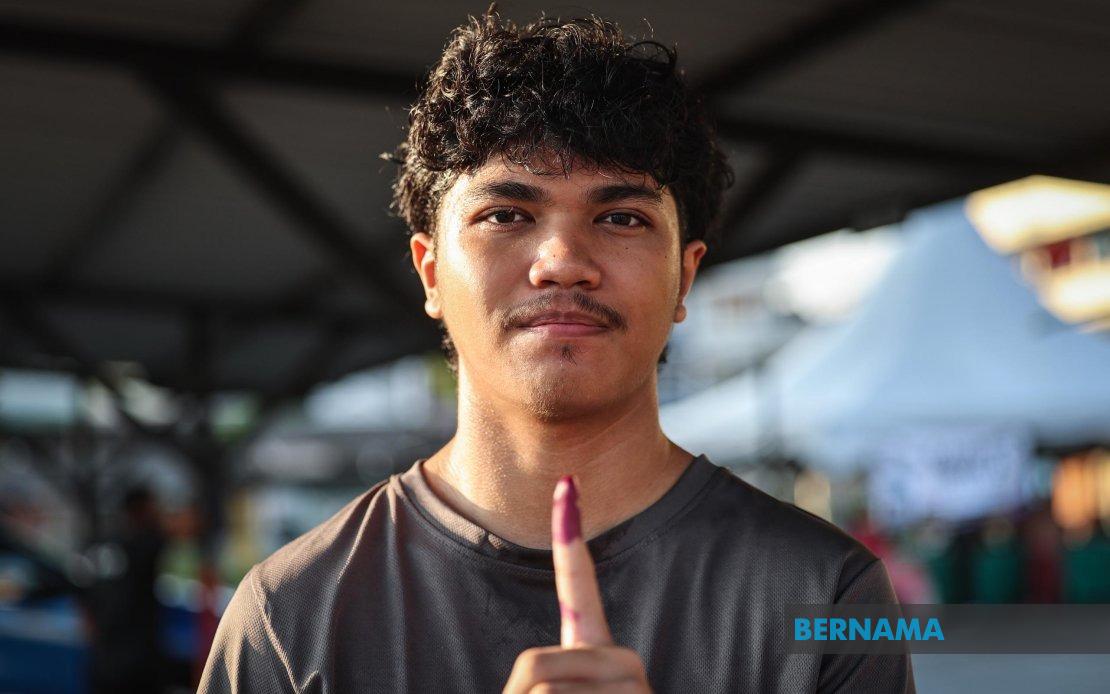
A notable pattern emerged during voting in the 16th Johor State Election on July 11, as young voters casting ballots for the first time articulated a strikingly pragmatic approach to electoral choice: they care far less about party colours than about whether their representatives will actually deliver on promises. This sentiment, expressed consistently across multiple polling stations throughout Johor Bahru, suggests a significant generational realignment in how younger Malaysians evaluate political leadership.
Ahmad Irfan Harith Ahmad Izwan, a 19-year-old agriculture diploma student at Universiti Putra Malaysia Sarawak, exemplified this new voter mentality when explaining his decision-making process. He deliberately arrived early at the SMK Bandar Baru Uda polling centre in the Larkin state constituency specifically to avoid queues, demonstrating a deliberate commitment to participating in the democratic process. Rather than accepting candidates at face value, Ahmad Irfan had methodically evaluated each contender's performance during the campaign period, seeking evidence that they possessed the capacity and will to improve residents' living standards. For him, the transaction between voter and representative had become transactional in the most literal sense: an exchange of electoral support for concrete, measurable improvements in community welfare.
This emphasis on tangible outcomes over partisan loyalty extended across the day's voting. Jolin Tan Pei En, a 20-year-old entrepreneur in online clothing retail, explicitly rejected the notion that party affiliation should guide voting decisions. When she cast her ballot at SMK Taman Molek for the Johor Jaya state constituency, her primary concern was whether the elected leader would work diligently and serve constituents with genuine commitment. Her perspective reflects a broader shift among young Malaysians who appear less invested in traditional party machinery and more focused on individual capability and integrity. This represents a potential realignment of Malaysian politics toward performance-based rather than ideologically-based voting patterns, with significant implications for how parties must campaign and govern.
Filzah Maisara Mohd Fuad, a 19-year-old culinary diploma student, brought emotional dimension to this analytical approach. For her, voting for the first time carried profound significance—not merely as a civic ritual but as a meaningful opportunity to shape her community's future. Casting her ballot at the Taman Setia Indah Religious School polling centre in the Puteri Wangsa constituency, Filzah expressed hope that her chosen representative would prove trustworthy and capable of advancing Johor's development trajectory. Her comments suggest that first-time voters are not approaching elections with cynicism or disengagement, but rather with heightened expectations and a desire to hold leaders accountable to standards of competence and sincerity.
The scale of this election underscored the importance of understanding these emerging voter preferences. The 16th Johor State Election operated across 1,076 polling centres containing 4,889 voting streams, accommodating more than 2.6 million registered voters who were eligible to cast ballots for representatives to fill 56 seats in the State Legislative Assembly. The sheer logistical complexity of managing this voting process—extending from 8 am until 6 pm following a 14-day campaign period—reflected the administrative machinery required to capture the democratic choices of Johor's electorate.
What becomes apparent from interviewing first-time voters is that this generation appears to have developed more sophisticated political judgement than earlier cohorts. Rather than treating elections as tribal exercises where party affiliation determines outcomes, these young voters are conducting independent assessments of candidate quality. They are asking whether individuals can demonstrate commitment, whether campaigns feature realistic and achievable promises, and whether candidates have previously shown capacity to execute on their stated objectives. This represents a maturation of electoral behaviour that could fundamentally alter how Malaysian politicians campaign and govern.
The emphasis on integrity and trustworthiness particularly stands out as a priority for first-time voters. Ahmad Irfan, Jolin Tan, and Filzah Maisara all explicitly mentioned wanting leaders they could trust to serve the people genuinely. This suggests that Malaysian youth have absorbed lessons about broken promises and underperforming politicians, and they are determined to support only those candidates who demonstrate both capability and moral commitment to constituents. In an era of declining trust in institutions globally, this focus on personal integrity as a prerequisite for political support represents a compelling response.
For Malaysian political parties and candidates, this emerging voter profile presents both challenge and opportunity. The challenge lies in recognising that traditional appeals to party loyalty, historical narratives, or ideological positioning may resonate less effectively with younger voters who are explicitly rejecting these frameworks. Instead, parties must invest in demonstrating concrete policy competence, delivering on previous commitments, and presenting candidates whose personal records substantiate claims of integrity and dedication. The opportunity exists for candidates and parties that successfully embody these qualities to capture enthusiastic support from a voting cohort that appears genuinely motivated by the prospect of effective governance.
The geographic dimension of Johor's election added additional context to this analysis. As Malaysia's second-largest state by population and a major economic centre, Johor faces complex governance challenges spanning urban development, infrastructure provision, agricultural support, and inter-community relations. First-time voters in constituencies like Larkin, Johor Jaya, and Puteri Wangsa are essentially signalling that they expect their elected representatives to address these substantive policy challenges competently. They are not content with symbolic gestures or rhetorical flourishes; they want leaders equipped and determined to solve problems.
The timing of this election also mattered contextually for understanding voter sentiment. Young Malaysians casting ballots in July 2023 were doing so against a backdrop of national political turbulence, economic pressures, and persistent questions about governance quality at federal and state levels. First-time voters were thus inheriting a political landscape marked by considerable scepticism about whether elected officials could be trusted to prioritise public interest above factional advantage. The fact that these young voters were arriving early to polling stations and thoughtfully evaluating candidates demonstrated resilience in democratic commitment despite this challenging environment.
What emerged most strikingly from interviews with first-time voters was an absence of ideological rigidity coupled with a presence of practical expectations. These young Malaysians were not demanding revolutionary change or ideologically pure candidates; they were simply asking that elected representatives work competently, honestly, and in service of constituent welfare. This fundamentally pragmatic orientation could reshape Malaysian electoral dynamics if it reflects broader generational attitudes. Politicians and parties that recognise and respond to this demand for performance-based governance may find themselves building enduring support among younger voters who represent Malaysia's electoral future.

