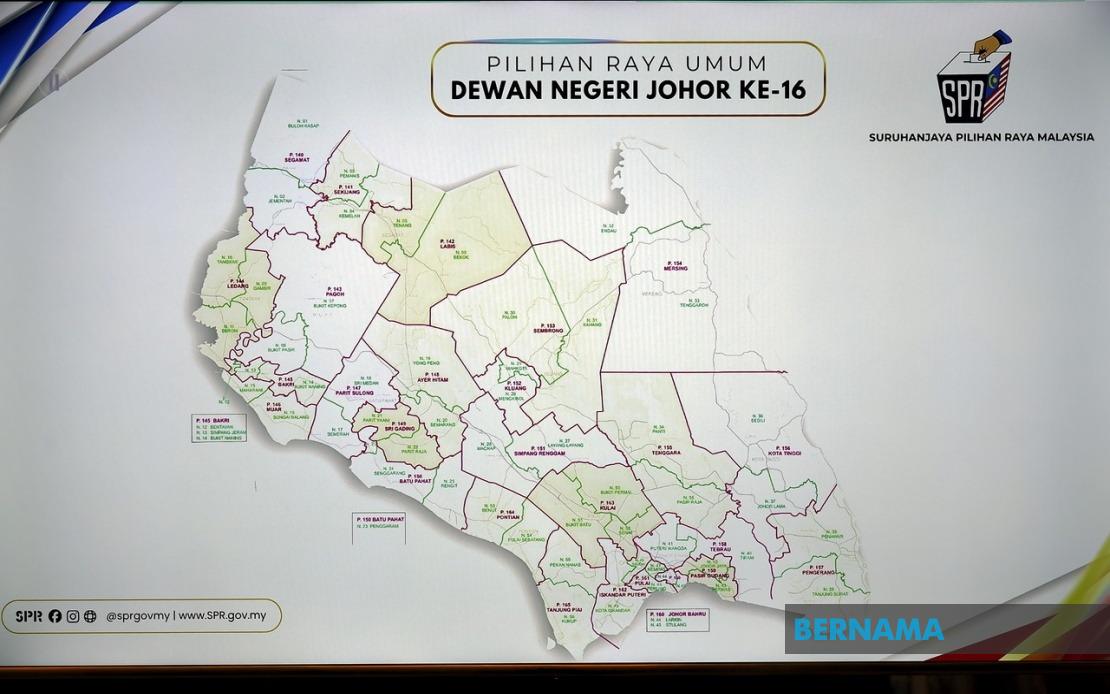
The 16th Johor state election transitions into its active campaign phase tomorrow as nomination day formally launches the electoral process. The contest will encompass all 56 state assembly seats, with prospective candidates required to register between 9 am and 10 am at various designated nomination centres throughout the state. Following the screening procedures, the Election Commission (EC) will release the definitive roster of approved contenders. Polling day has been scheduled for July 11, with early voting provisions available on July 7 for eligible voters unable to cast their ballots on the main election day.
The electoral participation base is substantial, with 2,727,926 registered voters according to the EC. This figure comprises over 2.7 million ordinary voters, supplemented by 12,041 military personnel and their spouses, and 12,710 police officers and their spouses. The size of the electorate underscores Johor's significance within Malaysia's political landscape, as the state represents one of the nation's largest and most electorally influential constituencies. The composition of the voter base, which includes sizable contingents of security force members, also reflects the federal government's institutional presence within the state.
All three major political coalitions have committed to contesting every available seat, signalling the high stakes involved in this contest. Pakatan Harapan (PH) has distributed its candidate nominations across its three component parties, with Parti Keadilan Rakyat (PKR) fielding 20 candidates, Amanah contributing 19, and the Democratic Action Party (DAP) putting forward 17. This allocation reflects the coalition's internal bargaining dynamics and perceived electoral strengths across different demographic regions within Johor. The full-slate strategy demonstrates PH's determination to recapture ground lost in the previous election cycle.
Barisan Nasional (BN) similarly presents a comprehensive candidate roster across all 56 seats, maintaining its traditional dominance through UMNO's contribution of 36 candidates, complemented by the Malaysian Chinese Association (MCA) fielding 16 candidates and the Malaysian Indian Congress (MIC) contesting four seats. This formation preserves BN's established framework as Malaysia's longest-serving ruling coalition and reflects the demographic composition it has traditionally mobilised. The coalition's full-seat participation indicates confidence in its ability to defend the substantial gains achieved in the previous 2022 state election.
Perikatan Nasional (PN), the relative newcomer to the established coalition framework, has constructed its slate through the combined efforts of PAS contesting 11 seats, Bersatu fielding 16, and the Malaysian Indian People's Party (MIPP) contesting five seats. PN's participation reflects the coalition's growing assertiveness in state-level politics and its positioning as an alternative to both PH and the weakened traditional opposition. The distribution of candidates within PN demonstrates the Islamist party PAS's continued significance within this alliance structure, alongside former Prime Minister Muhyiddin Yassin's Bersatu party.
Several smaller political entities have also registered their participation in the contest. The Malaysian United Democratic Alliance (MUDA), the centrist party formed in recent years, is competing for four seats, while the Socialist Party of Malaysia (PSM) is fielding a single candidate. Most notably, Parti Bersama Malaysia (Bersama) is making its inaugural electoral appearance, contesting 15 seats. Bersama's entry into electoral competition signals the continuing fragmentation of Malaysia's political landscape and the emergence of new partisan formations seeking to capture voter dissatisfaction with established players.
The Election Commission has issued guidance to prospective candidates regarding procedural requirements to ensure a smooth nomination process. Candidates have been advised to verify their nomination documentation in advance by consulting with the Returning Officer's Office or the State Election Office, thereby minimising the risk of last-minute administrative complications that could result in disqualification. Additionally, candidates must complete their deposit payments expeditiously and retain receipts as evidence of payment when submitting nomination papers, a seemingly straightforward requirement that nonetheless occasionally trips up unprepared campaigns.
The Malaysian Anti-Corruption Commission (MACC) has issued explicit warnings to all candidates and participating political parties regarding prohibited conduct during the election period. The warnings invoke both the MACC Act 2009 and the Election Offences Act 1954 (Amendment 2012), emphasising the criminal consequences of corrupt practices and electoral misconduct. To monitor compliance with these standards, the MACC has established five operational centres functioning around the clock across the locations of Tampoi, Batu Pahat, Kluang, Segamat, and Mersing. This decentralised monitoring network provides members of the public with accessible channels for reporting suspected corrupt activities or abuse of official power throughout the election period.
The Johor State Legislative Assembly was formally dissolved on June 1, initiating the constitutional process that culminates in tomorrow's nomination day. This dissolution followed the political dynamics that have characterised Malaysian state politics in recent years, where shifting coalition alignments and electoral mandates have produced volatility and uncertainty. The timing of the state election, occurring within the broader context of federal political developments, adds additional significance to the Johor contest as observers assess whether patterns visible in national politics translate into corresponding outcomes at the state level.
The preceding 2022 state election produced a decisive outcome that substantially favoured BN, which captured 40 of the 56 seats, establishing a commanding legislative majority. Pakatan Harapan secured 12 seats despite its then-stronger national positioning, Perikatan Nasional won three seats, and MUDA achieved a breakthrough victory in a single seat. That 2022 outcome defied numerous analysts' expectations that the PH federal government would have coattails extending to state-level contests. The current election will test whether voter preferences have shifted further toward BN, remain stable, or show movement back toward PH, particularly given the changing federal political configuration since 2022.
Johor's electoral significance extends beyond mere numerical representation. As Malaysia's most southerly peninsular state, Johor hosts substantial economic and demographic weight, with its capital Johor Bahru serving as a crucial commercial and transportation hub connected to Singapore. The state's development trajectory and governance performance influence neighbouring states and carry weight within broader Malaysian political calculations. An extensive BN victory would reinforce perceptions of coalition dominance, whereas gains for either PH or PN would suggest emerging competitive pressures requiring response from incumbent leadership. The next two weeks will reveal how effectively competing parties have mobilised their resources and how Johor voters ultimately weigh their political preferences.

