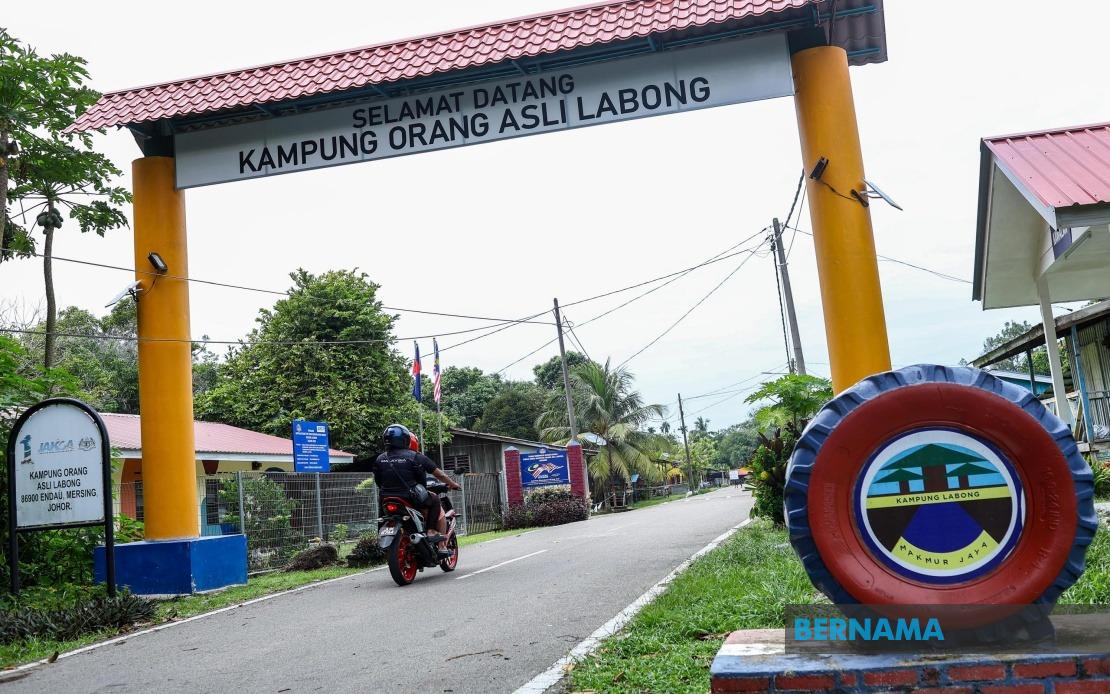
Johor's commitment to advancing the socioeconomic status of its Orang Asli population has gained concrete expression through an expanding suite of collaborative programmes between the state government and the Department of Orang Asli Development (JAKOA). In Kampung Orang Asli Labong in Mersing, visible improvements in community governance and personal welfare have emerged as direct outcomes of these coordinated interventions, suggesting a broader shift in how development resources are being channelled to indigenous settlements across the southern state.
Mabot Sela, the 80-year-old Tok Batin of Kampung Orang Asli Labong, has emerged as an articulate advocate for the state's approach. Having completed leadership training courses facilitated by JAKOA, Mabot credits these programmes with furnishing him the administrative competencies and governance knowledge necessary to navigate the complex relationship between his community and multiple government agencies. The training, he explained, addressed practical gaps in village administration and community decision-making processes, equipping customary leaders with contemporary management frameworks while respecting traditional structures. Beyond intellectual benefits, Mabot emphasised that the state government's recent decision to raise monthly allowances for village heads has materially improved his ability to manage personal circumstances, particularly the escalating costs associated with healthcare and medication—challenges endemic to ageing indigenous populations across Southeast Asia.
The allowance enhancement represents a recognition that Orang Asli leaders often balance competing demands between community representation duties and personal survival needs. For Mabot, the increased stipend has alleviated financial pressures that previously constrained his effectiveness as a liaison figure. This approach contrasts with earlier paradigms that viewed indigenous leadership as a purely voluntary or ceremonial function, instead acknowledging that effective governance requires compensating those responsible for translating state policies into community action and conveying local concerns upward through bureaucratic channels.
Despite these gains, persistent challenges continue to constrain development outcomes in Kampung Orang Asli Labong. Mabot highlighted recurring livestock and wildlife management problems—crop destruction by wild elephants and hazards posed by roaming cattle to vehicular traffic—that require coordinated responses transcending the village level. These issues underscore how rural indigenous communities remain vulnerable to environmental pressures and land-use conflicts that state-level programmes alone cannot resolve without integrated regional planning and resource management.
Village residents articulate nuanced perspectives on ongoing development needs. Sekoi Janja, a 68-year-old community member, provided historical context rarely captured in policy documents. She recalled an era when Orang Asli existence centred almost exclusively on forest resources and immediate surroundings, but acknowledged that contemporary circumstances demand different competencies and opportunities for younger generations. Her observation reflects broader transitions occurring across indigenous communities throughout Malaysia and the wider Southeast Asian region, where forest-dependent livelihoods have become increasingly constrained by environmental degradation, land appropriation, and integration into cash economies.
Skill acquisition and livelihood diversification emerged as priority areas in conversations with other residents. Norma Lonchai, a 44-year-old trader, distinguished between welfare assistance and capacity-building initiatives, arguing that sustainable development requires equipping Orang Asli individuals with marketable skills and income-generating opportunities rather than relying solely on financial transfers. Her perspective reflects a growing recognition among both indigenous communities and development practitioners that poverty reduction demands structural interventions creating genuine economic participation pathways.
The Johor state government's financial commitment provides measurable evidence of policy prioritisation. The allocation of RM3.8 million during the previous financial year funded nine distinct initiatives targeting welfare, education, infrastructure improvements, and community development activities benefiting approximately 18,000 Orang Asli residents across the state. This expenditure, whilst modest in absolute terms, signals sustained governmental attention to indigenous populations that historically received fragmented or ad hoc support.
These nine initiatives span multiple intervention categories reflecting a multidimensional understanding of development. Educational support addresses knowledge deficits constraining intergenerational mobility. Infrastructure investments tackle access barriers limiting economic participation and service utilisation. Welfare provisions offer immediate relief whilst longer-term capacity-building efforts establish foundations for autonomous economic advancement. Community development activities aim to strengthen local institutions and self-governance capabilities.
The comprehensiveness of this approach distinguishes contemporary Johor policy from earlier interventions focused narrowly on welfare provisioning. Policymakers appear to have internalised lessons from development literature demonstrating that sustainable improvements in indigenous wellbeing require coordinated action across multiple domains rather than isolated sectoral efforts. The inclusion of both leadership training and allowance increases exemplifies this integrated methodology, recognising that effective governance depends simultaneously on technical competencies and material security.
For Malaysian policymakers and regional observers, the Johor experience offers instructive insights into scaling indigenous development programmes. The demonstrated effectiveness of JAKOA collaboration suggests value in formalising such partnerships, establishing clear coordination mechanisms, and allocating dedicated resources. The emphasis on strengthening indigenous leadership rather than bypassing customary structures through external administration reflects acknowledgment that durable development requires local ownership and integration with existing institutional arrangements.
Looking forward, sustaining momentum will require addressing the structural constraints that residents themselves identified. Coordinated wildlife and land management addressing crop-raiding and livestock problems demands cross-agency cooperation and environmental planning transcending village and even state boundaries. Expanding skills development and livelihood opportunities will necessitate linkages with mainstream economic institutions and market systems. Equally important, continued dialogue with community members like Sekoi Janja and Norma Lonchai ensures that development programming remains responsive to evolving local priorities rather than calcifying around predetermined bureaucratic templates.

