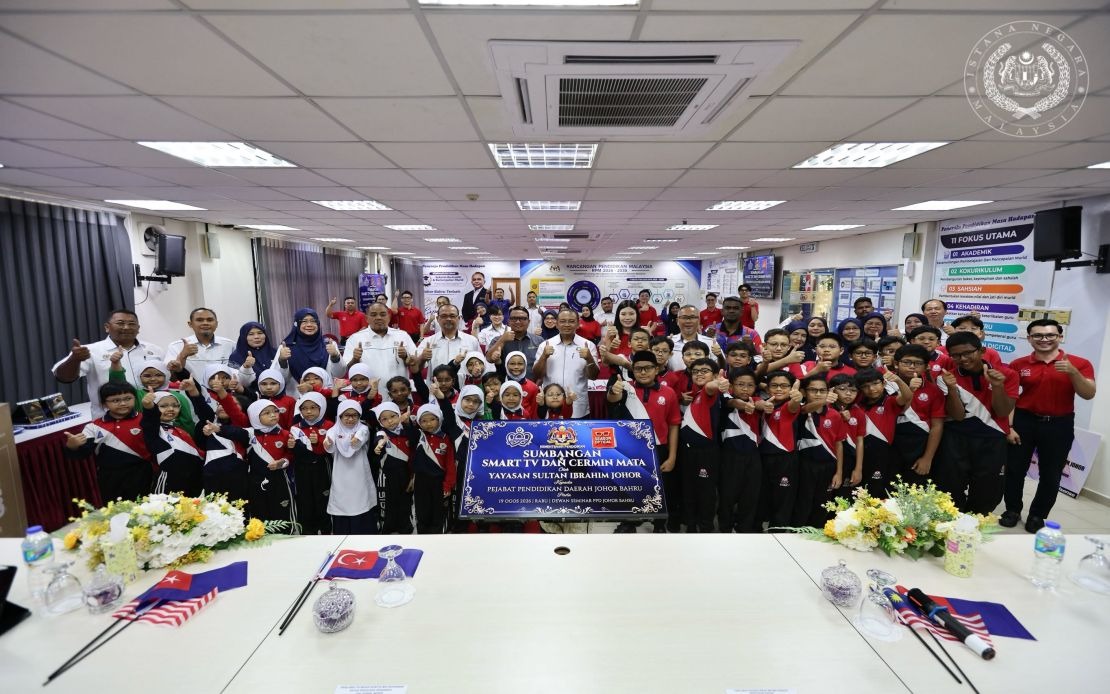
The Yayasan Sultan Ibrahim Johor (YSIJ) has stepped up its commitment to educational welfare by distributing technological resources and eyewear to schools across Johor Bahru, underscoring the royal foundation's focus on bridging equity gaps in student learning experiences. The initiative represents a multifaceted approach to addressing both classroom infrastructure needs and the often-overlooked health challenges facing lower-income pupils in the state's capital.
The donation package comprises ten 75-inch smart televisions allocated to schools throughout Johor Bahru District, intended to modernise classroom instruction and facilitate digital learning environments. These displays represent a significant upgrade for schools seeking to integrate multimedia content into their teaching methodologies, potentially enhancing student engagement with increasingly technology-dependent curriculum standards. For institutions operating with limited budgets, such equipment donations can substantially expand pedagogical options and expose students to contemporary learning tools.
Equally significant is the distribution of 2,000 pairs of corrective lenses to B40-category students—those earning below the lower-income threshold—across twenty schools within the district. This portion of the programme addresses a critical but frequently neglected barrier to academic performance. Vision impairment in students often goes undetected or uncorrected due to financial constraints, resulting in classroom difficulties that educators and parents may misinterpret as learning disabilities or lack of concentration. By providing free spectacles, the foundation directly removes a tangible obstacle to educational participation.
Central to the eyewear initiative's effectiveness is the deployment of Columba Vision Screener technology, a sophisticated scanning device donated by His Majesty Sultan Ibrahim, King of Malaysia. This equipment performs rapid optical assessments, identifying refractive errors and vision anomalies within approximately ten seconds per student. The technology's speed and accuracy streamline the screening process, allowing schools to assess large numbers of pupils efficiently without requiring complex clinical procedures or multiple visits to optometrists. The screeners can identify students who might otherwise slip through without correction, ensuring broader reach across the student population.
The spectacles themselves have been selected for durability and age-appropriateness, addressing practical concerns that arise when providing eyewear to school-age children. Student eyewear must withstand regular classroom activity, physical education, and the general wear typical of adolescent life. The partnership with Season Optical, a private optical retailer, has brought commercial-grade manufacturing standards to the distribution, ensuring that the lenses and frames meet quality benchmarks suited to their intended users. This quality assurance distinguishes the programme from merely symbolic gestures, creating lasting practical benefit.
The partnership structure reveals a deliberate strategy to leverage private-sector expertise and resources alongside government and royal institutional capacity. Season Optical's involvement brings optical industry knowledge and supply-chain management capabilities that complement the foundation's charitable mandate and the Education Department's administrative oversight. This tripartite model—combining royal patronage, government education systems, and commercial sector participation—has become increasingly common in Malaysian social programmes and reflects recognition that addressing educational inequality requires coordination across institutional boundaries.
The formal handover ceremony, conducted at the Johor Bahru District Education Office (PPD), involved YSIJ senior manager Shah Reza Md Kanafe transferring responsibility to education officials including Johor Education Department Student Development Sector principal assistant director Mohd Khatta Muhamad and Johor Bahru PPD chief officer Adnan Samsudin. This procedural formality ensures clear documentation of asset transfer and establishes accountability for distribution and subsequent maintenance of the equipment, particularly important given the scale of the donation and the number of schools involved.
For Malaysian policymakers and educators, this initiative illustrates emerging awareness that educational equity extends beyond textbooks and teaching staff to encompass student health and infrastructure. Vision correction represents one of several preventative health interventions that schools can facilitate, improving classroom participation rates and academic outcomes. The programme's focus on B40 students reflects targeted poverty-alleviation thinking, directing limited resources toward those facing the greatest financial barriers to accessing optical services.
The deployment of advanced screening technology also positions Johor as a testing ground for educational health infrastructure innovations. If the Columba Vision Screener programme proves effective in Johor, other states might consider similar implementations, creating a template for nationwide vision-screening initiatives. Such scalability would address a significant but underquantified problem: many Malaysian students, particularly in rural and lower-income urban areas, remain unaware of vision difficulties that remedial eyewear could resolve.
From a digital learning perspective, the smart television donations align with Malaysia's broader educational technology ambitions outlined in successive education blueprints. However, provision of screens alone does not guarantee improved learning outcomes; teacher training in effective multimedia pedagogy, curated digital content, and reliable electricity and internet connectivity remain essential complementary factors. Schools receiving these televisions will require ongoing support to maximise their educational potential, a consideration that extends beyond the foundation's donation itself.
The timing of this initiative, announced in mid-August, precedes the academic year's full momentum and provides schools time to integrate new equipment into their planning. For students receiving spectacles, earlier correction in the academic calendar offers maximum benefit across examinations and classroom performance assessments. The royal foundation's annual commitment to Johor education demonstrates sustained engagement rather than one-off philanthropy, suggesting that educational support will remain a priority within the foundation's strategic objectives.

